

One of the oddities of taxonomy is that lichens get species names, even though they’re not organisms. What might look like a fungus clinging to a rock is, in fact, a community of fungi and algae living in symbiosis. The alga provides food to its fungal host. In return, the fungus supplies water and nutrients. But an alga does not need to live as part of a lichen. So are there other benefits? Beatriz Fernández-Marín and colleagues examined the association between the lichen-forming fungus Mastodia tessellata (Verrucariaceae) and different species of Prasiola (Trebouxiophyceae). Mastodia is no ordinary lichen, which explains the team went to the Antarctic to study it.

“Mastodia is an intriguing case within lichen species and since long has been confronting lichenologists, and challenging ‘the concept of lichen’ itself,” Fernández-Marín said. “The fact of having macro- (e.g. visible by bare eye) instead of microscopic terrestrial algae within the lichen symbiosis is very rare among lichens and enables us to study them under natural conditions easily. In addition, both the free-living and the lichenized forms are co-habiting in the same microenvironment. This crossover makes the species a perfect case study to understand how being part of a lichen changes the life of an alga.”
“The ecological preferences of Mastodia are the second remarkable reason: it has a bipolar distribution, with an ancient austral origin and a later migration to the northern hemisphere (as nicely evaluated by two of our co-authors in a very recent work), and is always found in cold, wet, coastal habitats. This was particularly interesting for us because the context of our overall project is that we are trying to understand how desiccation and freezing tolerances are possible in some photosynthetic organisms. One of our objectives was to deepen our understanding of how lichens can survive freezing temperatures when wet. Among the different locations where Mastodia can be found, Antarctica offers the additional advantage of being a pretty pristine natural environment, where these organisms have not suffered the influence of humans, at least not significantly. So we can study them as they behave really in the wild.”
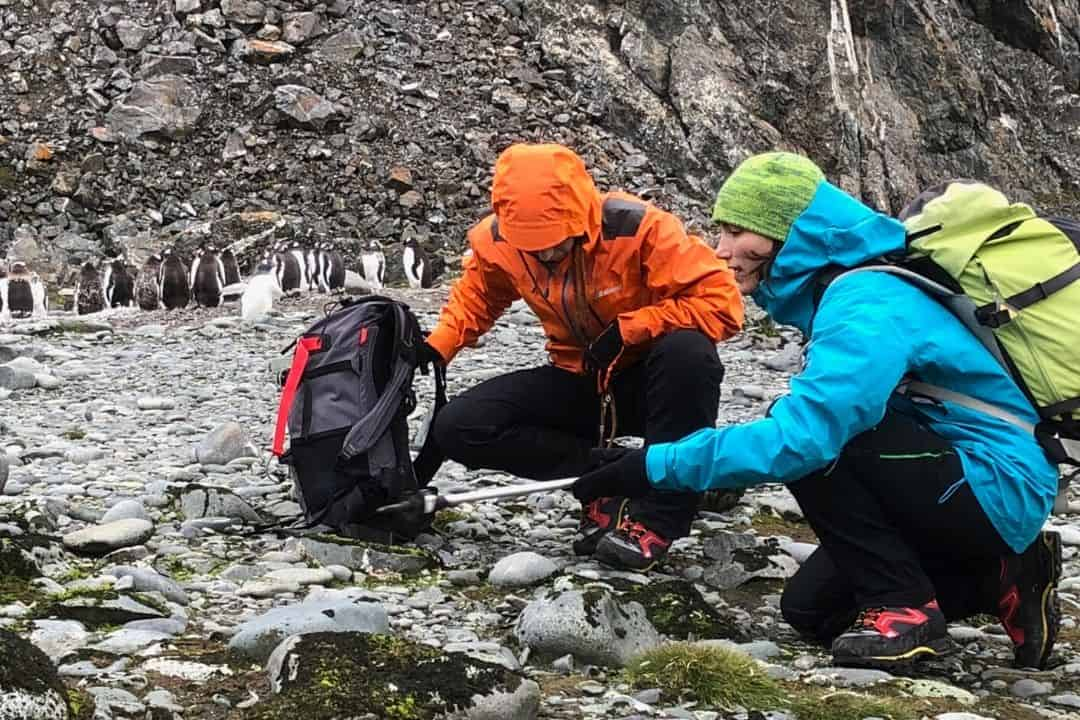
The fieldwork took place on Livingston, in the South Shetland Islands, fractionally north of the Antarctic mainland. Even though the team worked in the summer, conditions were harsh, Fernández-Marín said. "We could briefly summarise that 'working in Antarctica is different'. On the one hand, we needed to plan our sampling, experiments, fulfil permissions and other bureaucracies and even the delivery part of our equipment, several months in advance. I would say this was the hardest part of the research work. Once established in the Spanish Research Station –Juan Carlos I-, the work was relatively easy."

"I have to make a special mention to all the staff at the Station because they were responsible for making our job 'so easy' The main limiting factor was definitely the weather, particularly the wind, the fog and the sea sailing. For this reason, we had selected several locations with different levels of accessibility to run our measurements. We also had to be very flexible and imaginative to continuously adapt or schedule to what the meteorology was telling us."
The results of the study did overturn a few beliefs. In the paper, Fernández-Marín and colleagues write: "The identity of the photobiont of Mastodia tessellata as Prasiola crispa subsp. antarctica and the co-occurrence of free-living and lichenized forms of this species in Antarctica have been long-standing tenets... In our study, we found that the two co-occurring Prasiola forms belong to two different species: free-living specimens corresponded to Prasiola crispa and lichenized to Prasiola sp. The former is a nitrophilic species that usually grows close to penguin rookeries (Graham et al., 2009) and is known from both hemispheres (Moniz et al., 2012). On the other hand, Prasiola sp. is, so far, only known in the lichenized form and from Antarctica (Garrido-Benavent et al., 2017, 2018). The fact that co-occurring forms of Prasiola do not belong to the same species as previously thought raises the questions of what the niche of free-living Prasiola sp. is and whether it does really occur as a free-living alga."
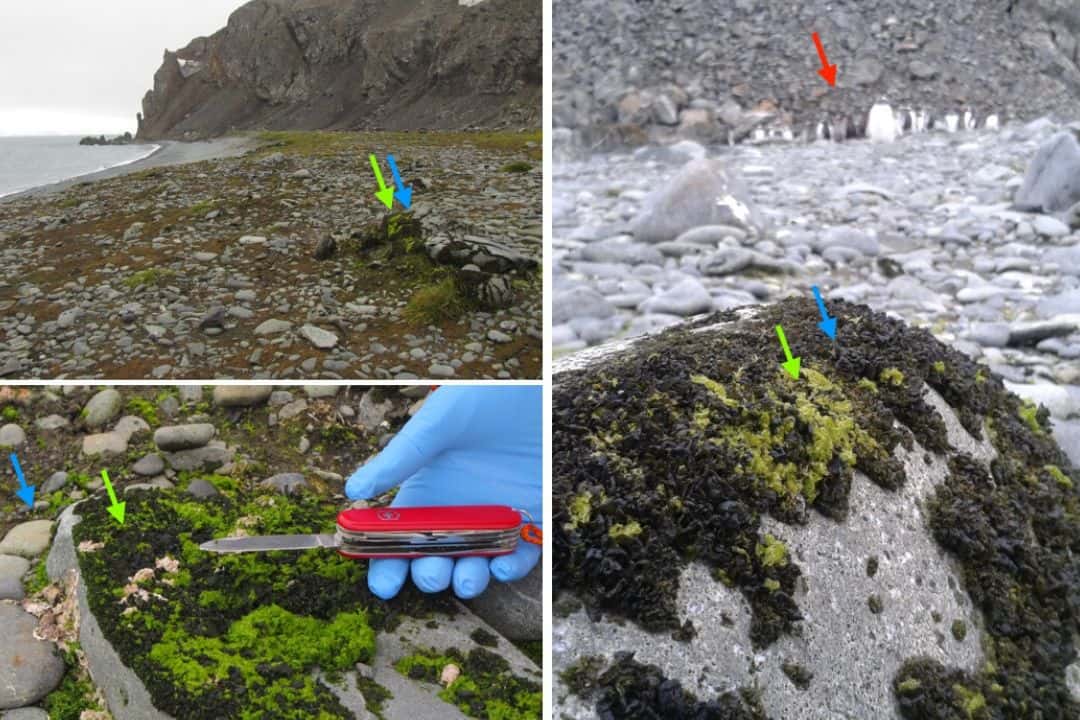
The existence of two species came as a surprise to the team, said Fernández-Marín. "Based on most of the literature available, Prasiola crispa was expected to be responsible for both the free-living and the lichenized forms. Luckily, we preferred to check the identity of both samples genetically, and we found that were actually two different species but still within the same genus and closely related. What at the beginning appeared to us as a disconcerting and unexpected surprise, ended up as a second important message in our publication: "algae species in the lichen Mastodia are more diverse than it was thought before and genetic identity should be checked when studying them". This has recently been shown by some of our co-authors.
Comparing the algae showed there were some significant differences. In particular, lichenization improved the freezing tolerance of Prasiola. The authors write: "While literature is available about freezing tolerance of intertidal algae, much less is known regarding lichen tolerance to freezing in their hydrated state and, to the best of our knowledge, virtually no study has dealt with the effects of lichenization on the enhancement of the photobiont fitness under low temperature."
"It is remarkable in that sense that, together with another recent publication we have provided one of the very few data available about molecular mobility in frozen photosynthetic tissue. So, overall, our work will hopefully be useful not only for lichenologists but for anyone interested on photosynthesis, cell-wall properties, molecular mobility and glass transition temperatures (i.e. for cryopreservation purposes), photoprotection, freezing and desiccation tolerances and water relations too!" Fernández-Marín said.
As well as the present, the authors also look to the future and what rising temperatures might mean for the algae. That freezing tolerance could become less critical for survival, which the authors say: "...would very likely lead to the spread of the free-living algae in detriment of the lichen form, with resultant alterations of unknown consequences in Antarctic ecosystems." Fernández-Marín said that how the ecosystem may change is difficult to predict. "The key answer to this question is actually the lack of enough knowledge to be able to predict what could actually happen if, for instance, the Mastodia lichen disappears from the maritime Antarctic ecosystems. This knowledge-gap emphasises the need for further research and efforts to be done in subsequent years. What we can tell already as a simple observation is that we observed tonnes of mites in our lichen samples and none or very few in our free-living Prasiola samples. Some species of animals (and very likely microorganisms too) are preferentially associated with either the lichen or the free-living alga. This isn't just a case of algae as a food source. They may also be looking for benefits, such as shelter for example."
"The other thing to be considered is that we were evaluating abiotic factors and their direct effects on the physiology (e.g. functioning) of the free-living vs lichenized Prasiola. However, both species require high concentrations of nitrogen in the soil. Accessible nitrogen is not easy to find in Antarctica. Because of this, they are strongly associated with the presence of fauna, or more precisely of their waste, mainly from penguins and other birds. So any other factor altering the habits, density, and distribution of the birds could drastically change the populations of both Prasiola and Mastodia."
"Last but not least, in the global change scenario, there is evidence not only about rising temperatures overall but also about dropping temperatures in some specific regions in the world, including the Antarctic Peninsula. This has been recently seen in the region, and the consequences for some other species of lichens were detrimental, as recently shown by some of our co-authors. So, to end up, I need to reiterate my initial statement: global warming would have unknown consequences in this particular habitat of Antarctica… and so further research is a must."