


There’s a puzzle on Lord Howe Island. It’s less than 15km2 (6 square miles) of land in the Tasman Sea. On it are two species of palm, Howea forsteriana and H. belmoreana. H. belmoreana is more successful on volcanic soil than its neighbour, but H. forsteriana is able to live on the calcareous soil of the island while H. belmoreana, for some reason, cannot.
The soils aren’t zoned so one side of the island is one type and the other half is another. The soil types are speckled across the island. Also, palms are wind pollinated. There’s no pollinator that an innovator can attract that doesn’t help the other tree. So, if the island was colonised by an ancestral Howea palm, how did speciation happen? This is the problem explained and tackled by Osborne et al. in a new paper in New Phytologist Arbuscular mycorrhizal fungi promote coexistence and niche divergence of sympatric palm species on a remote oceanic island.
The title gives away the answer, but how they got there is interesting. If H. belmoreana isn't in the calcareous soils, then the soil is the obvious place to look for the answer. Osborne et al. note that people have already looked at chemical composition, pH, salinity, and soil water content. What they argue is that the place you should investigate is the microbial community.
One of the key experiments was growing the palms in sterilised and unsterilised soil. What the authors found was that if you sterilise the soil, the palms almost always grow worse, regardless of soil or species - with one exception. H. forsteriana doesn't do significantly worse when grown in sterilised volcanic soil. This would suggest that H. forsterianaisn't making much use of the local microbial community, but H. belmoreana is - which is how that gets to grow better than H. forsteriana in volcanic soil.
Analysis of the soils and roots found that microbial diversity differs between soils rather than between species. They found that arbuscular mycorrhizal fungi are depleted in H. forsteriana on volcanic soil. By this, they mean that both abundance and number of species are reduced - though Osborne et al. note that identifying fungi through DNA metabarcoding is not straightforward. Looking at the relationships between the palms and the soils they propose a model for speciation on Lord Howe Island.
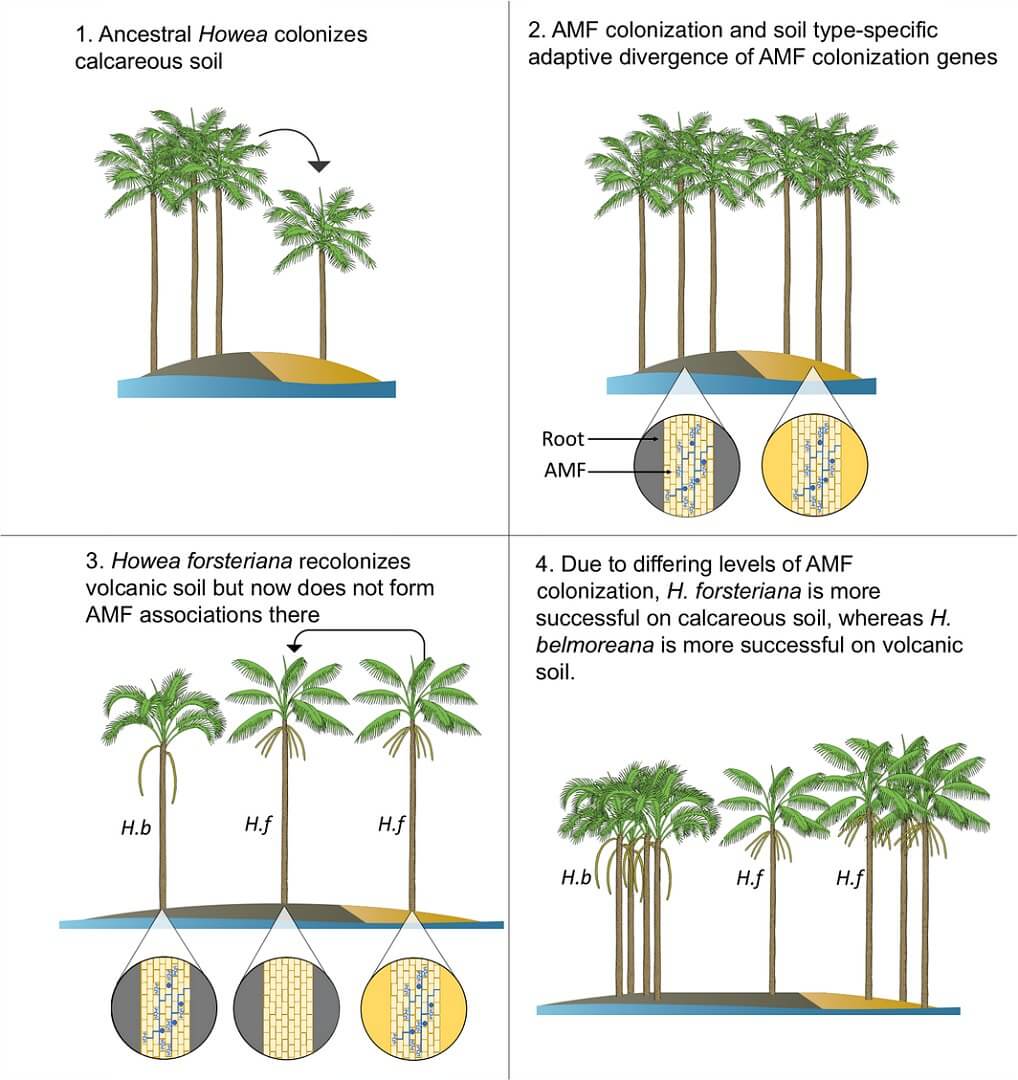
[caption id="attachment_23662" align="aligncenter" width="1018"]One possible scenario leading to the reduction of arbuscular mycorrhizal fungi (AMF) in Howea forsteriana (H.f) on volcanic soil relative to both H. forsteriana on calcareous soil and to H. belmoreana (H.b). Source: Osborne et al.[/caption]
They say palms may have colonised the calcareous soils and, once there, speciated by forming new associations in mycorrhizal fungi. Thus created H. forsteriana. Then this new species returned to the volcanic soils, and started to colonise there. Lacking the relationships that H. belmoreana has, it hasn't been so successful there.
Osborne et al. add that we know microbes can have effects on plants, such as altering flowering times. This would reduce gene flow between one set of palms and another. In the discussion, they point to studies in orchids, where pollinators have driven speciation and mycorrhizae have allowed them to co-exist. There doesn't seem to be a lot on mycorrhizal-driven speciation, though there is a paper on the possibility of it in orchids (which Suárez et al. largely discount). Osborne et al. say that this could be common in plants. It certainly sounds like there's a lot of potential for research of you can find some suitable candidates.