


New research into the biomechanics of explosive seed dispersal in squirting cucumbers (Ecballium elaterium) reveals how these plants have adapted a suite of unique traits that help propel their high-speed seeds far and wide. The research was presented by Helen Gorges at Society for Experimental Biology Annual Conference in Antwerp.
Seed dispersal comes in many forms, and much is known about animal, wind and water-assisted dispersal – but less is known about the self-propelled dispersal mechanisms of plants. One of these is the ballistic dispersal of the squirting cucumber, which uses high-pressure explosions to eject its seeds at high speed across large distances.
The lead researcher, Helen Gorges, is a PhD student specialising in functional morphology and biomechanics at Kiel University. Here she uses cutting-edge imaging technologies like high-speed videography and micro-CT scanning to understand rapid plant movements.
Squirting cucumber explosive seed dispersal (over 300x slowed down). Video Helen Gorges. CC BY-NC-ND.
This dramatic botanical performance is one of nature's most spectacular examples of ballistic seed dispersal, a strategy that has evolved independently across at least 23 plant families despite its rarity in the plant kingdom.
"Many factors have to interact perfectly to disperse the seeds in the most efficient way, while not destroying the whole plant too early," says Gorges.
To reduce direct competition for space and resources between parent and offspring plants, there is an evolutionary drive for plants to disperse their seeds as far as they possibly can. The research conducted by Ms Gorges aimed to explore the mechanisms that control the cucumber's fruit during ripening and maximise its chances of successfully dispersing.
Ms Gorges and her team used microcomputed tomography to create a 3D-model of the whole fruit, as well as micro-CT imaging and high-speed videography to capture the exploding fruit in fine detail. "We recorded the explosion of the fruit with high-speed videos at 1,000 fps and 10,000 fps to calculate the speed of the seeds and the possible shooting distances," says Ms Gorges. "We also analysed pictures during the ripening of the fruits to measure the curvature of the fruit stem and the angle between fruit and stem."
Recent research by other botanists has found there’s a lot of interaction between fruit and stem, prior to explosion. Oddly despite needing pressure to push the seeds out, Box and colleagues found that there’s a movement of fluid from the fruit to the stem. This has the effect of altering the position of the fruit to improve the firing angle.
Gorges and colleagues have also found the fruit stem straightens up during ripening. They have observed it creating an average 53° angle that is close to the theoretical perfect angle of 50° that would maximise shooting distance.
Squirting cucumber explosive seed dispersal in real time and slowed down. Video Helen Gorges. CC BY-NC-ND.
The team found that the seeds can achieve speeds up to 29 miles per hour and reach shooting distances up to 12 metres. "It's super interesting to watch the explosions through high-speed recordings, as the explosions happen way too fast to see anything in real-time!" says Ms Gorges.
Additionally, the team found that the seeds always exit the fruit facing the same way and produce a mucilaginous coat when they get wet, which becomes an adhesive when it dries and improves conditions for germination.
One of the puzzles for botanists is that despite its effectiveness, ballistic dispersal remains uncommon among plants. The work by Gorges and colleague may help explain this by giving scientists a better understanding of the effort needed to grow specialised organs for dispersal, as well as the constraints on seed size and shape.
The research isn’t going to help develop a more powerful and deadly cucumber. Instead, the findings have potential applications for bio-inspired launching systems as hydrogel-based actuators for medical tools and micro-robots. "There are also many applications in soft robotics, drug delivery systems and similar devices, where energy-efficient launching systems are desired," says Ms Gorges.
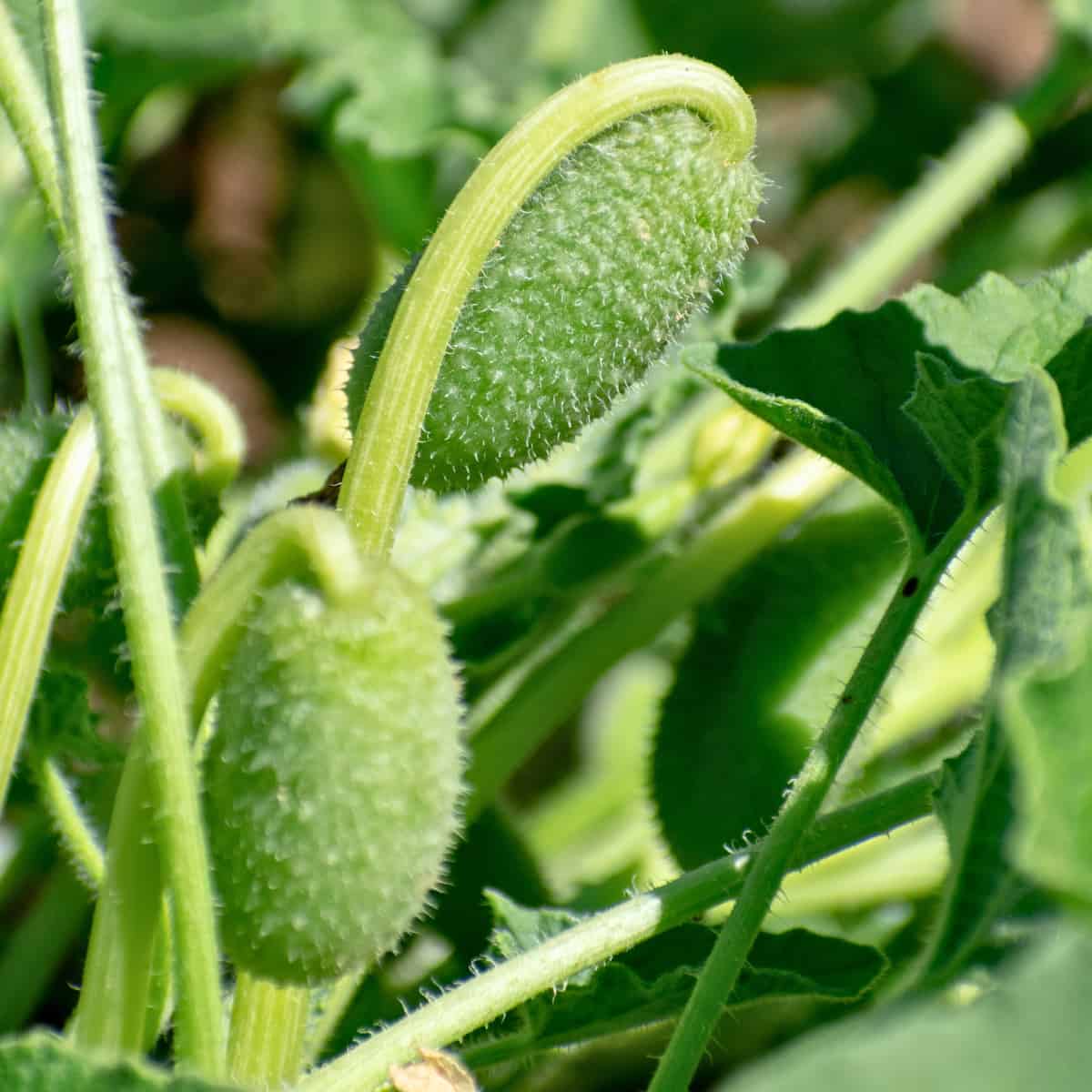
Cover image: Close up of squirting cucumber, Ecballium elaterium. Image: Mohamed Haddad / Canva.