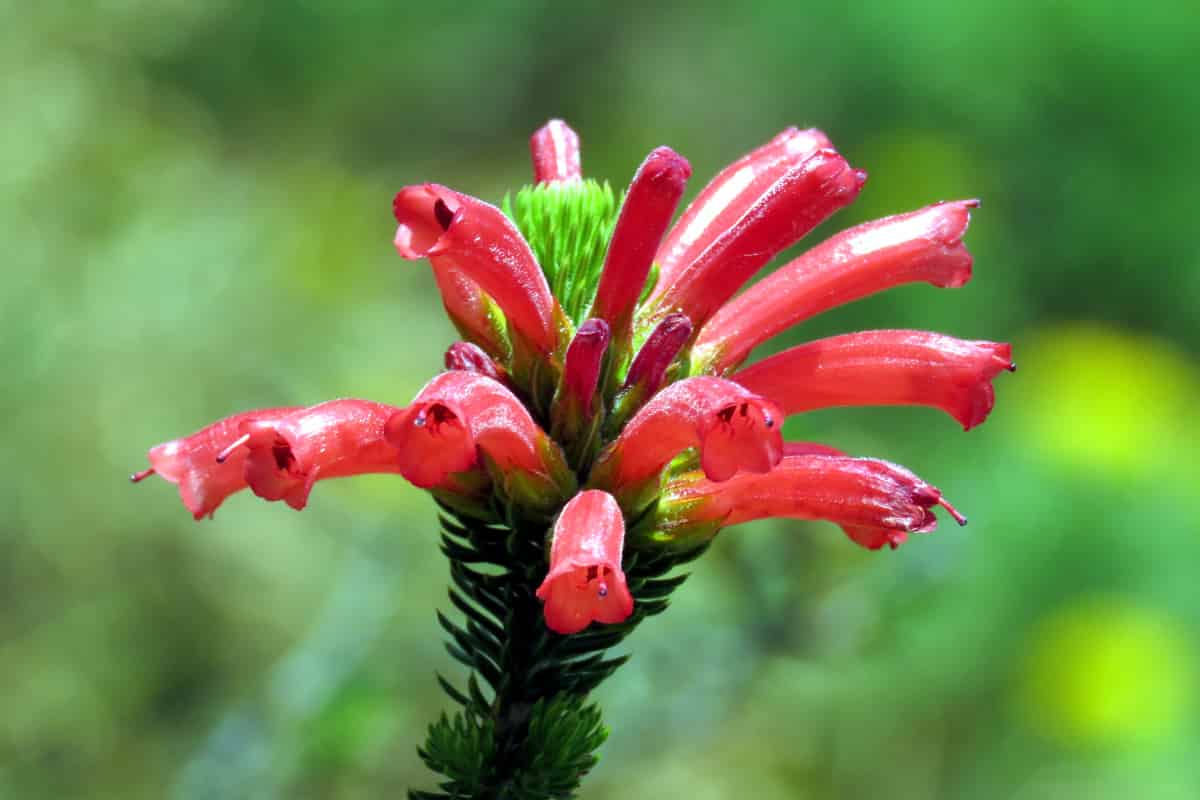



Researchers Musker and colleagues studied the genetic makeup of Erica abietina, a variable heather species from South Africa’s Cape Peninsula. Their research, published in Molecular Ecology, found evidence of multiple pollinator shifts and complex evolutionary history within this single species complex.
The team used DNA sequencing to examine genetic relationships between Erica abietina populations. They discovered that flowers adapted for bird or insect pollination evolved independently at least twice. Surprisingly, populations with different pollinators could still interbreed where their ranges overlapped.
To uncover these patterns, the scientists collected leaf samples from across the Cape Peninsula and analyzed thousands of genetic markers. This revealed distinct genetic clusters corresponding to different subspecies, as well as evidence of recent and ancient hybridisation between some populations.
The researchers found that while floral traits can evolve rapidly in response to different pollinators, this alone does not necessarily lead to new species formation. Other factors like geographic isolation also play important roles in the diversification of these heathers.
We find that the subspecific classification of E. abietina is only a partial reflection of its evolutionary history. Notably, there is evidence of cryptic diversity in the complex, which may have gone unrecognized due to a focus on floral traits in the taxonomic literature.
Musker, S. D., Pirie, M. D., & Nürk, N. M. (2024). Pollinator shifts despite hybridisation in the Cape’s hyperdiverse heathers (Erica, Ericaceae). Molecular Ecology, 00, e17505. https://doi.org/10.1111/mec.17505. (OA)
Cross-posted to Bluesky, Mastodon & Threads.
Cover image by Prosthetic Head – Own work, CC BY-SA 4.0, Link