


Amami Oshima is a Japanese island in the Ryukyu archipelago and lies roughly between Kyushu and Okinawa. It’s known for its endemic species, including the Amami rabbit. The Amami rabbit is one of the hardest rabbits to spot in the world. It’s nocturnal, dark-furred, and keen on dense forest growth for grazing, which makes it difficult to see, but it’s also rare, endemic to two islands, Amami-Oshima and Tokunoshima. Now research by Kenji Suetsugu and Hiromu Hashiwaki has found another interesting feature. Their paper in Ecology shows that they disperse vampire plants.
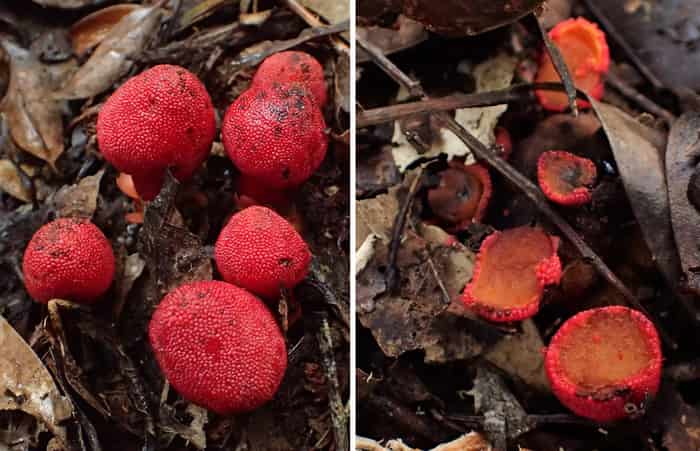
The plant is Balanophora yuwanensis, which may be a subspecies or sister species of Balanophora yakushimenis. It’s an odd-looking plant that looks a bit like a mushroom, and might be proof of the saying, ‘you are what you eat’. This is because Balanophora yuwanensis doesn’t make its own food through leaves. Instead, it taps into local fungi and deprives them of food, water and nutrients.
While fungi cater for most of its needs, Balanophora yuwanensis has a problem when it comes to dispersing its seeds. It produces lots and lots of tiny, one-seeded fruits in collections called infructescences. Typically, you’d expect small dry seeds to be carried away on the breeze, but you don’t get a lot of that in the undergrowth where Balanophora yuwanensis lives. What you do get are odd bite marks on the infructescences. And you get rabbits.
As far as anyone can tell, Pentalagus furnessi, the Amami rabbit, is an unusual rabbit. Not much is known about it, as it’s hard to find. It lives forages in the undergrowth of two islands in the Ryukyu archipelago, and it does this at night. To make it more difficult, they are all dark-furred. So ecologists are left looking for a few black rabbits, hiding in shadows at night.
What they do know is that they’re almost living fossils. Amami rabbits are the remains of a lineage of rabbits that have since died out on mainland Asia. They survived on islands like Amami Oshima as they were isolated from changes elsewhere.
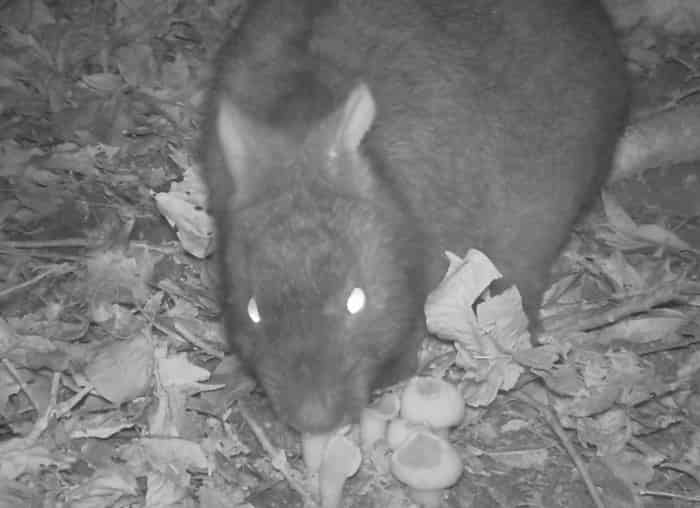
Suetsugu and Hashiwaki set up camera traps in the undergrowth to see if they could catch a rabbit damaging the Balanophora yuwanensis infructescences. They found both birds and mammals feeding on the fruits, and also got this clip of one of the nocturnal visitors.
The video clips showed this was no freak event. Of the mammals visiting the plants to feed, over 90% of them were rabbits. During the day, they found that birds were the main visitors. Crucially they gathered evidence to show that the rabbits eating the seeds were most likely the method of dispersal and not an interference. In their article, they write:
Prior to the infructescences turning brown and dry, these fruit feeders consumed most of the fruits of all the infructescences monitored, thus making it unlikely that wind dispersal is the principle means of B. yuwanensis seed dispersal. Although the feeding frequency of birds was comparable to that of the Amami rabbit, the amount of fruit consumed per unit of time was much higher for the Amami rabbit than for the birds. In some cases, the Amami rabbit consumed an entire infructescence in a single visit. Therefore, we concluded that P. furnessi was the main fruit feeder of B. yuwanensis as it consumed a more significant percentage of infructescences than any other visitors.Suetsugu & Hashiwaki 2023.
In a press release, the authors comment that the findings are unusual because these are dry fruits. "Intriguingly, the Amami rabbit is a seed dispersal agent for B. yuwanensis even though the plant produces dry fruits, whereas seed dispersers are typically incentivized by fleshy fruits. As shown in the video, the rare rabbit species consumed both dry fruits and vegetative tissue from B. yuwanensis. This is notable because the potential role of rabbits as seed dispersers has largely been overlooked due to their diet, which primarily consists of leaves rather than fruits. However, this study reveals that the Amami rabbit serves as a major seed disperser for B. yuwanensis, incentivized by the plant's vegetative tissue."
"This research also highlights the previously unrecognized ecological role of the endangered Amami rabbit as a seed dispersal agent, and suggests that the species may have other functions yet to be discovered."
READ THE PAPER
Suetsugu, K. and Hashiwaki, H. (2023) "A non-photosynthetic plant provides the endangered Amami rabbit with vegetative tissues as a reward for seed dispersal," Ecology, p. e3972. Available at: https://doi.org/10.1002/ecy.3972.