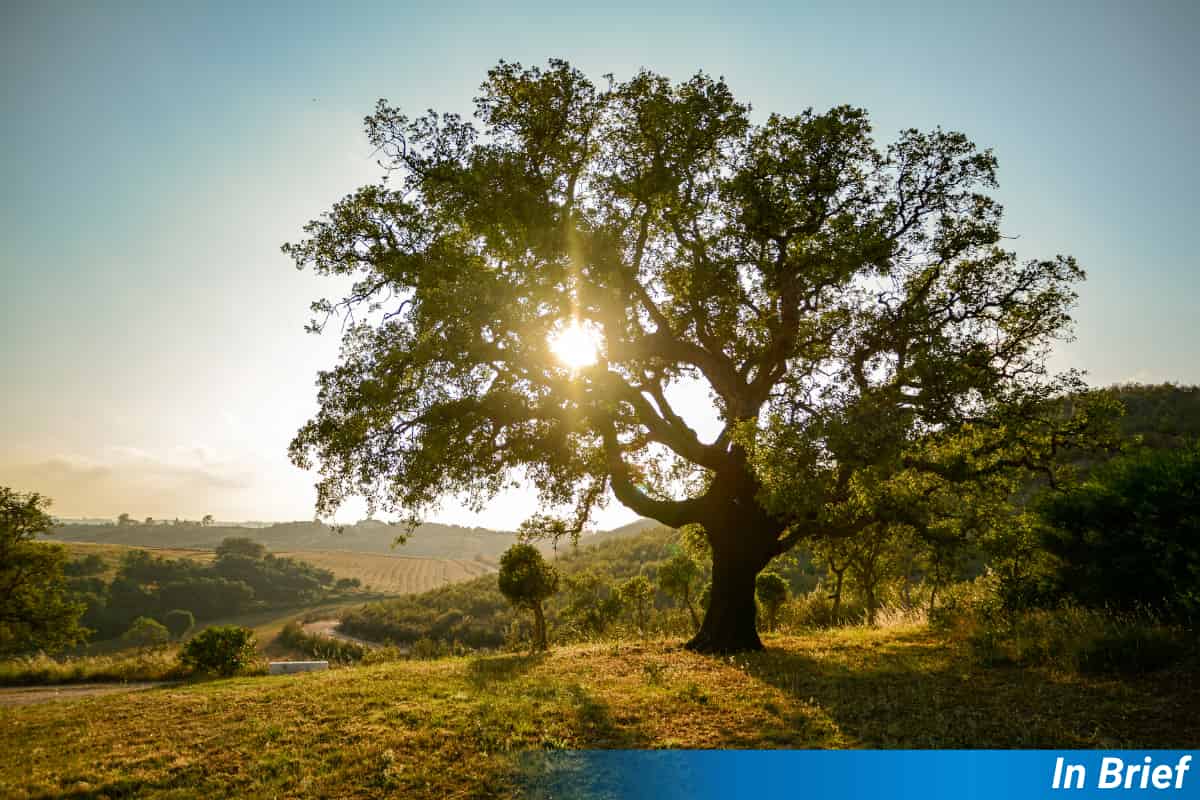



Climate change is leaving its fingerprints in the DNA of oak trees, according to new research by Assemar and colleagues.The team analysed cork oaks, Quercus suber, in Morocco’s Maâmora forest, to see how natural selection is helping cork oaks survive changing conditions. Their results could help conserve these economically and ecologically important trees.
Scientists found that cork oak trees with a specific genetic marker (ZAG20-171) tend to live in areas with more variable daily temperatures, more consistent yearly temperatures, higher altitudes, and less rainfall overall. This suggests these trees might be better adapted to drier, more temperature-variable conditions.
The researchers found these genes by examining leaf samples from cork oak trees from across the Maâmora forest. These samples provided the material for the team to analyse DNA microsatellites, and apply statistical methods to see which DNA sequences correlate with which climate and geographical factors.
The work builds on earlier studies that found evidence of genes that help the oak cope with drought. This research provides new evidence of adaptation to climate change and conforms that cork oaks are evolving to survive on a warmer planet. The work highlights how genes are an essential part of the plant to consider when conserving a species.
Assemar, F.E., Alami, M., Rabeh, K., El Antri, S., Filali-Maltouf, A., & Belkadi, B. (2024). Revealing local adaptation of Quercus suber L. populations under climate change through Genome Scans and Environmental Association Analysis. Tree Genetics & Genomes, 20(29). https://doi.org/10.1007/s11295-024-01662-w ($)
ReadCube: https://rdcu.be/dTrPd