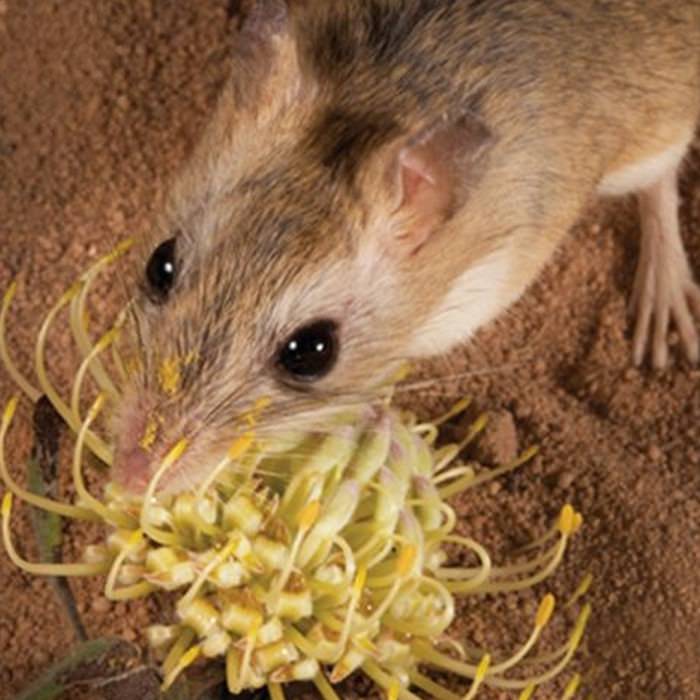


If you want to please Leucospermum arenarium (Proteaceae) you’d better leave brushes and combs alone, as it has an unusual way to get pollinated.

Plenty of plants are pollinated on the wind, or via currents in water. Others get some help. Insects are favourite, but plants are known to use birds and bats to carry pollen from one flower to another. What doesn’t happen very often is pollination by a rodent. To begin with people thought rodent pollination was just the flowers getting lucky on occasion, but more research has shown there is more going on than that, and that some plants have adapted to attract rodents. One might be L. arenarium the subject of a paper in Annals of Botany by Christopher Michael Johnson and Anton Pauw.
One adaptation Johnson and Pauw mention is a new word to me, geoflory. These are flowers on, or close to the ground. The proximity to the ground makes them accessible to rodents, or so the explanation goes. Johnson and Pauw point out that rodents can climb, and will if they think the trip is worth the effort.
Another adaptation they look for in a rodent-pollinated plant is in the nectar. If the flower is going to work then it can’t be destroyed by a rodent visiting it for food. It might deposit pollen on the rodent as it gets demolished, but it won’t be in a position to receive pollen from other plants. So L. arenarium must be doing something interesting with its nectar, if it’s getting rodents to pollinate it.
To examine the pollination in action Johnson and Pauw staked out some flowers in one of areas you can find them in South Africa. By day they kept their distance and watched. For the night, they baited traps and waited to see who came to forage.
The day results probably took a lot of patience:
Diurnal observations recorded no bird visitors and only nine insect individuals (six Hymenoptera, two Coleoptera, one Diptera) visiting L. arenarium flowers during 22·5 h of observation.
That's less than one every couple of hours. I'm not sure I could concentrate to observe the insects at that rate. I'd be wanting to read a book, which isn't a good idea when you're supposed to be watching the flowers. When the insects did arrive, they didn't carry off any pollen. The traps caught rodents. Gerbillurus paeba, the hairy-footed gerbil and Rhabdomys pumilio, the striped field mouse were caught with pollen about them.
Fortunately they didn't have to rely just on chance observations. They also bagged some flowers, so they could only self pollinate and caged some flowers, so only insects could get in. Then they caged some flowers with doors for the rodents to get in. The bagged and caged flowers didn't produce many seeds. It was only when rodents could access the flowers that the plants produced many seeds.
The plants protected their flowers by producing a sugary nectar that was channeled to the petals so the rodents didn't have to take the flower apart to get it.
So there is little doubt the flowers are getting pollen on to the rodents, but there is another problem they face.
If you try sticking things to a mammal's fur they're not going to be happy. It doesn't matter if you douse a rodent in pollen, if it's not going to stay there. Does it?
Johnson and Pauw examined the foreheads of gerbils that came to visit the flowers. They also examined their faeces. Sure enough they found that a lot more pollen had been through the gerbil than stuck to the outside.
What they propose is that grooming is bad news for the flowers, and there won't be a lot of long term carrying of pollen. However some rodents might be fussier about their fur than others. If that's the case then it would be interesting to see if G. paeba and R. pumilio are less worried about looking good compared to other rodents in the area when they're out foraging.
There's certainly a big cost to the flower to use rodents to pollinate. I wonder if the specialism makes the rodents very good at delivering the pollen to the right flower, in much the same way that some orchids will specialise with a pollinator to ensure accurate delivery for pollen.
You can now pick up the paper free from Annals of Botany. You can also pick up an older paper co-authored by Anton Pauw, if you're interested in rodent pollination, from the American Journal of Botany, Rodent pollination in the African lily Massonia depressa (Hyacinthaceae).
Johnson C.M. & A. (2014). Adaptation for rodent pollination in Leucospermum arenarium (Proteaceae) despite rapid pollen loss during grooming, Annals of Botany, 113 (6) 931-938. DOI: http://dx.doi.org/10.1093/aob/mcu015