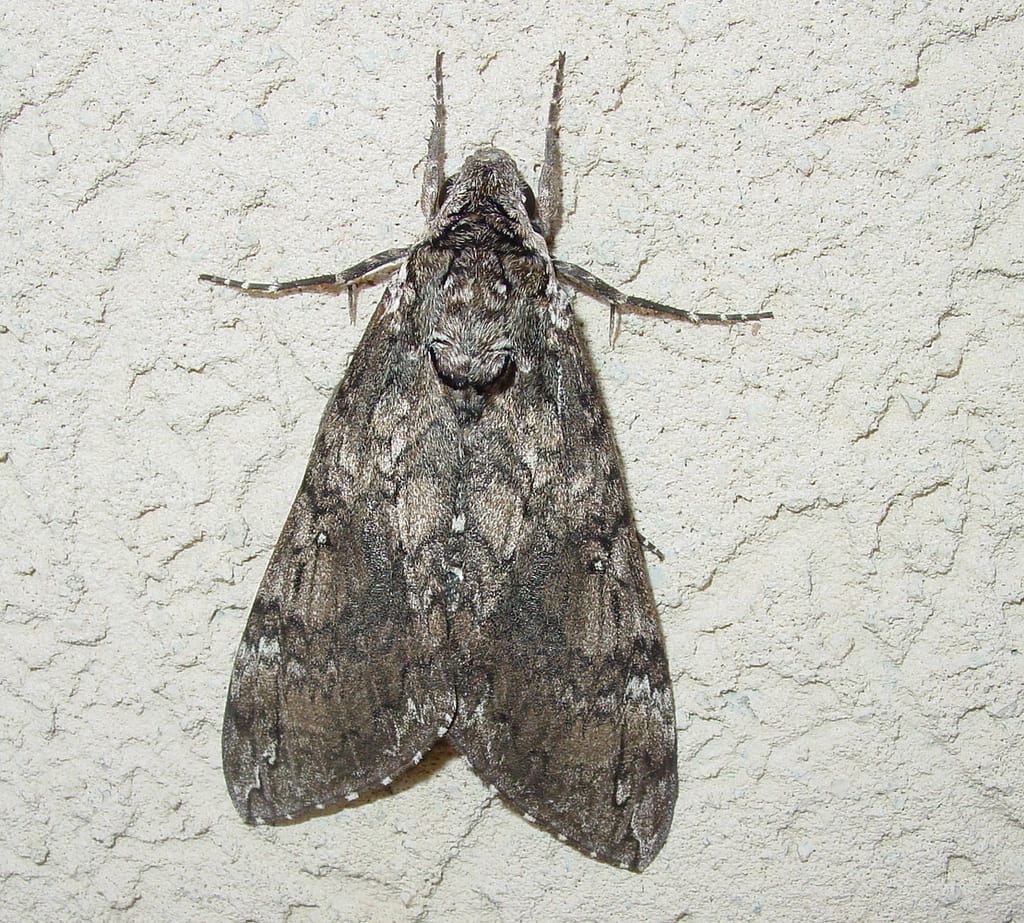


Thanks to JSTOR Global Plants for pointing to an interesting paper in Functional Ecology, Shape matters: corolla curvature improves nectar discovery in the hawkmoth Manduca sexta.

The research looks at how the the 3D structure of a flower helps guide hawkmoths towards nectar. Scents and sight can guide a pollinator, but to what extent does the physical form aid a visitor? Campos et al. compared trumpet-shaped flowers against flatter flowers. There’s quite a few ideas of how the mechanical properties of a flower work with pollinators. There’s the shape, and also the internal structure such as grooves in the interior that can act as guides. What is significant and what is not?
The Campos paper is novel because they have found a way to control for these features. Actually finding flowers with all the relevant factors controlled for would either be near impossible or else very impossible. Instead the team printed them.
I hadn’t thought at all about 3D printing for Botany, until I listened to to documentary on 3D Bioprinting, a couple of weeks ago (BBC Radio, available worldwide). In fact flowers seem to be just one of many things that botanists could use 3D printing for.
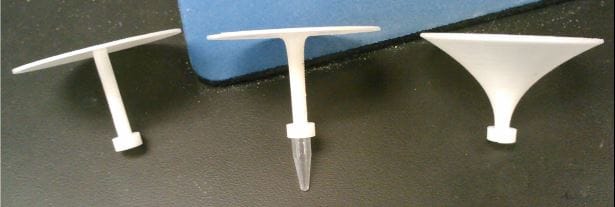
The ‘flowers’ look very minimalist interpretations of flowers, so people who know more about the mechanics of flowers than me can debate to what extent the approximation is useful. In many ways the simplistic shapes give very clear parameters that can be tested. Another feature is that they’re monochrome. This is because of the limitations of 3D printing. The shapes are built from layers of plastic and each layer has its own colour, so it may well be a limitation for a while yet.
As well as demonstrating that botanists can make physical structures and vary them to test hypotheses, 3D printing also bodes well for replication. A factor in replicating experiments is the equipment. How trumpet-shaped is trumpet shape? Having a stored plan means that other scientists could download and run their own variations on published experiments.
I’m now wondering what could happen if you could combine TreeSketch with 3D Printing.