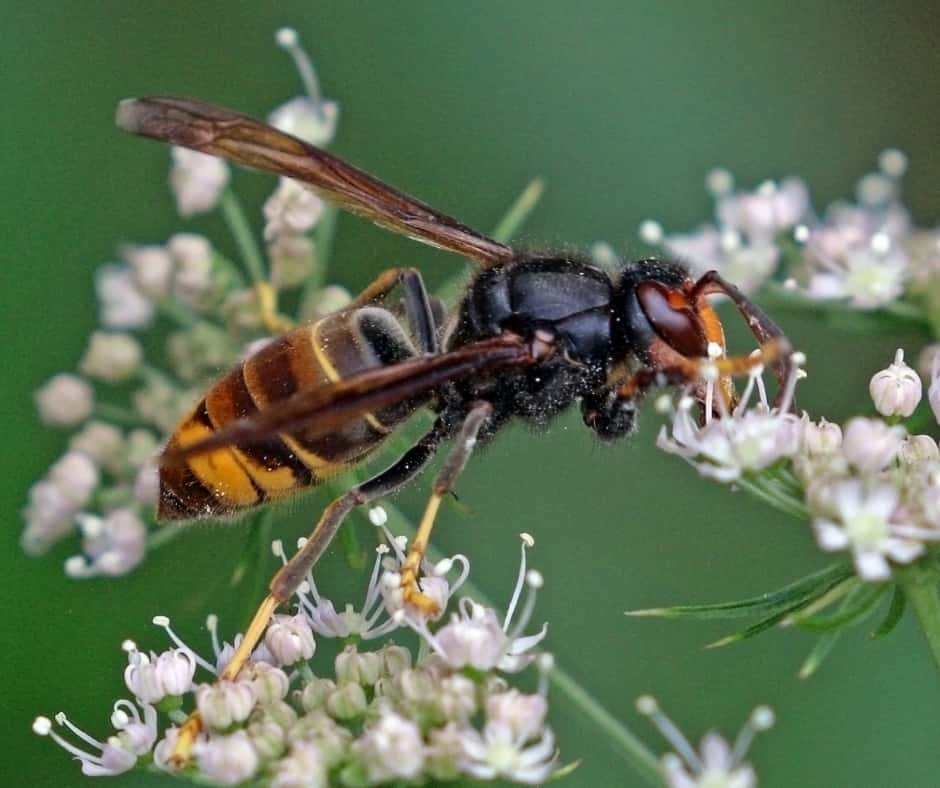


Wycke and colleagues are bothered about an invasive species, Vespa velutina nigrithorax, the Asian hornet. It preys on insects. European honey bees make excellent prey for the hornet, as they share similar cycles and the European bees have no experience of evading Asian hornets. In fact, before 2000, the honey bees hadn’t seen a single Asian hornet. Some time in the early 2000s it seems maybe as few as one female was accidentally imported from China, and managed to survive to build a colony in France. They’re now spreading their range and milder winters are helping them travel into other countries.

It would be handy if they could be trapped. But how?
The usual response is to place baited traps, but these can wipe out all sorts of insects. Given the problems invertebrates are having already, Wycke and colleagues looked to see if they could find a targeted trap, so they studied Sarracenia hybrids.
Sarracenia is a genus of North American pitcher plant. They tend to stand up with trumpets, containing fluid for digesting prey. Pulling in an American plant to eat an Asian hornet sounds a bit of a leap, but Wycke et al. had already read Les Sarracénies pièges pour le frelon à pattes jaunes (Sarracenia traps for the yellow-legged hornet) by Meurgey and Perrocheau. These authors had claimed their Sarracenia plants were more likely to trap hornets than typical, so could these Sarracenia hybrids also help with the Asian hornet problem?
Wycke and colleagues located several hornet nests in Nantes, and then set out Sarracenia traps. They found that the Sarracenia plants did trap more Asian hornets than European hornets. However, they also found hornest were a tiny number of the insects found. In 2016, under 1% of the insects were Asian hornets. What the Sarracenia were catching most often were flies. Wycke's team weren't that surprised, they knew that ants and flies usually make the bulk of the diet for Sarracenia.
Given the tiny success rate, it might be tempting to see this as a failure, but that would be very wrong. The experiment was a huge success, in that it got a very clear result. The traps are not suitable if you want to target invasive hornets, so you don't need to waste more time with S. juthatip soper nor S. evendine.
However, while the results here showed the plants weren't trapping hornets, Wycke and colleagues don't just leave it there. In their paper, they discuss why these Sarracenia failed, and note that not all fluids in pitchers are the same, and different pitchers are adapted to different prey. They suggest the problem isn't that the idea is flawed, but that the wrong plants are being used.
What would happen if you used another kind of pitcher plant, Nepenthes? This is a plant found in Asia, and some species might be more adapted to catch Asian hornets, if they share the same habitats. So if you find that pitcher plants are not very effective traps, it might be you need to find the right one.