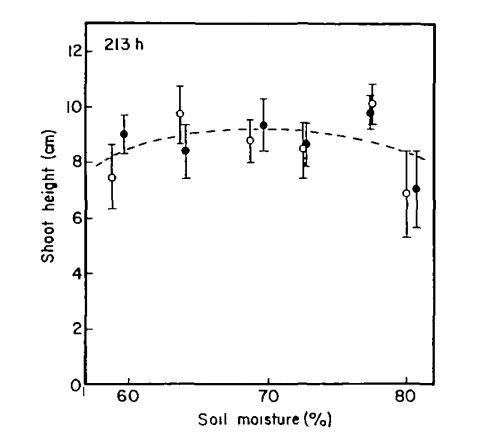



A Test to Verify the Biocompatibility of a Method for Plant Culture in a Microgravity Environment by Brown and Chapman is an example of the basic science people needed to do with the shuttle.
If you’re going to run plant experiments, then the plants will need to perform basic function in order to live. One example is taking up water and this was a problem. Soviet experiments and theoretical work suggested the way plants reacted to soil moisture in orbit was very different to how they behaved on Earth. This would have a major effect on any experiment results because unusual behaviour could be due to whatever it was you were experimenting for, or it could just be the way it goes in microgravity.
STS-3 carried what NASA called ‘bio-engineering tests’ to see if botanical experiments with their systems were practical. The test has HEFLEX, the Helianthus Flight Experiment. The question HEFLEX was to look at was how sunflower nutation happened in orbit. This is the spinning effect of the stem in growing seedlings. You can see Arabidopsis doing this in the time-lapse video below.
There was a problem with STS-2 which meant that the experiments for that mission were cut short. STS-3 had the opposite problem, the mission was longer than HEFLEX would be, but it still allowed researchers to compare the effects of soil moisture.
Tests showed plant responses seemed to be comparable, and additional post-landing inspection also show the effects of launch and re-entry were no big problem.
This research went on to be cited in a few papers, and you can pick up Circumnutations of Sunflower Hypocotyls in Satellite Orbit for free from Plant Physiology, which had Brown and Chapman among the authors. But the chain doesn't stop there.
Nutation remains a puzzle in plant sciences. Circumnutation as an autonomous root movement in plants in AmJBot dates from 2012 (again free access). AoB PLANTS, the open access plant journal has a paper Petiole hyponasty: an ethylene-driven, adaptive response to changes in the environment by Polko et al. Both of these papers refer back to Brown et al's PlanyPhys paper, despite being terrestrial papers. This first paper, specialising in how a lab on the space shuttle worked, is part of a chain of research. It shows launching seedlings away from the planet can bring us closer to understanding life upon it.
You can read more posts on papers from our spaceflight supplement by clicking the STS-3 tag.
Today's Papers
Brown A.H. & Chapman D.K. (1984). A Test to Verify the Biocompatibility of a Method for Plant Culture in a Microgravity Environment, Annals of Botany, 54 (supp3) 19-31.
Brown A.H., Chapman D.K., Lewis R.F. & Venditti A.L. (1990). Circumnutations of Sunflower Hypocotyls in Satellite Orbit, Plant Physiology, 94 (1) 233-238. DOI: 10.1104/pp.94.1.233
Migliaccio F. & A. Fortunati (2012). Circumnutation as an autonomous root movement in plants, American Journal of Botany, 100 (1) 4-13. DOI: 10.3732/ajb.1200314
Polko J.K., A. J. M. Peeters & R. Pierik (2011). Petiole hyponasty: an ethylene-driven, adaptive response to changes in the environment, AoB Plants, 2011 plr031-plr031. DOI: 10.1093/aobpla/plr031