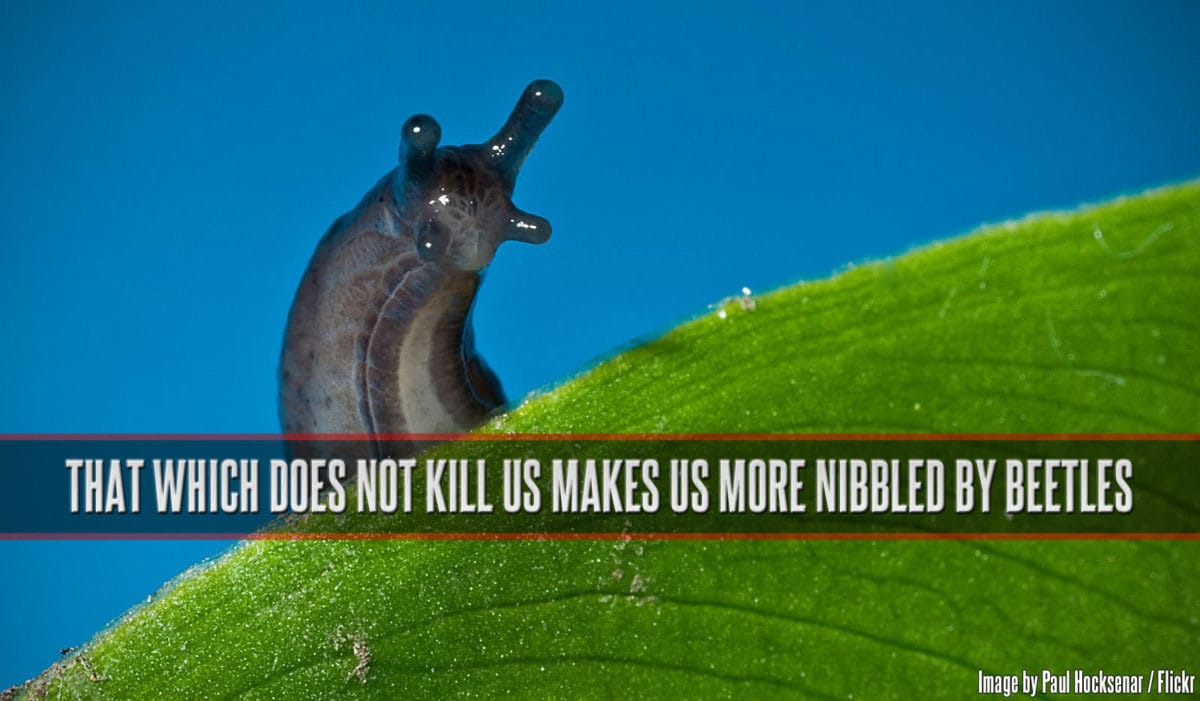



“That which does not kill us makes us stronger”, or so said Friedrich Nietzche, but is that really the case? This month in Annals of Botany Orians et al. have published a paper where that tests this idea: How slug herbivory of juvenile hybrid willows alters chemistry, growth and subsequent susceptibility to diverse plant enemies.
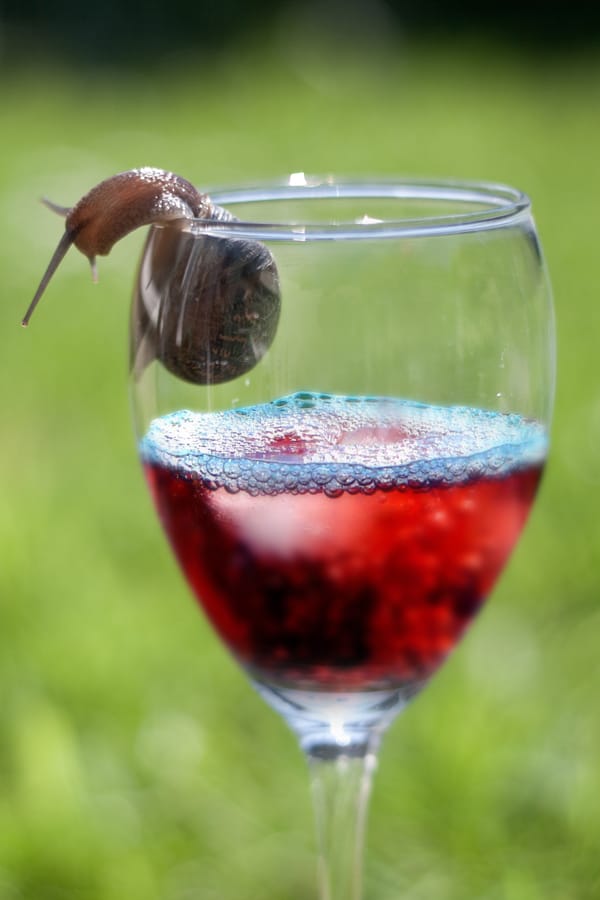
Orians et al. looked at the effect slugs feeding had on willows. In North America there are a couple of willows Salix eriocephala and Salix sericea that have a problem. The problem is the exotic slug Arion subfuscus. Exotic in this case means that the species isn’t from the local area, not that it likes jazz and has a sophisticated taste in cocktails. The willows didn’t evolve with the slugs, so they’re something they’re having to adapt to. It’s also something their hybrid offspring will have to adapt to. Why is a slug a problem for a tree? It because they start as seedlings and, at their earliest stage before they become woody, they’re a tasty morsel for a slug. In the case of hybrid willows, slugs can also play a role in selection. What plants do they eat and what plants are left to grow. Are the remaining plants stronger after being surviving ‘selection’ by the slugs and does the experience leave them changed?
The experiment was elegantly simple. You prepare two trays of juvenile willows. In one you let loose the slugs. The other has no slugs. When around 85% of the saplings in the test tray had been munched, the remaining plants were removed to a safe area and, as they grew, studied. The results were a bit of a surprise.
The seedlings that survived were the least tasty. That’s no surprise. What did surprise Orians et al. was when they looked at all extra defences that the selected willows had developed like bitter-tasting tannins. There didn’t seem to be any extra defences. What they found was that the survivor plants had more more shoots compared to roots. Plants can react to their surroundings by moving building resources between roots and shoots and compared to the unmolested plants, the surviving willows were top-heavy. Why?
Orians et al. have an idea. When a willow gets to a certain size they might be able to start producing more tannins and volatile chemicals that give off a warning smell to slugs. The faster they grow the quicker this defence starts. So they don’t need more defences, they just need to get the defences they’ve got working faster than their neighbours.
They also found slug selection had other effects.
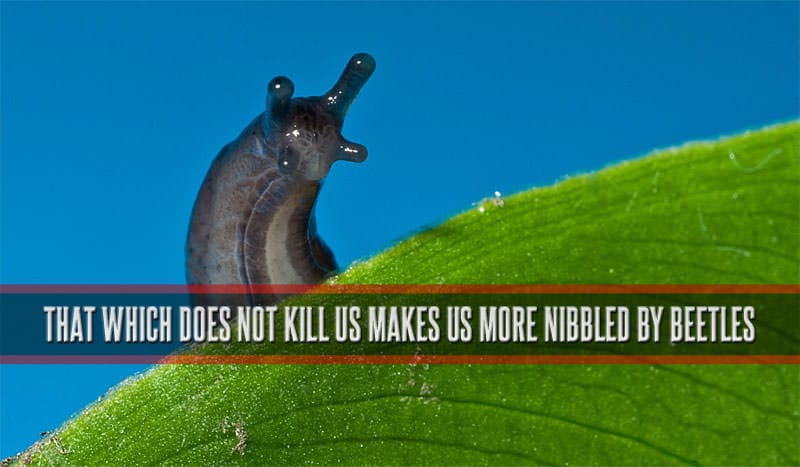
The push to get more nutrition into the shoots makes the plant taller, but it also makes it more susceptible to other species. More tests with the survivor plants found they were more tasty to native species than the unmolested plants. Indigenous beetles found the adapted plants much more delicious. Also the survivor trees were more susceptible to willow rust fungus. It means that in the wild the willows are under attack on two fronts. They need to adapt to beat off the slugs, but if they do then they’ll get attacked by other wildlife. If they don’t adapt they’ll be better off if they reach adulthood, but that’s not likely because a slug has already eaten them.
This has consequences for conservation. If a plant could adapt to fight off an invasive herbivore you’d expect things were getting better. In fact Orians et al. show that what might happen is that previously tolerable species become much bigger problems and that selection as seedlings is making the plants weaker. It seems Nietzche was therefore wrong, that which does not kill us might be making us more of a target for other things.
Reference
Orians C.M., Fritz R.S., Hochwender C.G., Albrectsen B.R. & Czesak M.E. (2013). How slug herbivory of juvenile hybrid willows alters chemistry, growth and subsequent susceptibility to diverse plant enemies,
Annals of Botany, 112(4) 757-765. DOI: 10.1093/aob/mct002
Images
Snail & Wine by Adam Foster/Flickr. [cc]by-nc-nd[/cc]
Mr Slugo by Paul Hocksenar/Flickr. [cc]by-nc-sa[/cc]