

There were a couple of stories in the Atlantic a few months ago on the American Chestnut, Castanea dentata. The tree used to be abundant across the eastern United States, even just a hundred years ago. Writing in last year’s special issue on Root Biology, Rout and Callaway said it was effectively extinct in the wild, thanks to Cryphonectria parasitica. C. parasitica is a fungus that Asian chestnuts can fight, but that kills many sweet chestnut trees. It arrived in the USA in the 1870s (and in the UK in 2011).
One story in the Atlantic is about what the loss of the American chestnut means. Corby Kummer concentrates on the social side, particularly on chestnut as a staple food. One route to reintroducing chestnuts to their native habitat is cross breeding them with Asian chestnuts. Obviously an Asian chestnut is not an American chestnut, so there’s a long and careful programme of cross-breeding to select for blight resistance, but still keeping the American character of the tree, as much as is possible.

The other story is a different approach. Rebecca J. Rosen reports on research to splice the right genes into the American chestnut genome. Unlike backcrossing with Asian chestnuts, this could be a more targeted approach to preserving the American chestnut, without carrying over extra genetic baggage. However, when I say that Transgenic Research, then there might be another issue that needs to be tackled. Will the public accept transgenic trees?
What is Functional Extinction?
If something goes extinct, then it’s no longer around. This is simple enough and, if it’s not longer around then it’s bad news for anything else that relied on it. For example the pygmy hog is endangered, if it becomes extinct then that’s bad news for the pygmy hog louse, which can only survive on pygmy hogs.
Functional extinction happens when numbers of a species fall so low they no longer perform their role in the ecosystem. This creates a knock on effect on other species, eradicating them from a locality or driving them extinct, even if the functionally extinct plant is not wholly extinct.
One reason they might not is that they might not accept trees anyway. No trees is the new normal, what Randy Olsen has called a ‘shifting baseline’. Trees will be a change anyway and people tend to be wary of change. Genetic manipulation might be a convenient focal point, for somehow claiming these are not real chestnuts. But even if you think altered trees don’t count for conservation, the project still has a big positive contribution to make. A paper published in Nature earlier this year alerted me to a concept I’d not come across before “functional extinction”.
C. dentata could be said to be functionally extinct, because there are now whole swathes of chestnutless land. The altered trees, whether they’re backcrosses or transgenic, can fill the chestnut’s function in the ecosystem. It used to be said that a squirrel could travel from Georgia to Maine without ever putting its foot on the ground. It’s unlikely that such a squirrel would grumble that the 1/16 Asian chestnut genes in the trees somehow devalued the experience.
A more serious issue is exactly what trees do you plant? Will the new trees suffer from a genetic bottleneck? Karl Haro von Mogel of the Biofortified blog will be travelling to hear what’s happening with the latest research and you can help get him there. If you do, you can ask him to put forward any questions you have with a clear conscience.
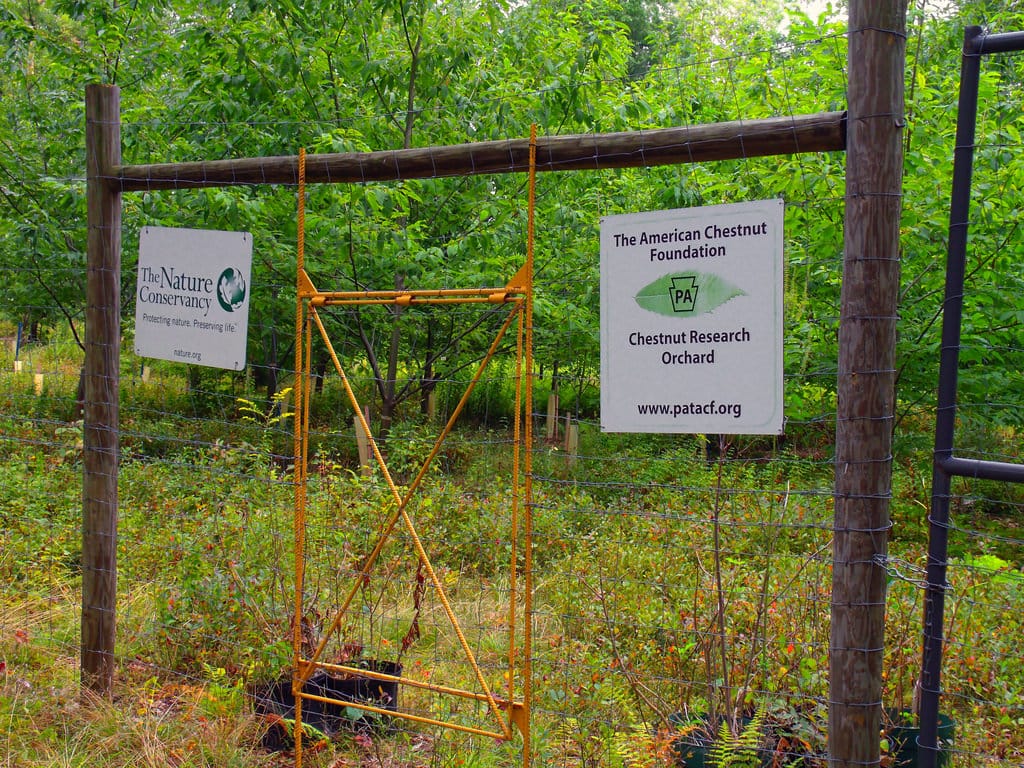
Image
Research Plot by Nicholas A. Tonelli/Flickr. [cc]by[/cc]