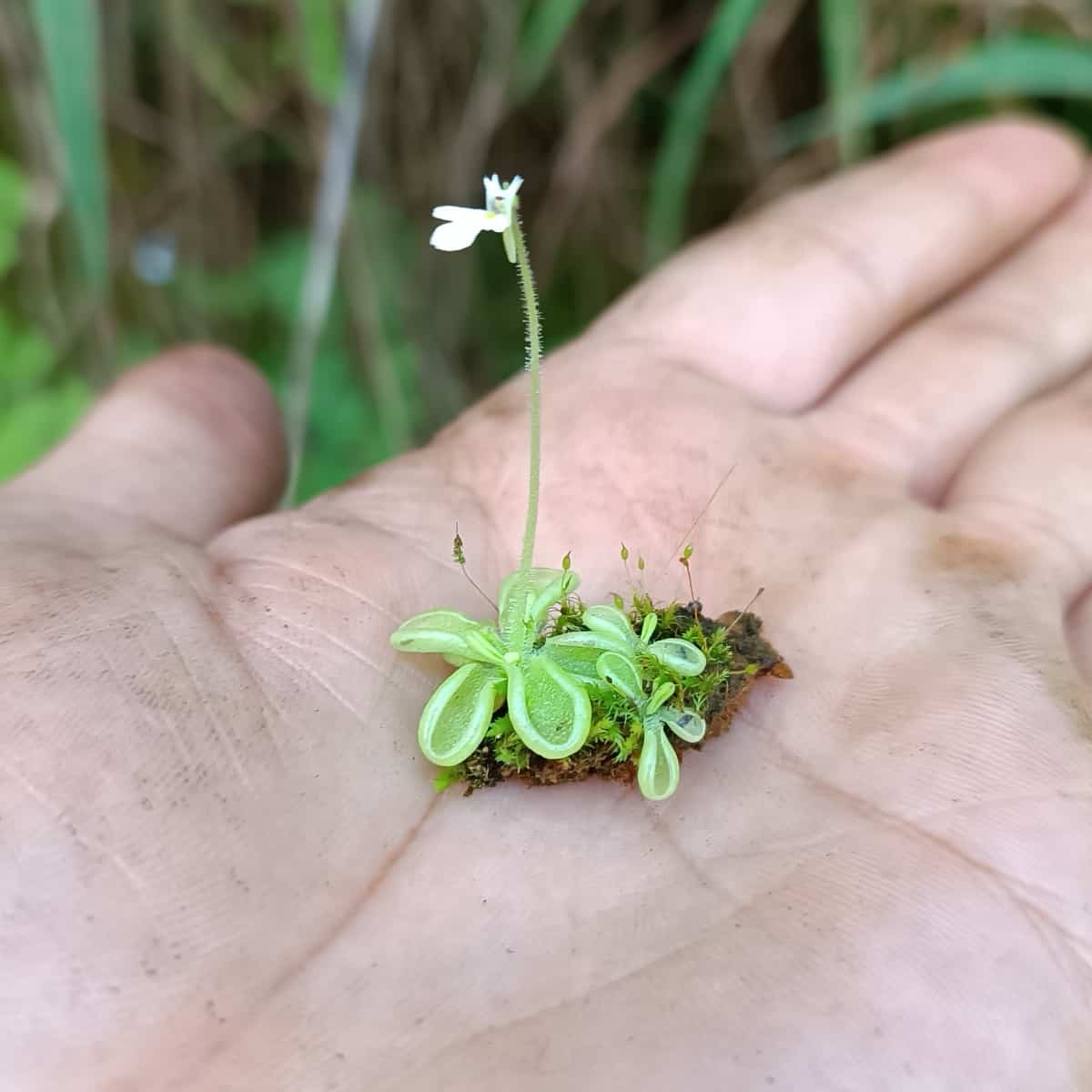



Arturo Tavera and colleagues have been studying Pinguicula crenatiloba, a butterwort that grows up to a centimetre across. What surprised them is that when they visited near the end of the growing season they found the plants had caught as much prey as plants 10× its size.
Researchers studied 4 populations in Mexico, sampling them each November when they were fully mature, to see how well they hunted. They collected plants from oak and pine forests across Mexico, from 1,620m to 2,300m elevation, and examined each insect they caught under a microscope.
Catching the plants at the right time is crucial, as these butterworts live just between September to December. The plants grow in nutrient poor soil, so catching prey to supplement their diet is critical for reproductive success. But this timing led to problems back at the lab.
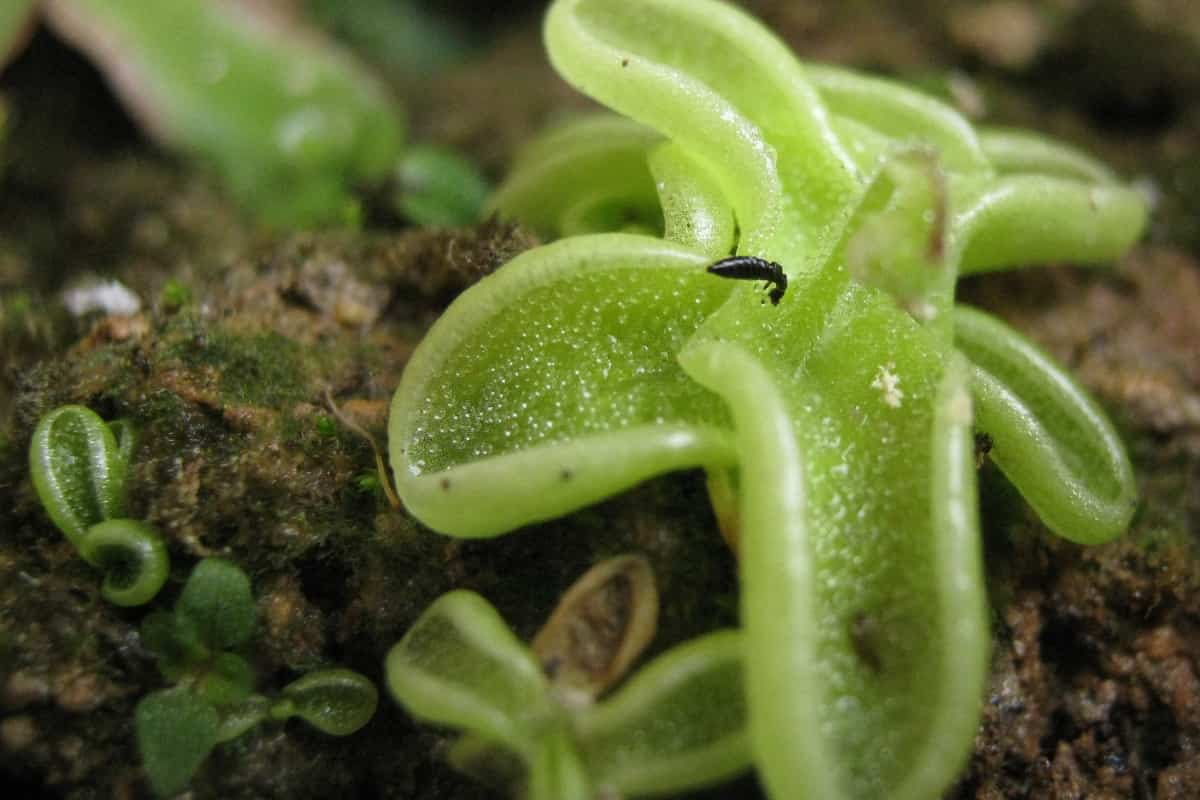
Butterworts catch prey with their leaves. Each leaf is covered with microscopic glands that produce sticky mucilage to catch prey, plus digestive enzymes to break them down. So the prey were left on the leaves, when they were examined under a microscope. Or were they? The authors write: “It is worth noting that incomplete and partially degraded prey were found in all examined P. crenatiloba individuals; however, these specimens were excluded from our dataset due to our inability to identify them accurately.” So they believe their numbers are an underestimation of prey.
The numbers were an average of 3.66 prey per plant in Guadalajara, where plants grew on eroded pathways with no other plants nearby. In Urupan, in contrast, the plants grew alongside other neighbours and caught an average of 12.77 prey in 2023, though plants at the site had only 6 in 2022. Tavera and colleagues think rainfall may account for some of this difference. Too much rain might wash away the sticky mucilage that catches insects, but they say this idea needs testing. The other sites, Pátzcuaro and Morelia reported 6-8 prey per plant. (8/10)
The butterworts are worth keeping an eye on, and not just because they’re killers. They can also act as recorders for ecologists. The number and variety of prey can tell us what ground-dwelling soil arthropods are at work in these forests and help monitor this microscopic community.
This study is interesting as the first of Pinguicula crenatiloba prey, but also for comparing differences between sites, and also annual differences. Research often focuses on big, showy species – but studying tiny ones like this reveals new strategies for surviving harsh environments.
Tavera, A., López-Hernández, L. and Cuevas, E. (2025) “Remarkable prey capture diversity in Pinguicula crenatiloba, one of the smallest butterwort species,” Arthropod-Plant Interactions, 19(4). Available at: https://doi.org/pzxf
Read free via ReadCube: https://rdcu.be/ezkKQ
Cross-posted to Bluesky & Mastodon.
Cover Image: Pinguicula crenatiloba in Mexico by Dagoberto Valentín Martínez / iNaturalist. CC-BY-NC