


Attractive colour and sweet scent are the most common strategies flowers use to advertise their nectar. When pollinators arrive, they sip the sugary reward, and as they move on, guided by the colour and scent of the next flower, they carry pollens with them. However, in a study published in Plant Biology, Albuquerque and colleagues reveal that some pollinator bats in Brazil do not sniff to find their flowers; they call into the night and follow the echo straight to their dinner.
“We documented the first case of a bat-pollinated cactus whose flowers lack perceptible floral scent,” write Albuquerque et al in their article “To be or not to be fragrant: floral scent of some bat-pollinated cacti”.
This finding has changed our understanding of how bats locate flowers.
Across the world, around 500 plant species are ‘chiropterophilous’, meaning bats pollinate them. Pollinator bats are primarily nocturnal, and nocturnal pollinators rely heavily on their sense of smell to find their nighttime meals. The odour emitted by bat-pollinated flowers usually resembles fermenting fruit, cabbage, garlic, and urine, which, although unpleasant for humans, is attractive to the bats.
However, over the past 20 years, scientists have discovered that bats don’t just rely on odour to find flowers – they use additional cues such as visual signals, echolocation, and reinforced learning (trial and error). Visual detection is a useful strategy for diurnal bats, but at night, it depends largely on bats’ ability to perceive ultraviolet light, allowing them to recognize flowers that glow in the ultraviolet spectrum of twilight.
Echolocation, on the other hand, is a well-known mechanism of seeing not by light, but by sound, when animals make fast, high‑pitched sounds (too high for humans to hear). When these sounds hit something – a bug, a fruit, or a water surface – they bounce back as echoes. Bats use echolocation to navigate and locate objects in the dark. They can even use echolocation to detect certain floral structures, like petals.
But can bats use echolocation alone to sound out a flower?
Albuquerque and colleagues put this idea to the test in east Brazil, a global hotspot for cactus diversity and home to many bat‑pollinated species. They focused on three endemic members of the subtribe Cereinae (Cactaceae, Cereeae): Coleocephalocereus goebelianus, Stephanocereus leucostele, and S. luetzelburgii. All three species are columnar cacti, growing as tall, cylindrical shrubs or trees.
In earlier work, the team confirmed that these cacti bloom at night. And more recently, they determined that bats visit these cacti during evening and nighttime hours.
“[Bat] visits started when flowers were completely open, at approximately 18:00–18:30 h, … with bats hovering in front of the flowers and inserting the head in the flower tube aiming to reach the nectar chamber,” write Albuquerque et al in their Plant Biology article.
But did the flowers attract their attention with scent? Or something else?
To answer this question, Albuquerque et al captured the air around the flowers by covering each bloom in a polyester bag during its opening period at night. They then sampled the air inside the bags and transported these samples back to the laboratory, where they analyzed the chemical compounds. The team found volatile compounds with a strong garlic‑like odour in two species of the genus Stephanocereus. But, in the air sampled around the flowers of C. goebelianus, they detected no perceptible floral scent, which made them wonder whether this species might use a different sort of signal to attract its bat pollinator.
“Considering the lack of smell, bats must use other ways to find C. goebelianus flowers during the night, such as echolocation, reinforcement learning and perhaps visual cues,” write Albuquerque et al.
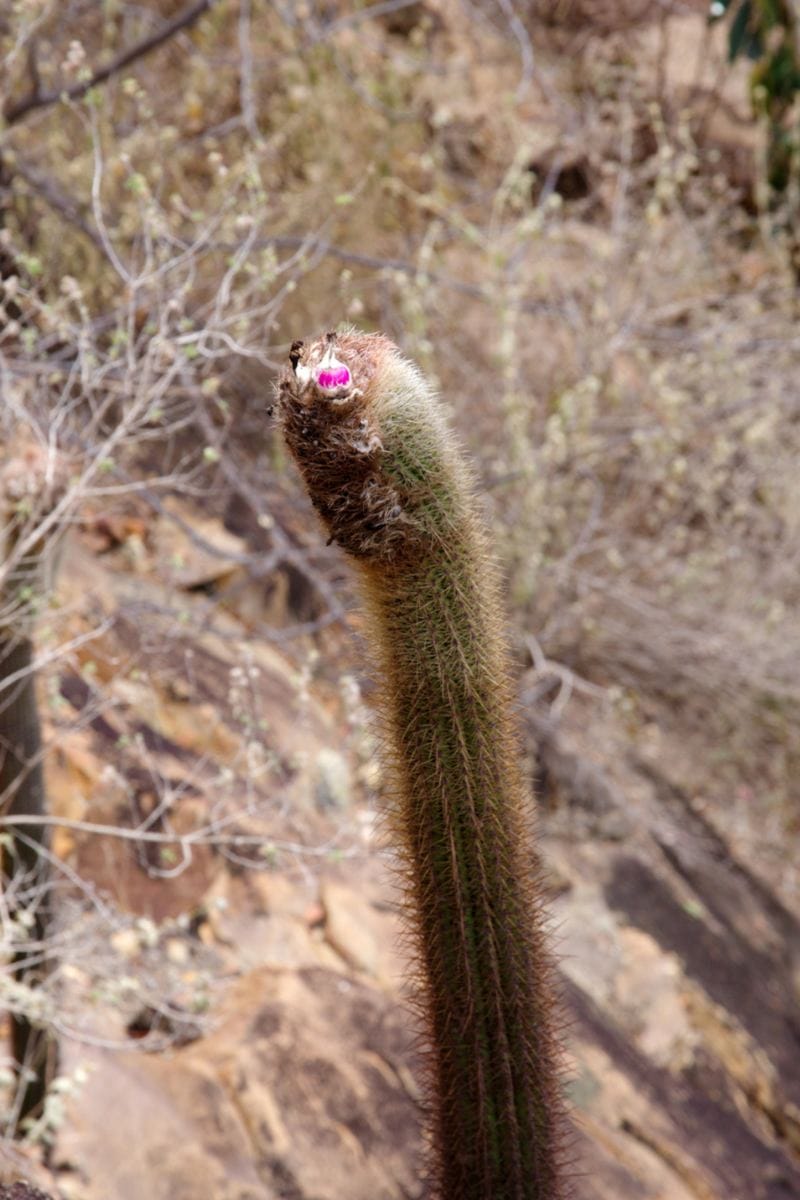
The team noted that in C. goebelianus, the flowers – and later the fruits – grow from a specialized, sturdy structure that looks like a fuzzy hat called a cephalium. This is a compact, bristly area that forms on the side, the tip, or as a ring around the stem. The authors hypothesized that the cephalium enhances bat detection of flowers by increasing ultrasound absorption in the area surrounding the bloom. Specifically, they hypothesized that the dense structure of the cephalium reduces background echo ‘noise’ and increases the efficiency of echolocation by the bat.
What makes this especially interesting is that C. goebelianus appear to have other adaptations that may help it acoustically stand out – quite literally. These cacti are generally taller than the surrounding vegetation, which, together with the presence of cephalium, might enhance acoustic ‘visibility’, or ‘audibility’, of C. goebelianus flowers.
These results and follow on hypotheses are in line with other studies. For example, a disc-shaped leaf that is displayed above the flowers of Marcgravia evenia, an epiphytic vine, is known to act as acoustic nectar guide for bats.
Additionally, some ancient plant species are known to communicate with bats through other specialized anatomical features. Some carnivorous pitcher plants have a curved, dish‑like opening that reflects bats’ echolocation calls clearly, helping the animals pick out the pitchers from the noisy forest background. The bats roost inside the pitchers, and in return, they fertilize the plants with their droppings.
As more examples of bat-plant co-evolution are found, one thing seems clear. The bats not only call for their dinner; the plants themselves are picking up the phone.
READ THE ARTICLE
Albuquerque‐Lima, S., Milet‐Pinheiro, P., Navarro, D., Taylor, N., Zappi, D., and Machado, I.(2023) To be or not to be fragrant: floral scent of some bat‐pollinated cacti. Plant Biology, 26(1), pp. 28-33. Available at: https://doi.org/10.1111/plb.13586.
READ MORE:
Albuquerque-Lima, S., Taylor, N., Zappi, D., and Machado, I. (2023) Floral Specialization and Bat Pollination in Subtribe Cereinae (Cactaceae): A Morphological Approach. Diversity, 15(2), pp. 207. Available at: https://doi.org/10.3390/d15020207.
Schöner, M., Schöner, C., Simon, R., Grafe, T., Puechmaille, S., Ji, L., and Kerth, G. (2015) Bats Are Acoustically Attracted to Mutualistic Carnivorous Plants. Current Biology, 25(14), pp. 1911-1916. Available at: https://doi.org/10.1016/j.cub.2015.05.054.
Simon, R., Holderied, M., Koch, C., and von Helversen, O. (2011) Floral Acoustics: Conspicuous Echoes of a Dish-Shaped Leaf Attract Bat Pollinators. Science, 333(6042), pp. 631-633. Available at: https://doi.org/10.1126/science.1204210.
Cover image: Coleocephalocereus goebelianus by Martin Lowry / iNaturalist CC BY-NC 4.0