


Beetles and orchids are two of the most diverse groups of living organisms on Earth. So, we might expect them to share a long and dramatic evolutionary history. However, that does not seem to be the case.
For decades, orchids were treated as the aristocrats of the pollination world. Their flowers are masterpieces of precision, usually pollinated by agile partners such as bees and butterflies. Beetles, in contrast, have a bad reputation. They are often described as clumsy, heavy and more interested in chewing petals than carefully transporting pollen.
Orchid pollen is packed into tight bundles called pollinaria, and many scientists believed beetles were not delicate enough to handle such a refined system. However, this idea has started to crack. Over the past twenty years, researchers have discovered that some orchid species are, in fact, pollinated by beetles. Species such as Satyrium microrrhynchum and Luisia teres have shown that beetles can be loyal and surprisingly effective pollen carriers. Even so, key questions remained. Are beetles truly good at moving pollen between different plants or do they mostly cause self-pollination? And do orchids show clear traits that point to beetle adaptation?
To answer these questions, Steven D. Johnson and his team turned their attention to Disa elegans, a rare South African orchid that blooms only after fire. In the fire-prone fynbos landscapes where it grows, beetles had been seen visiting its flowers, but no one had rigorously tested whether they were doing the job properly.
The researchers observed flowers in the field for more than forty hours, capturing and identifying every visitor and examined which insects carried pollinaria. Moreover, they measured floral shape and colour, analysed nectar volume and sugar concentration, collected and decoded the chemical composition of the floral scent, tracked pollen movement using coloured dyes, and performed controlled hand-pollinations to determine how self-pollination influenced seed production.
They found that almost every effective visitor to Disa elegans was a scarab beetle. The most common were Trichostetha capensis and Trichostetha signata, along with a smaller beetle from the genus Lepithrix. Many T. capensis and T. signata carried orchid pollinaria stuck on their thorax, exactly where one would expect the flower’s sticky pads to attach. Some beetles carried not just one or two bundles of pollen, but dozens. Other insects dropped in occasionally, but they rarely left with pollen attached.
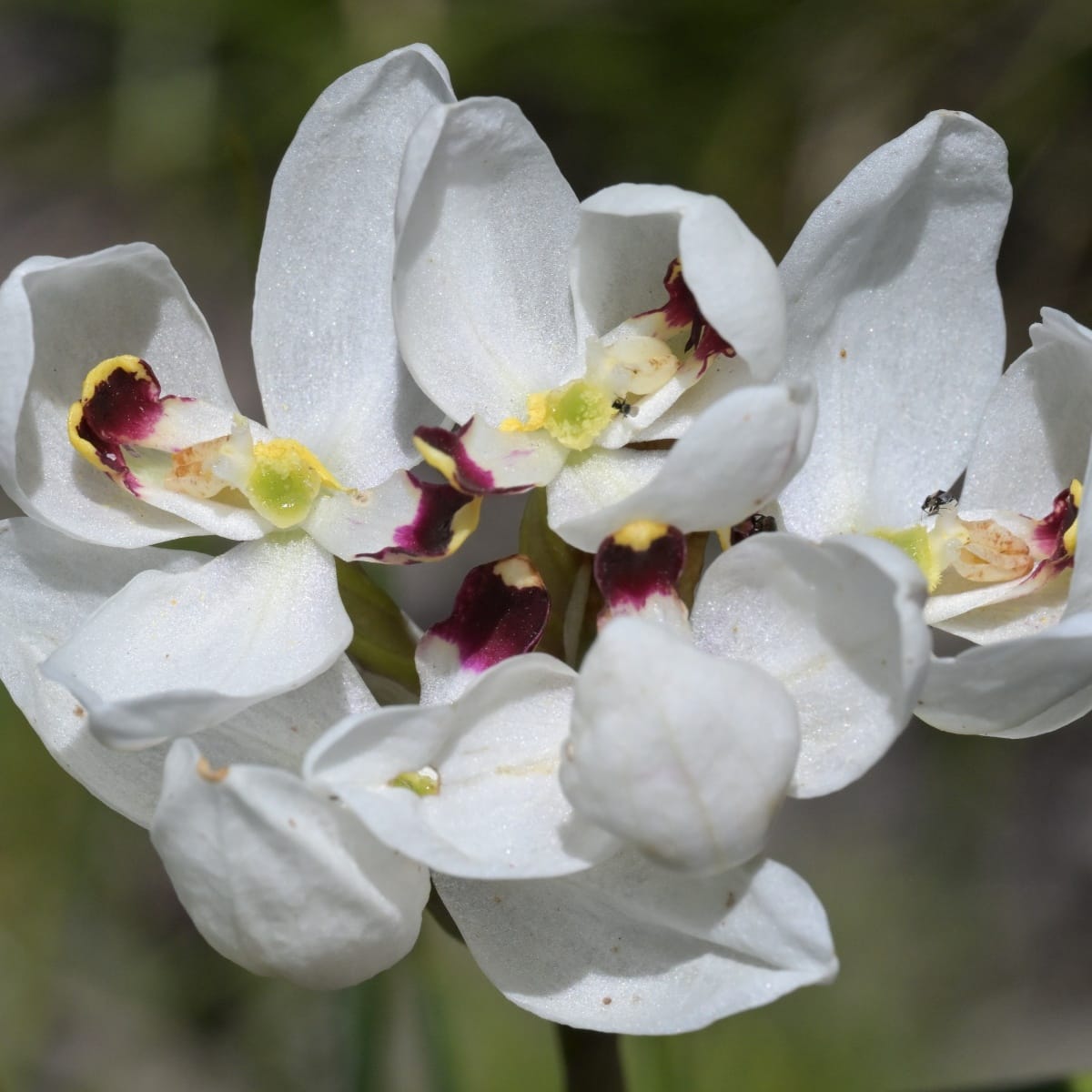
The flowers themselves seem perfectly suited to these beetles. Most species in the genus Disa hide their nectar deep inside a narrow tube called a spur. Disa elegans does something different. It places droplets of very dilute nectar openly on the flat surfaces of its petals and lip.
This small detail makes a big difference. Beetles have short mouthparts and feed with broad sweeping movements. They are not built for reaching into deep floral tubes, like bees or butterflies. By offering nectar out in the open, the orchid makes feeding easy for beetles and less attractive to other insects.
The flowers also produce a fruity scent rich in linalool and methyl benzoate. Linalool is a fragrant compound known to stimulate beetle antennae, acting almost like a signal that says “food is here”. Bright yellow and maroon markings guide the beetles towards the nectar, positioning their bodies so that pollen is picked up and deposited with surprising precision.
And the system works. Around half to nearly all flowers on surveyed plants received pollen, and roughly 11 per cent of the pollen removed from flowers ended up on a stigma. That efficiency rivals many bee-pollinated orchids.
Beetles also moved pollen a few metres, sometimes skipping several plants, producing a dispersal pattern similar to other insect-pollinated species. About 30 per cent of the pollen deposited came from the same plant, a level of self-pollination common in orchids. However, this is not a problem, as self-pollinated and cross-pollinated flowers produced equally healthy seeds.
Together, these findings tell a clear story: beetles are not careless visitors blundering through delicate flowers. They are efficient and reliable partners. The so-called aristocrats of the plant world have formed a successful alliance with insects that science once underestimated.
READ THE ARTICLE:
Johnson SD, Hobbhahn N, van der Niet T, Pauw A. 2025. Floral specialization for beetle pollination and its implications for pollen dispersal in an African orchid. American Journal of Botany 112. https://doi.org/10.1002/ajb2.70117
Portuguese translation by Victor H. D. Silva
Cover picture: Disa elegans by jmdgraham (iNaturalist).