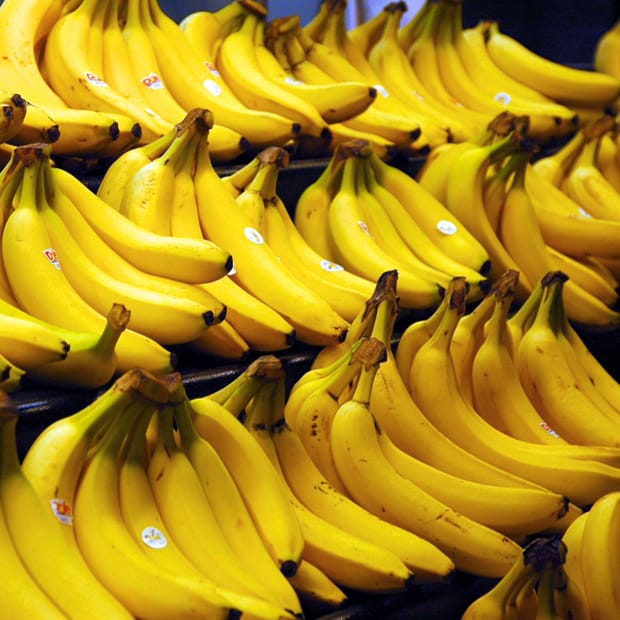



The answer to that schoolboy question used to be ‘shark-infested custard’. Now, though, it seems it’s simply ‘bananas’(!). To explain, Paul Grant et al. have detected high levels of many pesticides in the blood of spectacled caimans – freshwater alligatorid crocodylians (reptiles that are like alligators and crocodiles) – in Costa Rica. Whilst the caiman don’t eat bananas, the cocktail of pesticides within the carnivores is inferred to have originated from banana plantations upstream of the caimans’ area, and to have contaminated the waterways that the reptiles inhabit. Caiman pesticide concentration decreased with distance from the intensively managed banana plantations – ‘high-intensity banana crop watershed of Rio Suerte’, and their body condition was negatively correlated both with total pesticide concentrations and with proximity to banana plantations. Both of which findings support the views that pesticides may have led to toxic effects in the caiman, either directly, impoverishing their overall health, or indirectly, via pesticide effects on the quantity or quality of their prey.
Concerns are raised on many levels. The caimans inhabit the Tortuguero Conservation Area: how should conflicts between economics and development on the one hand – bananas are a major income generator for Costa Rica – and conservation on the other be managed? Many of the pesticides found in caiman include insecticides categorised as Persistent Organic Pollutants (POPs), which are banned under the 2011 Stockholm Convention: why are such compounds being used? In a rather understated way the abstract concludes thus: ‘…results indicate that pesticide use in banana plantations is impacting a high trophic level species inhabiting one of the most important wilderness areas in Costa Rica (Tortuguero National Park)’. Whilst this is not the place to solve those problems, we can at least air them, and this example does make the point that botany can impact upon many areas of life. Bananas, food for thought (and caimans, a biomonitor with real teeth!).
[Not wishing to be overly picky, but I do note that the journal’s abstract shows several zero probabilities for the results of certain statistical tests, e.g. ‘F = 20.76; p= 0.00’. Hmm, a terminal digit missing methinks. But, maybe that’s what happens when you get too close to a crocodilian..? – Ed.]