


Various plants, crops and extracts have been used over several generations to contribute to household food and nutrition security in semi-arid areas (Khan, et al. 2013; , Smith, et al. 2007; Schipper, 2000; Heslop-Harrison and Schwarzacher, 2007; Combrinck, et al. 2007; Flavier et al. 1995). A wide variety of plants are used within a broader knowledge framework termed ‘indigenous knowledge’ (Warren, 1991). However, there is no clear agreement about what exactly constitutes the knowledge paradigm. Despite the lack of clarity, communities use various facets of this concept to tackle complex challenges related to food, education, health care and natural resource management (van Rensburg, et al. 2007). Unfortunately, it is usually not taken seriously as a viable alternative for ensuring food security and nutrition. Many people rely on methods based on the scientific approach and thus IKS may be at the verge of extinction. This, however, is not to imply that the two knowledge systems are mutually exclusive.
General utilization of vegetables in Africa is low and in 1995 per capita consumption of vegetables was 29kg whereas the world average was 75kg/year/person (Maundu 2006). Systematic exclusion of traditional vegetable crops in diets is attributed to many factors including the green revolution, urbanization and changing lifestyles and gross under-valuation of indigenous knowledge systems (Flavier, et al. 1995, Warren, 1991, Kolawole, 2001, Maikhuri, et al. 1999). Consequently, little concerted efforts are being implemented to conserve local gene banks of traditional vegetable seed in Africa. However, in recent years, there has been recognition that traditional vegetables or more broadly orphan crops are highly adaptable to local conditions and therefore important in the attainment of household food security (Pretty and Bharucha, 2014).
Rwanda is a small emerging economy located in East Africa with an estimated population of 13 million (National Institute of Statistics of Rwanda National Demographic Survey, 2012). The country has been experiencing economic growth largely driven by improved agricultural productivity from the government’s Crop Intensification Program and Land Use Consolidation. These programs focus on conventional crops such as maize, Irish potatoes, beans and banana. However, less emphasis is placed on traditional vegetables (TV). This study involved the identification of traditional vegetables found in Musanze District in the Northern Province, their subsequent contribution in the livelihoods of rural farmers in the District and institutional and policy constraints in production. This study also influenced a discussion on FAO FSN forum which explored how different methods of indigenous food preparation are influenced by the changing social, economic, cultural and institutional conditions and how these ultimately determine food security.
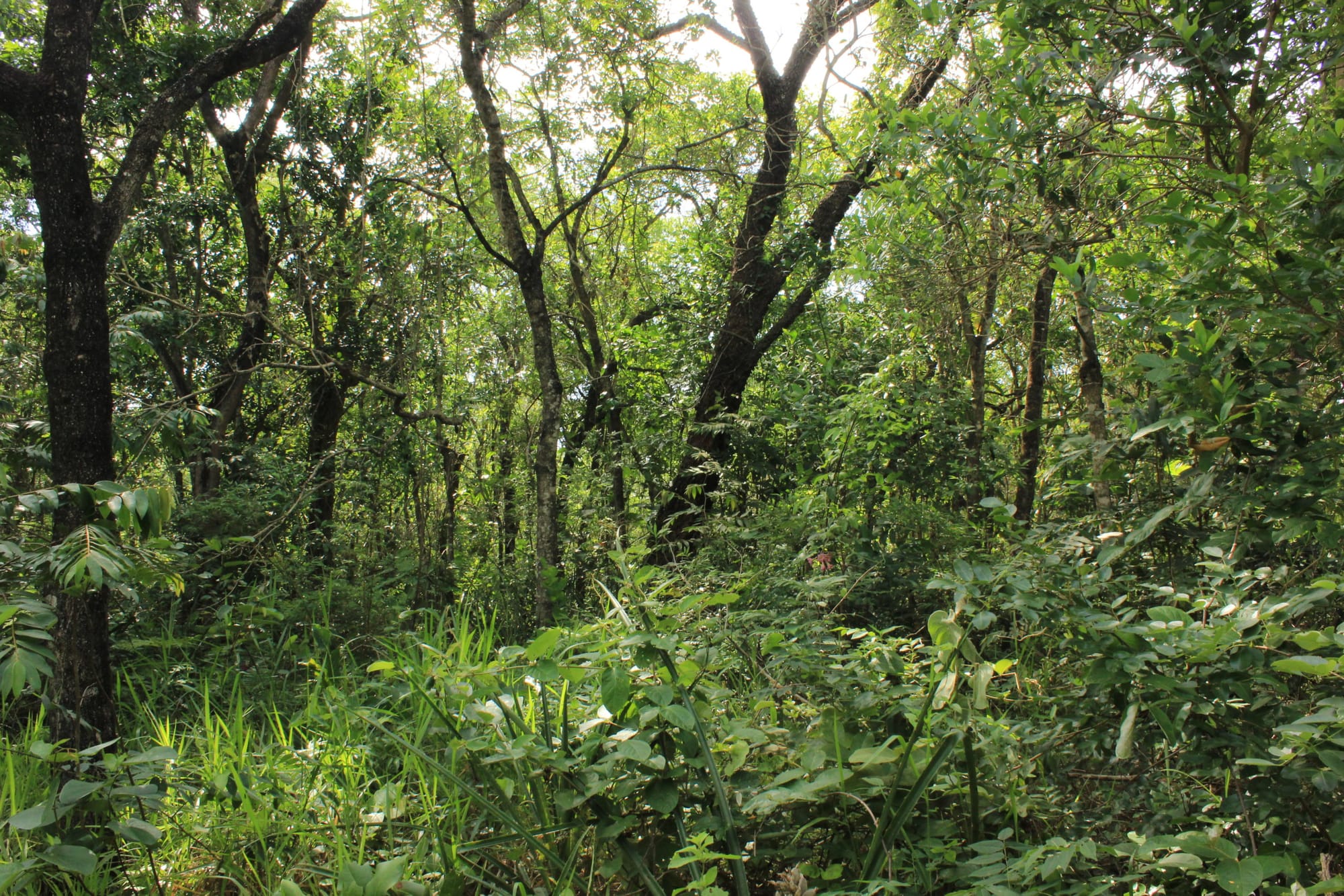
[caption id="attachment_15092" align="aligncenter" width="1060"]Traditional vegetables found in Musanze District, Northern Rwanda[/caption]
Survey
We conducted a survey in Musanze District specifically in Busogo, Kimonyi and Muko sectors. The sectors were selected randomly from a list of sectors found in the district. The population stood at 314,242 inhabitants on an area of 530.4 km2 implying subsequent density of 592.6 habitants per km2 (DDP Musanze, 2013-2018). The district has a surface area of 530.4 km2 including 60 km2 of Volcanic National Park and 28 km2 Ruhondo lake. It is bordered by Uganda and D.R.C in the North, by Gakenke District in the South, Burera District in the East and Nyabihu District in the West. Currently, Musanze District comprises 15 administrative sectors, 68 cells and 432 villages commonly named Imidugudu.
Multi-stage sampling was used to select 100 farming households in Musanze district. A structured questionnaire administered at the household level was used to collect relevant data for this research. The questionnaire consisted of 5 sections focusing on the identification of the farmer, household economic activities, and utilization of traditional vegetables, agronomic practices used to grow traditional vegetables, marketing aspects and constraints faced during consumption and selling traditional vegetables. Two main tools used for analysis were gross margin analysis and the binary logistic regression model.
Results
Utilization of traditional vegetables
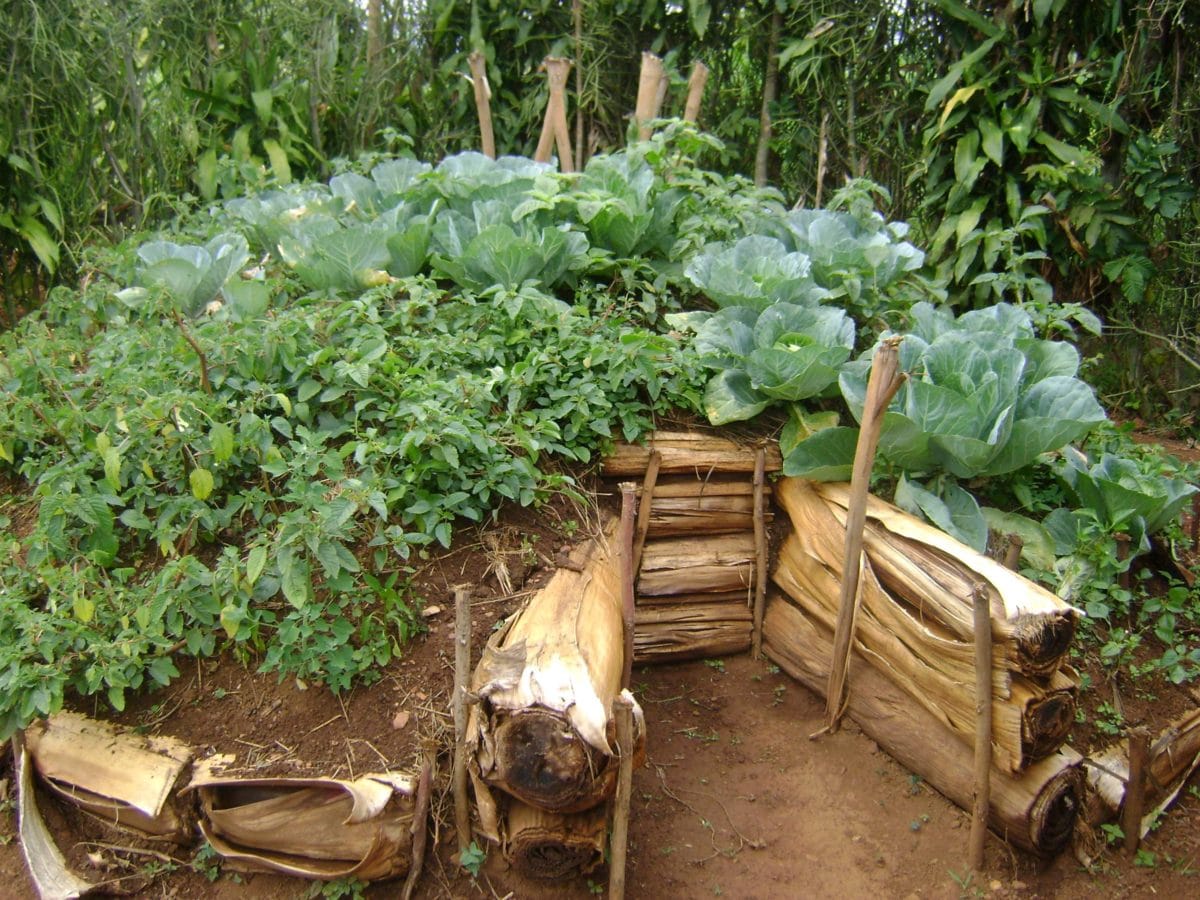
The researchers were interested in ascertaining the quantities consumed of the different classes of traditional vegetables. Most of the respondents consumed Amaranthus, followed by Nightshade (45%), Eggplant (14%), Spider plant (12%), Cucumber 5%, and Nakati (2%). Quantity consumed per week ranged from 0.004 kg to 1.86 kg per household (green weight). Kitchen gardens were used to grow these vegetables and typically between 2-6m2 indicating the land constraint that farmers are facing in agricultural production. Only 5% sampled farmers had access to extension services for growing traditional vegetables. In addition, access to certified seed was a critical constraint.
[caption id="attachment_15091" align="aligncenter" width="2592"]Kitchen garden in Musanze District[/caption]
Economic profitability of traditional vegetables
We considered both quantities meant for household consumption and also for sale. In cases, where markets were missing, shadow pricing was used to impute economic values to both inputs and outputs. The mean gross income equal to 64 661.88 Frw/month/m2 (US$107), while the total cost was 40368.00Frs/month/m2 (US$68), resulting in a net income of 24293.88Frw/month/m2 (US$40). Traditional vegetables can therefore be considered as an alternative for generating income for the poor in rural areas.
Promoting use among rural farmers
Number of cattle owned, availability of extension support, farm size had a positive and significant effect on the probability of adopting TVs among farmers. Age, household size, education, availability of seeds were not statistically significant (p<0.05). The coefficient of extension support shows that farmers who have access to training have a higher chance of adopting TVs than the untrained farmers. This may be due to the ability of trained farmers to obtain process and use information available on the relative advantages of TVs. Further, training also has the tendency of confidence generation among the farmers resulting in higher rates of adoption. The number of cattle owned positively influenced the probability of TV integration by the household due to the availability of manure. In Rwanda, the government is emphasizing cattle ownership through the One-cow per household initiative.
Recommendations
TVs play an important role in household food security and income generation. However, priority could be put on production, use, consumption, conservation and commercialization programs of Amaranth, Nightshade, Spiderplant , Pumpkin, Nakati, and Eggplant because these are the main traditional vegetables. There is need to enhance awareness of farmers by providing with appropriate extension services. The current National Agriculture Policy does not make explicit reference to traditional vegetables. Instead it emphasizes on staple foods like Beans, Irish potatoes, Rice, Maize, Wheat, Soya bean and Banana. Furthermore, the main programs are:
- Coffee programme
- Tea programme
- Pyrethrum programme
- Roses programme
- Exotic fruits programme
- Ornamental plants programme
- Beans programme
- Rice programme
- Maize programme
- Wheat programme
- Soya programme
- Irish potatoes programme
- Hides and skins programme
- Honey programme
- Meat programme
- Milk programme
No specific program on traditional vegetables is highlighted. Findings of this analysis have also been confirmed in other countries within the East African Community, and therefore reinforce the idea that TVs could be considered at the national policy level because of potential roles in reducing malnutrition that remains endemic to the region.
References
Combrinck S., Du Plooy G.W., R. I. McCrindle R.I. & Botha B.M. (2007). Morphology and Histochemistry of the Glandular Trichomes of Lippia scaberrima (Verbenaceae), Annals of Botany, 99 (6) 1111-1119. DOI: http://dx.doi.org/10.1093/aob/mcm064
Flavier J.M., De Jesus A. & Navarro C.S. (1995). 43. The Regional Program for the Promotion of Indigenous Knowledge in Asia (REPPIKA), The Cultural Dimension of Development, 479-487. DOI: http://dx.doi.org/10.3362/9781780444734.043
Heslop-Harrison J.S. & Schwarzacher T. (2007). Domestication, Genomics and the Future for Banana, Annals of Botany, 100 (5) 1073-1084. DOI: http://dx.doi.org/10.1093/aob/mcm191
Kolawole O.D. (2001). Local Knowledge Utilization and Sustainable Rural Development in the 21st Century, Indigenous Knowledge Development Monitor, 9 (3) 13-15. Available via ResearchGate
Maikhuri, R.K., Rao, K.S., Saxena. K.G., & Semwal, R.I., (1999). Traditional Crops In The Central Himalayas. Plant Genetic Resources Newsletter 1999, 120, pp. 1-7 via Negi (2007).
Maundu, P. (2006). Promotion of Under-Utilized Food Plants in Sub-Saharan Africa: Experiences with African Leafy Vegetables, International Plant Genetic Resources Institute via http://hdl.handle.net/10625/51375
Musanze District Development Plan (2013-2018). District Development Plan. Available at http://www.musanze.gov.rw/
Negi C.S. (2007). Changing face of polyculture in the Darma and Johaar valleys, Pithoragarh, Kumaun Himalayas, International Journal of Sustainable Development , 14 (4) 428-436. DOI: http://dx.doi.org/10.1080/13504500709469743
NISR Demographic and Health Survey. 2012. Indicator Reports. 2012. Kigali, Rwanda.
Pretty J. & Bharucha Z.P. (2014). Sustainable intensification in agricultural systems, Annals of Botany, 114 (8) 1571-1596. DOI: http://dx.doi.org/10.1093/aob/mcu205
Schippers, R.R. (2000). African Indigenous Vegetables. An Overview of the Cultivated Species. Chatham. UK: Natural Resources Institute/ ACP-EU Technical Centre for Agricultural and Rural Cooperation. Info at http://r4d.dfid.gov.uk/Output/179575/
Smith, F. I., & Eyzaguirre, P. (2007). African leafy vegetables: their role in the world health organization's global fruit and vegetables initiative. African Journal of Food, Agriculture, Nutrition and Development. Online at http://www.bioline.org.br/request?nd07019
van Rensburg W.J., Van Averbeke W., Slabbert R., Faber M., Van Jaarsveld P., Van Heerden I., Wenhold F. & Oelofse A. (2009). African leafy vegetables in South Africa, Water SA, 33 (3) DOI: http://dx.doi.org/10.4314/wsa.v33i3.49110
Warren, D. M., 1991. Using Indigenous Knowledge in Agricultural Development. World Bank Discussion Paper No.127, Washington, D.C: The World Bank