



Xylem are responsible for delivering water and nutrients from roots to plant canopies. The degree of connectedness of the xylem network can affect its hydraulic efficiency and safety. A high degree of connectedness can act as a backup in case of injury and promotes sharing of nutrients between plants organs. However, it also allows pathogens and embolism to spread more easily. Sectored xylem networks are less well connected. Sectored plants have larger springwood and conduit diameters, lower conduit density, increased conduit isolation and decreased lateral flow. This can impact within-plant resource allocation and contribute to non-uniformity of fruit quality and production in cropping systems.
In their new study published in AoBP, McElrone et al. investigate the effect of xylem anatomy and hydraulic sectoring on grapevine fruit production. The authors combined sap flow measurements and infusion of xylem-specific dyes to document functional conductive area and flow pathways from roots to shoots of 20-year-old Thompson Seedless and 8-year-old Chardonnay grapevine varieties in California. They also used micro-computed tomography (microCT) to better understand the 3D structure of xylem.
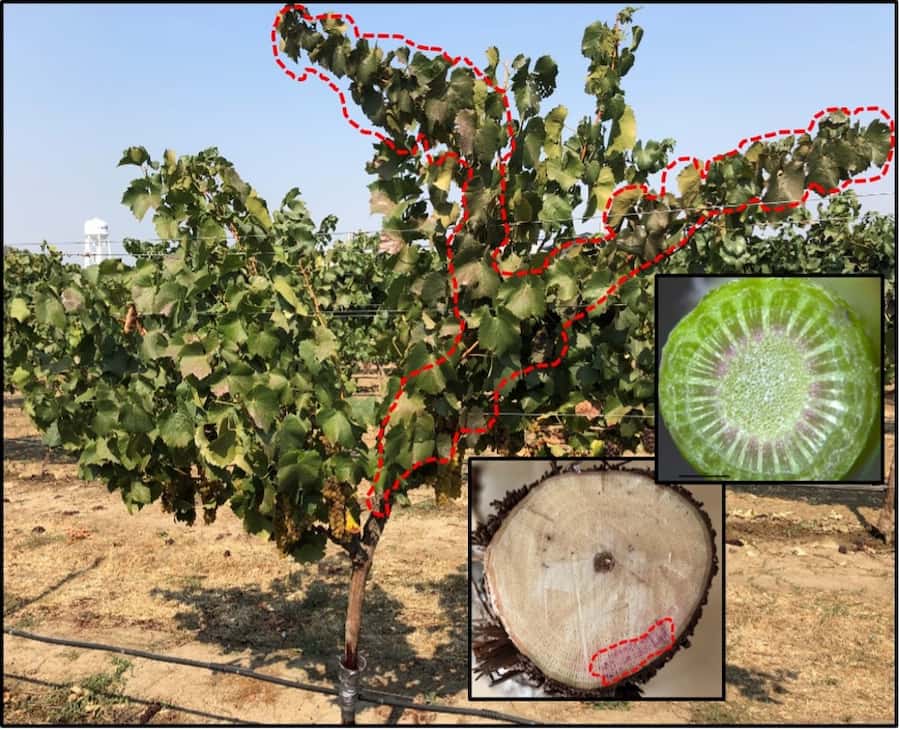
In their work, grapevine xylem exhibited hydraulic sectoring, where transport was limited to discrete packets of the water-conducting vascular tissue. Detailed anatomical observations showed that xylem tissue was capable of water delivery to any portion of the vine canopy but functioned in a sectored manner due to high axial permeability between organs on one side of the vine.
Dye injected into vine xylem water revealed that these preferential flow paths connected, in some cases, individual roots to the leaves and fruit clusters on just a few stems. Sectoring likely contributes to within vine fruit variability. The results of the study provide insights for commercial vineyard management that aims to maximize fruit uniformity at harvest. Specifically, it was concluded that annual pruning may induce sectoring in what is otherwise an integrated plant.