

You can listen to this page as an audio file.
https://anchor.fm/botanyone/episodes/The-Why-and-How-of-Horizontally-Expanding-Leaf-Patterns-e16745e
Phyllotaxy is the arrangement of leaves around the stem of a plant. The phyllotactic pattern of rice plants is distichous phyllotaxy: leaves are arranged in two vertical columns on opposite sides of the stem.

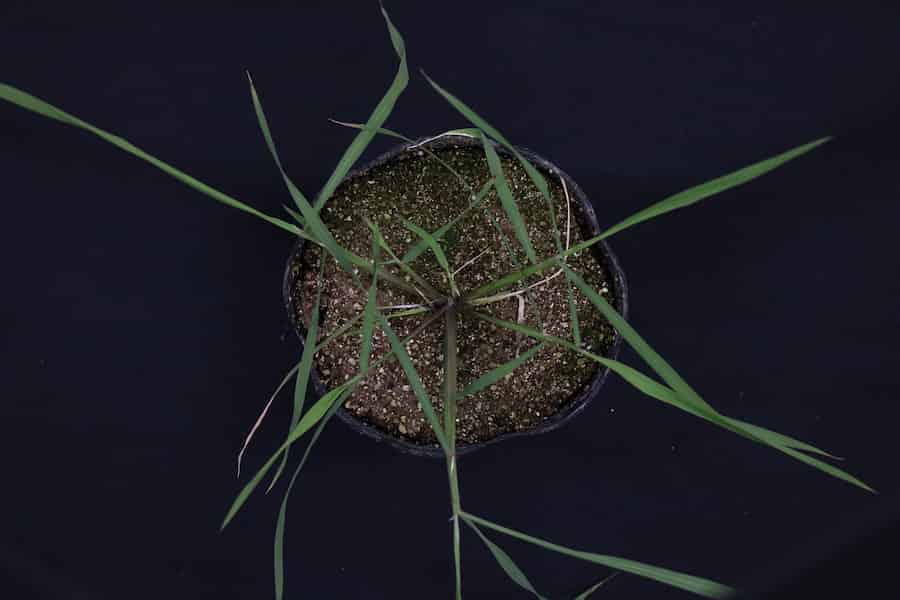
Distichous phyllotaxy can present in different three-dimensional arrangements: Cultivated rice has opposite leaves growing in two vertical columns forming a vertically standing fan-like shape. Wild relative species of cultivated rice have opposite leaves growing in an alternate arrangement forming a horizontally expanding radial shape.
An understanding of the mechanisms that control the plant architecture of rice will not only enable us to understand the plants’ adaptation to surrounding environments but also facilitate the breeding of rice varieties with higher yield potentials.

Yoshiki Tokuyama, graduate student of Plant Breeding Laboratory at Hokkaido University, and colleagues in Japan, carried out a research project to uncover the mechanisms of radial leaf patterns in rice. To do this, they compared the growth patterns of wild and cultivated rice with differing plant shape.
The authors deployed several methods to compare these lines:
- detailed time-course phenotyping – the elevation and azimuth angles of culms were measured manually every 1-2 days,
- three-dimensional micro-computed tomography (micro-CT) – a 3D imaging technique utilizing X-rays to see inside an object, slice by slice,
- and computational modeling to analyze the organ-level developmental mechanisms.
From the phenotyping and micro-CT data, the authors were able to determine that changes in the elevation angle in the main culm and azimuth angle in the primary tillers (a tiller is a branch arising from the base of the plant) contribute to radial shape development.
The authors used computational modelling to understand the mechanics that produce the main culm and tiller movement and the subsequently radial shape in wild rice. According to Tokuyama, “The computational simulation enables us to find sufficient factors to explain the culm movements and manipulate them independently.” The movements were simulated as controlled by three kinematic factors: descent controlling elevation decrease of the main culm, spread controlling movement of the primary tillers, and ascent controlling the elevation increase of the main culm and primary tillers.
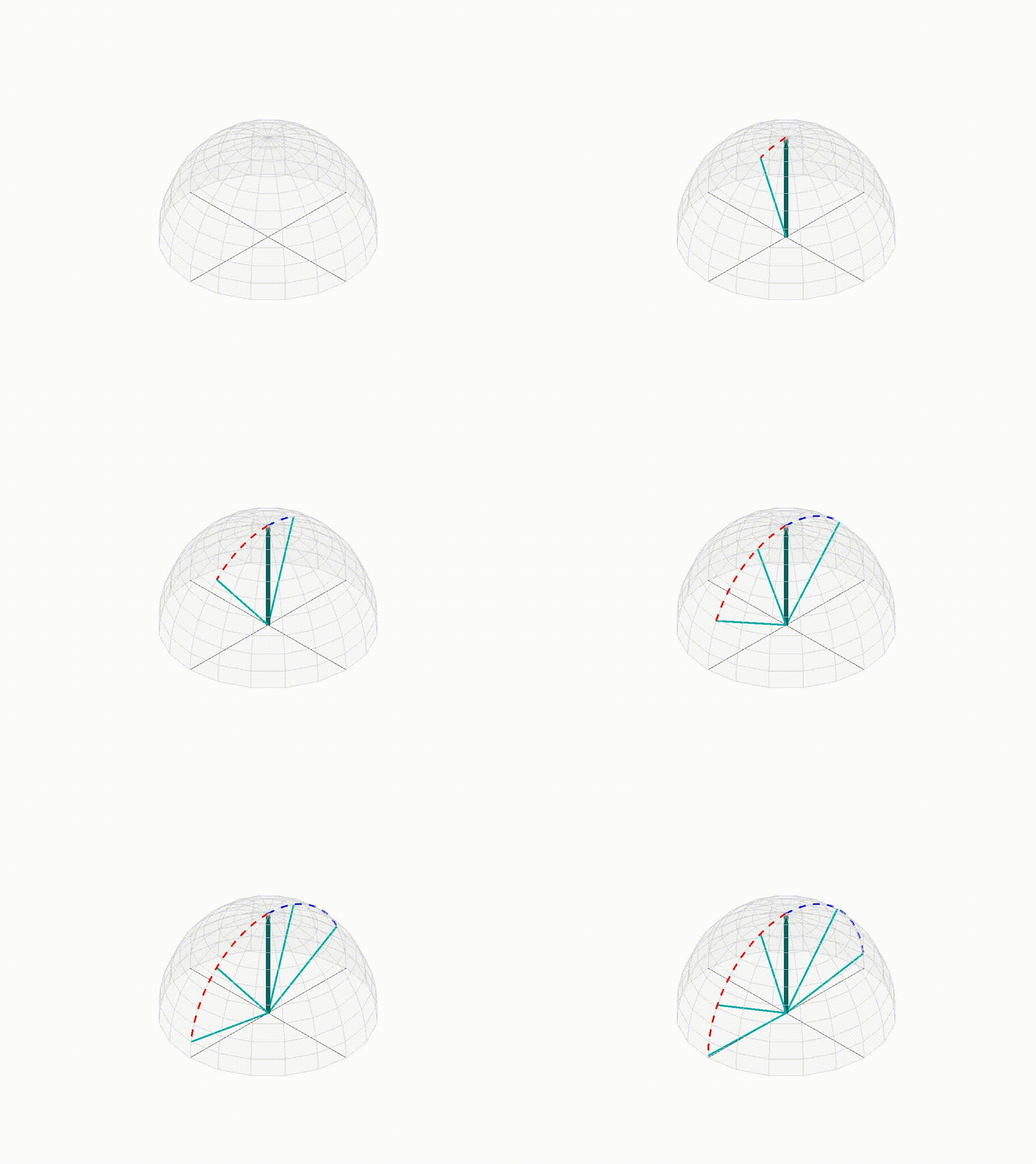
The computational models predicted that a combination of movements, including that controlled by (ascent) negative gravitropism, produces the overall radial shape. Gravitropism is the process by which plants can sense gravitational pull and adjust their organs’ growth direction accordingly.
“We hypothesized that one of the factors controlling the upward movement in the model is negative gravitropism. However, negative gravitropism has never been analyzed in wild rice” explains Tokuyama.
The authors experimentally assessed how negative gravitropism affects the radial plant shape in two ways. They grew a wild strain with pots angled at 45° to determine if the altered direction of gravity affected the mechanics of tiller and culm growth. None of the four plants grown at 45° had radial plant shape. When grown at 90°, the nodes near the base reacted to the gravity stimulus and increase the size of their lower side causing them to grow upwards, confirming negative gravitropism in the wild rice strain. This paper demonstrates that a kinematic model can explain the mechanisms of how the shape in distichous phyllotaxy plants changes as part of their adaptation to the surrounding environment.