

The relationship between plants and their pollinators is a key driver of floral diversification. As plants evolve new traits that better attract or reward the pollinators visiting their flowers, this selective process generates a vast diversity in forms and patterns observed across different species. A new study published in Annals of Botany investigated this overlooked factor and made a surprising discovery about how regional changes in bee and other pollinator actions can directly impact the evolution of flowers across vast areas.
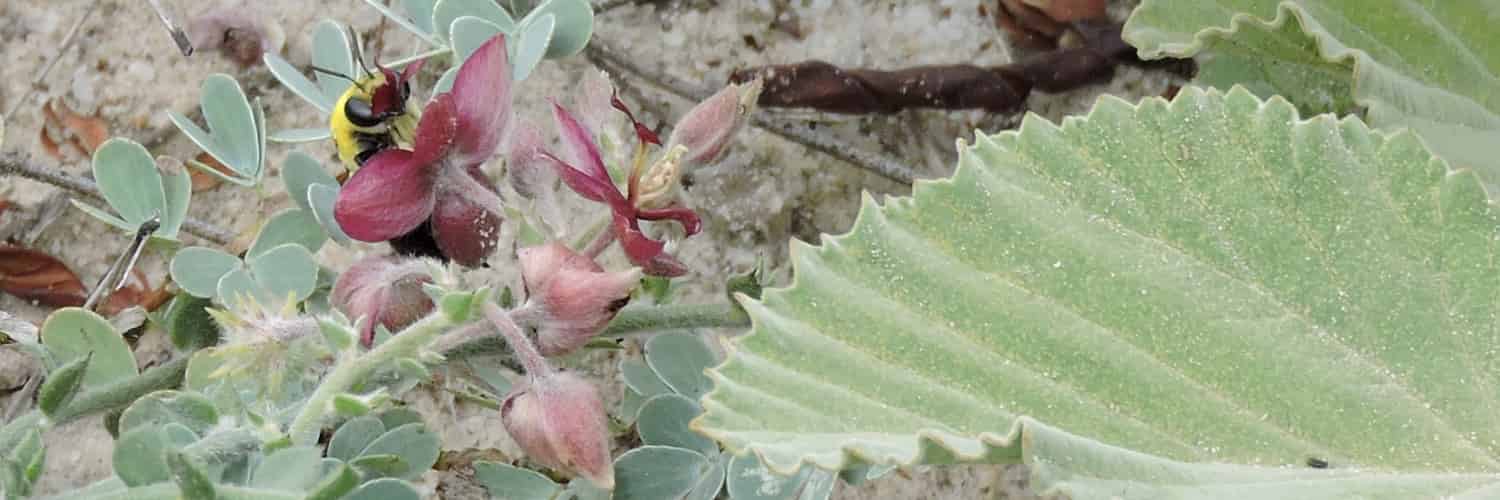
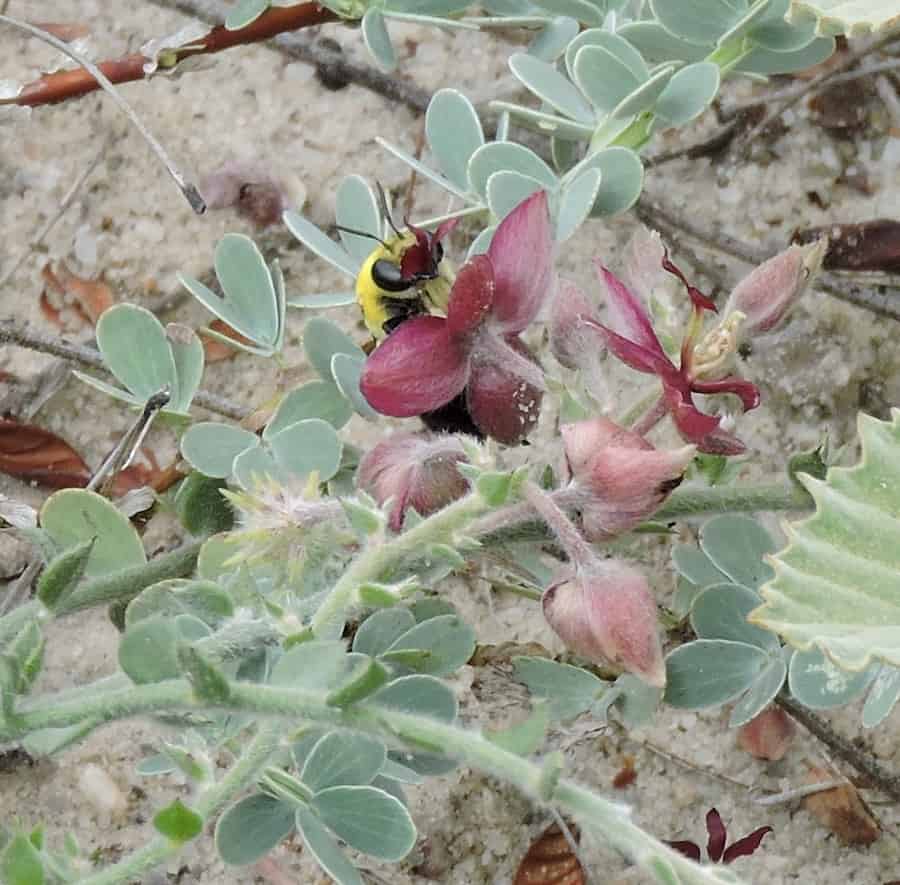
The study focused on Krameria grandiflora, a shrub native to arid and semi-arid regions throughout North and South America. K. grandiflora produces oil rewards that attract oil-collecting Centris bees as its primary pollinators. The researchers were interested in how patterns of natural selection acting on the plant’s floral traits might differ across its extensive range, spanning thousands of kilometres.
To investigate spatial variation, the team from East Tennessee State University sampled five populations distributed across the species’ continental distribution, from northern Mexico to northern Argentina. At each site, they closely observed bee visitation rates and behaviours, quantifying pollen deposition and germination as a measure of reproductive success. Three key floral characteristics were analysed – the distance between the flag-like petals and the stigma, sepal length indicating advertisement, and nectar oil volume indicating reward production.
Through statistical analyses, they then estimated the strength and direction of natural selection gradients on these traits within each population. Surprisingly, the strongest selective pressure was found on the fit between petals and stigma not where the flag-grasping behaviour of Centris bees was observed, but rather where it was absent. Additionally, comparison of selection gradients between sites revealed substantial geographical differences, generating a “selection mosaic” across the species’ range.
Geographical variation of phenotypic selection on the flag-stigma distance represents a selection mosaic, which suggests diverging selective pressures to this floral trait across space, potentially leading to differentiation of pollination ecotypes… This may be due to the atypical oil-gathering behaviour of Caenonomada bees, which were the most frequent pollinators in the northern- and southernmost populations, where selection through the absence of flag grasping was demonstrated to be relatively strong. In the meantime, selection on the flower-pollinator fit was weaker where the stereotypic flag grasping behaviour of Centris bees was predominant.
Carneiro et al. 2024
To understand this unexpected pattern, the researchers delved deeper. Video observations showed that in areas without flag grasping, the bees interacted with flowers in alternative ways, such as standing atop the stigma to collect oil. Through modelling, they attributed over 75% of the geographic variation in selection solely to divergent selection on petal-stigma distance between sites.
These results demonstrate the adaptive significance of K. grandiflora‘s specialized floral structures, even in regions where the ancestral pollinator behaviour is lacking. More broadly, the study provides compelling evidence that differences in pollinator behaviour across a species’ range can directly drive the formation of selection mosaics through spatially variable natural selection regimes. This geographical variation in interactive strategies used by pollinators shapes the optimal floral designs selected for in each local community.
Looking to the future, understanding how selection gradients change depending on regional pollinator assemblages and behaviours will become increasingly important. As climate changes alter species distributions and drive shifts in plant-pollinator networks, mismatches may arise between locally co-evolved interactions. By shedding light on this mechanism of floral evolution, this work offers insights into how such relationships may respond and reshape diversity in the face of global environmental transformation.
READ THE ARTICLE
Carneiro L., Aristides Cocucci A., Sérsic A. N., Machado I.C. and Alves-Dos-Santos I. (2024) Pollinator-mediated selection on Krameria oil flowers: A flower-pollinator fit adaptation to an atypical oil-collecting behaviour? Annals of Botany. Available at: https://doi.org/10.1093/aob/mcae102