


Have you ever had some house plants become more and yellow and start looking sad?
Whilst leaf yellowing can be caused by many problems, one of them might be nutrient deficiency. Some of the most common fertilisers contain nitrogen, phosphorus and potassium (NPK) but there are many other essential and non-essential elements which plants need.
An essential mineral element is manganese (Mn) which is important for photosynthesis and respiration. However, in extreme quantities, Mn can cause phytotoxicity especially in acidic soils or whilst the plant is waterlogged (i.e. roots are in standing water). Another non-essential metalloid element is silicon (Si), which is the second most abundant element in the earth’s crust and is important for plant growth and development.
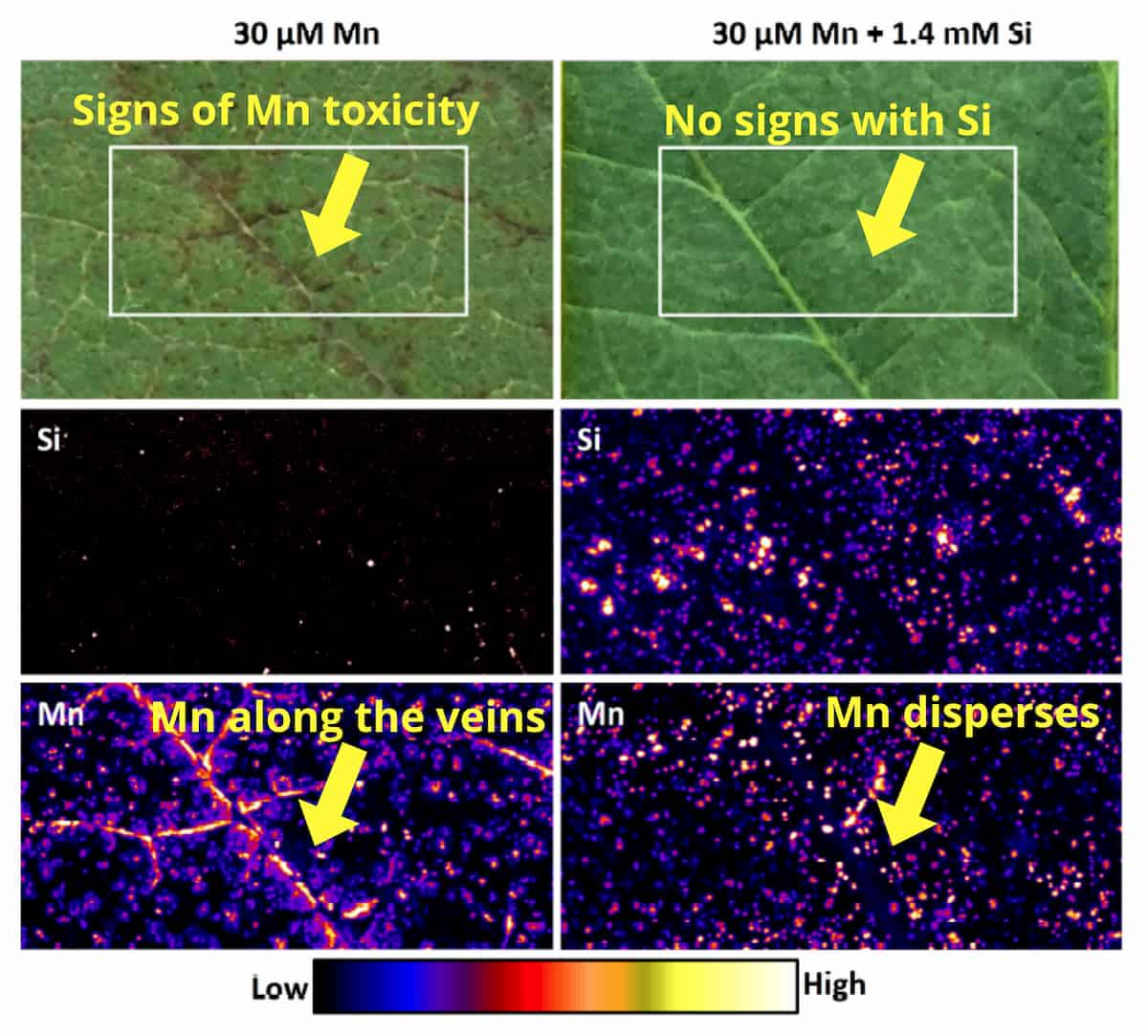
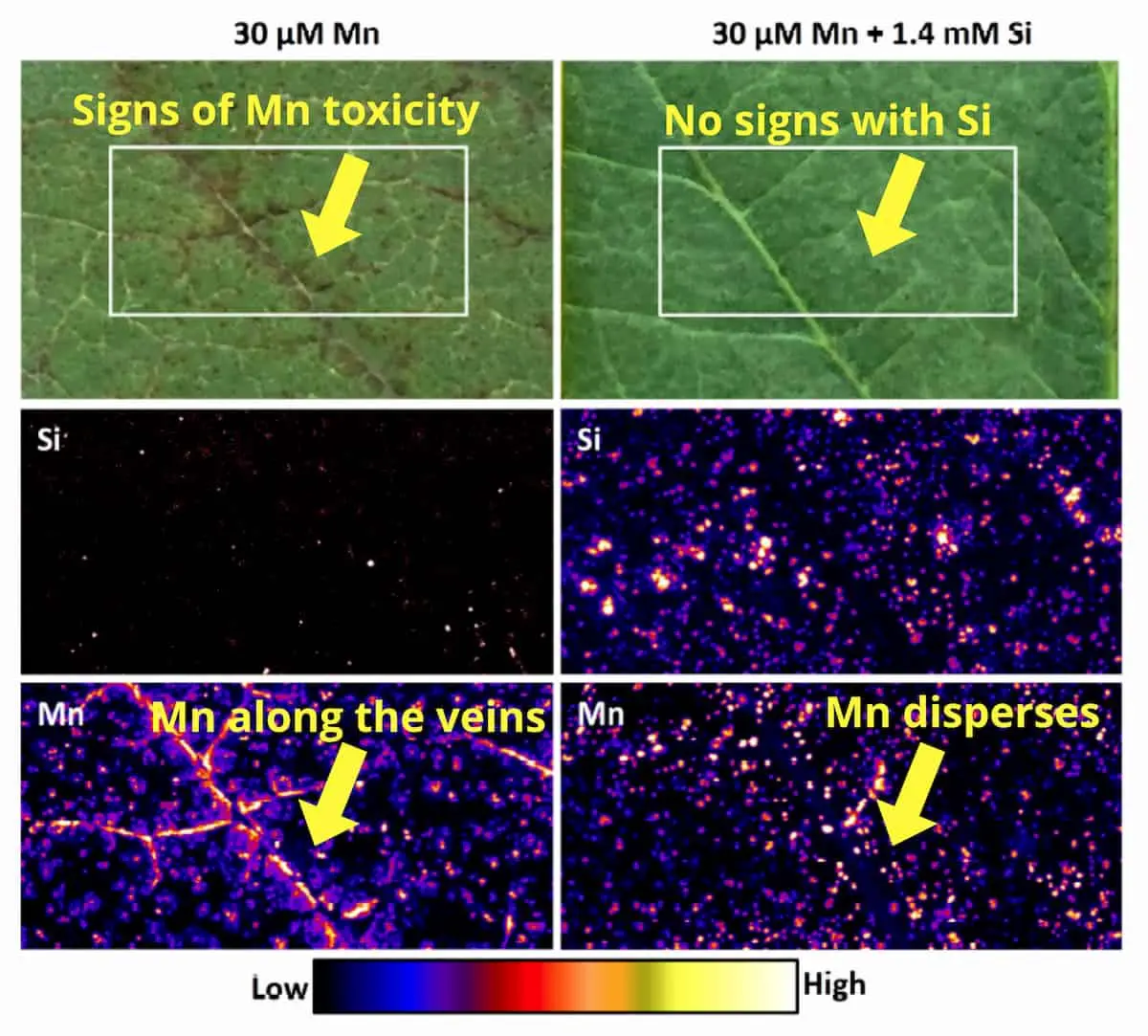
In the previous decades, the role of Si addition for tolerating environmental stresses has been gaining a lot of interest as it can lead to plant cell wall thickening. Testing if Si can help some crops to withstand Mn toxicity can be done in greenhouse experiments using different doses of the elements and looking at how the plants grow. Whilst these observations lead to perhaps overoptimistic conclusions, a new technique of using micro-X-ray fluorescence (µ-XRF) enables scientists to visualise where and how much of these elements are taken up by the plant.
van der Ent and colleagues (2020) at the University of Queensland used a synchrotron-based (i.e. the electromagnetic radiation emitted when charged particles are accelerated radially) µ-XRF to visualise Si distribution on soybean and sunflower plants experiencing Mn toxicity. You can watch Dr Antony van der Ent talking about his research on hyperaccumulation by plants to avoid toxicity on Gardening Australia.
In a short interview, Dr van der Ent explained, “Our group has been working on hyperaccumulator plants for about 10 years, concentrating mainly on plants from tropical regions in the Asia-Pacific. Thus far we’ve focussed our efforts mainly on hyperaccumulator plants of nickel, cobalt and manganese, but we also work on micronutrients uptake and toxicity in crop plants, such as soybean and sunflower.”
In the current study, authors saw less dead plant tissue when Si was added and Si was often co-located with Mn but in response, Mn accumulated in other areas in the plant, still causing phytotoxicity. These findings debunk many previous ideas about whether Si addition helps crops withstand Mn toxicity.
“This study was technically challenging, because of the difficulties in conducting the microXRF analysis while avoiding/minimizing sample artefacts” Dr van der Ent explains. The breakthrough in their methods is visualising elements with small atomic numbers in living, hydrated plant tissues. This could only be done previously using dried tissues, which is possibly not particularly representative of a growing plant. Some of the authors previously wrote a review (Koppitke et al., 2018) on using synchrotron-based µ-XRF to visualise elements in plants in the Plant Physiology journal. Their methods will now help other scientists to visualise the nutrient uptake process in great detail in the future.
The lead author is excited about their results as “This research has shown that it is possible to measure (and map the distribution of) very light elements, such as silicon, in fully hydrated (live) plant organs, in this case, soybean and sunflower leaves. We plan to apply these methods to other elements and other plant species and improve the methodology for time-resolved studies” and he added, “We hope that this work inspires more plant scientists to use laboratory-based micro-X-ray fluorescence (XRF) elemental mapping in their research”.
This research is a great example of why fundamental research and looking beyond darkening leaf veins and hairs is crucial to inform farmers how to look after their crops.
READ THE ARTICLE
van der Ent, A., Casey, L., Blamey, F., and Kopittke, P. (2020) Time-resolved laboratory micro-X-ray fluorescence reveals silicon distribution in relation to manganese toxicity in soybean and sunflower. Annals of Botany, 126(2), pp. 331-341. Available at: https://doi.org/10.1093/aob/mcaa081.