


That is the usual route taken by water within plants. And for most of them that is all there is. However, not all plants are the same (see the earlier Brachypodium ≠ Arabidopsis blog post). Take for instance plants that live in cloud forests. Despite the general persistence of water-bearing cloud or fog cover, when that life-sustaining envelope of hydration is absent – and coupled with the aridity that accompanies those ecosystems’ high elevations – such habitats experience seasonal drought and can be quite arid. Consequently, plants in that habitat can’t always rely on soil-stored water and several employ other, additional mechanisms for water abstraction.
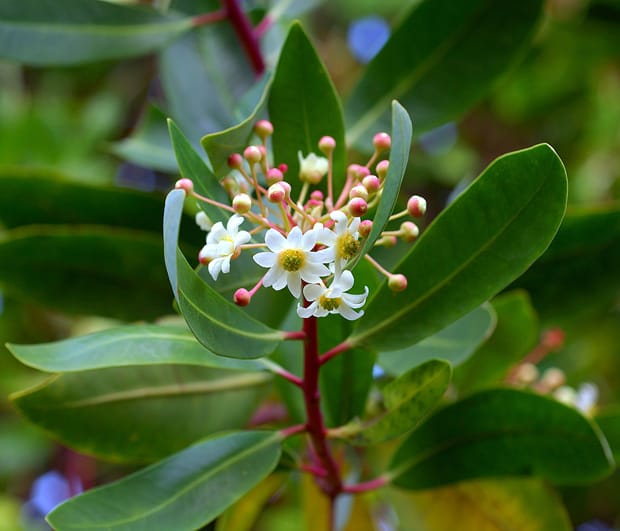
Although foliar water uptake (FWU) is a widely recognised water-acquisition strategy for such plants, its prevalence and importance to water and carbon economy of tropical cloud forest species is largely unknown. Using studies both in glasshouse and in the ‘field’ (sorry, I just can’t get used to calling a mountain habitat study area a field…), Cleiton Eller et al. have demonstrated the importance of FWU for Drimys brasiliensis (Winteraceae). They have shown that fog water diffuses directly through leaf cuticles(!), is transported through the xylem to below ground, and enhances leaf water potential, photosynthesis, stomatal conductance and growth relative to plants sheltered from fog. They drily conclude that ‘Foliar uptake of fog water is an important water acquisition mechanism that can mitigate the deleterious effects of soil water deficits for D. brasiliensis’.
This also messes up anyone’s ‘linear teaching model’ where we tell our students that water travels unidirectionally – upwards – in the xylem, photosynthates travel bidirectionally in the phloem (no, not in the same sieve tubes at the same time… or does it..?). Plant biology, eh, certainly has its ups – and its downs…