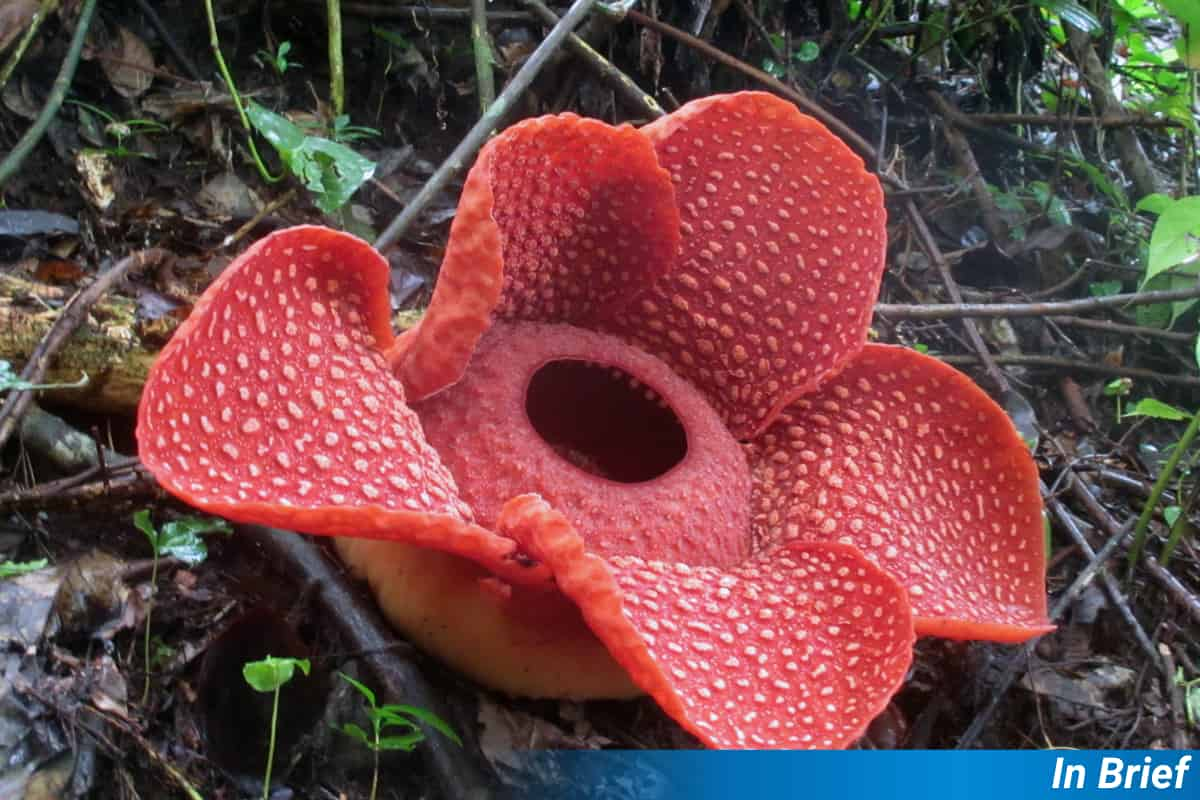


Erika Marie A. Bascos and collaborators have characterised for the first time the compounds behind the putrid scent of Rafflesia consueloae flowers, one of the largest flowers in the world. Yes, you read that right! Rafflesia flowers have a putrid odour that attracts their pollinators, the carrion flies – those that feed on decomposing meat.
The researchers used a unique, non-destructive method to collect scent samples from different parts of the flower at various stages of development, from flower buds to mature fruits. They then analysed these samples to identify the specific compounds present in the scent.
The team identified thirteen compounds, but the one responsible for the rotting smell, dimethyl disulphide, was only detected in fully bloomed flowers. This suggests the plant precisely times its scent production to coincide with when pollinators can access its reproductive organs, potentially increasing pollination success.
Previous studies on Rafflesia focused mainly on its visual features and overall smell. This new research provides the first detailed look at how the flower’s scent changes over time and varies across different flower parts, offering insights into its pollination strategy.
Bascos, E.M.A., Fernando, E.S., Duya, M.V., & Rodriguez, L.J.V. (2024). What’s that smell? The putrid scent of Rafflesia consueloae, its origin and developmental regulation. Flora, 318, 152571. https://doi.org/10.1016/j.flora.2024.152571 ($)