

An entry by R. Siva and S. Babu of VIT University.

Plant Systematics involves the recognition, comparison, classification and naming the millions of plants that have existed and exist at present on the earth. India is rich in plant diversity and possesses almost 7% of the world’s flowering plants.1 In addition, India has a relatively good number of bryophytes (approximately 3000) and pteridophytes (approximately 1400). Most of the plants reported in India are based on the work of British taxonomists like Hooker or Gamble. The fact is that India lacks expertise in the field and there is a scarcity of knowledgeable taxonomists in India. At present, there could be only few ‘finger-countable’ plant taxonomists in India, the country where vast reserves of flora are yet to be studied. Many legendary plant taxonomists are either no more or retired with no replacement. The sporadic and limited studies on taxonomy in India are mainly oriented towards angiosperms. Cryptogams are long neglected from both taxonomical documentation and research exploitation
This subject has failed to attract the young researchers. One reason could be the educational system in India. Different branches of science are perceived not to have equal value. For instance, only few universities offer botany or zoology courses for graduate studies. If this situation persists, at some point in time, botany and zoology will have to be categorized as `endangered subjects’.2
There have been several earlier publications emphasizing on the fate of taxonomy and taxonomists in India3-5 as well as other parts of the world.6-7 Despite there has not been much change in the overall scenario. This has undoubtedly left a great deal of vacuum in this important field of taxonomy.
We propose the following as initial ways to change the present scenario in this aspect.
- Proper recognition of plant taxonomists in the form of awards and rewards.
- Specialized institutes on plant taxonomy in addition to Botanical Survey of India so as to make enough room for job opportunities.
- Introduction of plant taxonomy in the existing syllabi of undergraduate biology and biotechnology courses.
- Establishment of more number of research centres in the name of “Institute of Plant Biology”, with plant taxonomy focus.
Acknowledgments:
We sincerely thank Prof. Sean Mayes, Department of Crop Genetics, University of Nottingham and Prof. R. Uma Shaanker, University of Agricultural Science, India for their critical comments
References
- Ajmal Ali M. & Choudhary R.K. (2011). India needs more plant taxonomists, Nature, 471 (7336) 37-37. DOI: 10.1038/471037d
- Siva, R., 2005. ‘Science becoming `endangered?’’, The Hindu, Education Plus, Oct. 31st.p 8.
- Dharmapalan B. (2001). Role of funding agencies for the betterment of taxonomy, Current Science, 81 (6) 629. PDF: http://www.currentscience.ac.in/Downloads/download_pdf.php?titleid=id_081_06_0629_0629_0
- Hariharan G.N. & Balaji P. (2002). Taxonomic research in India: Future prospects, Current Science, 83 (9) 1068-1070. PDF: http://www.currentscience.ac.in/Downloads/download_pdf.php?titleid=id_083_09_1068_1070_0
- Kholia B.S. & Fraser-Jenkins C.R. (2002). Misidentification makes scientific publications worthless – save our taxonomy and taxonomists, Current Science, 100 (4) 458-461. PDF: http://www.currentscience.ac.in/Volumes/100/04/0458.pdf
- Wägele H., Klussmann-Kolb A., Kuhlmann M., Haszprunar G., Lindberg D., Koch A. & Wägele J.W. (2011). The taxonomist – an endangered race. A practical proposal for its survival, Frontiers in Zoology, 8 (1) 25. DOI: 10.1186/1742-9994-8-25
- Guerra-García J.M., Espinosa F. & García-Gómez J.C. (2008). Taxonomy today: an overview about the main topics in Taxonomy, Zoologica baetica, 19 15-49. URL: https://storage.ghost.io/c/2e/eb/2eeb2fa9-78ad-4718-9c6b-8b5b05545bf6/content/files/www-ugr-es/~zool_bae/vol19/zoo-2.pdf
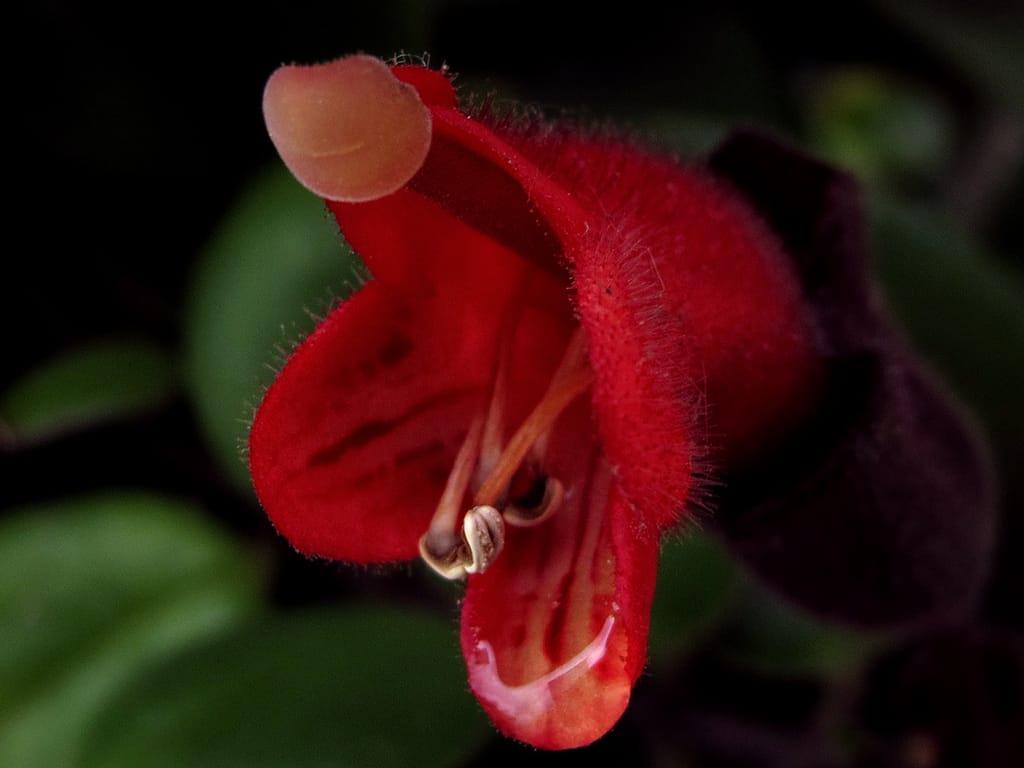
Photo: Aeschynanthus radicans by Jacinta Lluch Valero. [cc]by-sa[/cc]