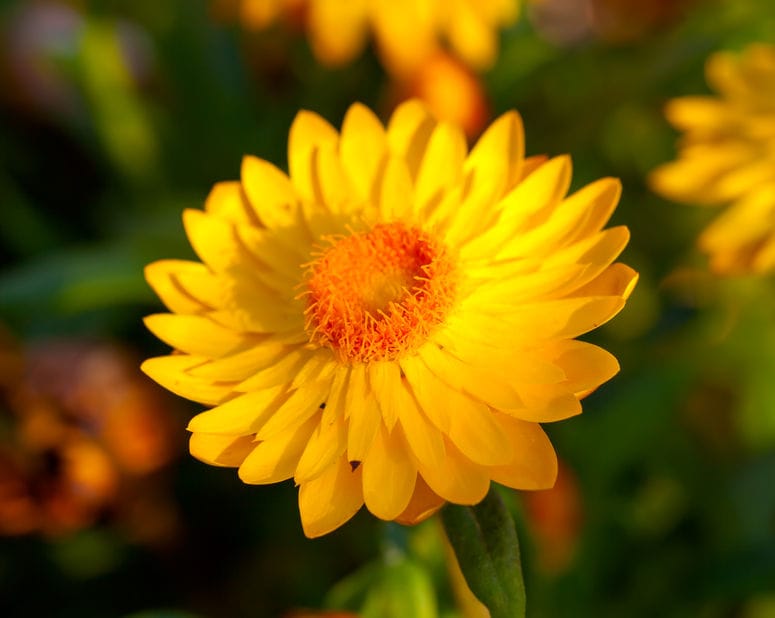


Aleksandra Rypień and Dorota Kwiatkowska examine colourful papery leaves, called scarious bracts, that surround the inflorescence of Golden Everlasting, the subject of their recent Annals of Botany paper Gradient of structural traits drives hygroscopic movements of scarious bracts surrounding Helichrysum bracteatum capitulum are adapted to move when environment humidity changes. Although all their cells are dead, these remain ready to bend toward the inflorescence centre to hide florets or outward to expose them.

Plants, despite the lack of muscles, evolved a wide range of mechanisms to generate motion. Movements of plant organs vary in speed: from very slow growth movements of shoots to snapping of carnivorous plant leaves or rapid explosive seed dispersal. Biologists have investigated how plant organs move in the absence of muscles since the pioneering work of Charles Darwin. Results of these investigations are crucial to understand plant propagation or reaction to changing environmental conditions. Moreover, we have adapted a number of movement mechanisms “invented” by plants to build modern constructions that are for example able to react by changing their shape in response to changing humidity or temperature.
Mechanisms of some movements seem incredible. This is the case for hygroscopic movements, where organs perpetuate reversible hygroscopic movements long after their separation from the mother plant or after plant death. Their mechanism is based on deformation of cell walls due to changes in water content, mainly in response to changes in humidity of surrounding environment. Because size, structure or composition of the cell walls in different organ portions are not the same, their wetting or drying generates compression in some organ portions and tension in others, which eventually leads to the movement. In its course the organ is often bending, twisting, rotating or curling.
Not the entire organ is involved in providing force driving the movement, but only its part called the actuator, which is built of an active and resistance part. Such construction resembles a thermally actuated bimetallic strip that curves in response to temperature changes, only the plant actuator responds to water rather than temperature. The active part is able to contract when drying or swell during wetting, while the resistance part stabilizes the developing forces. Hygroscopic movements contribute to flower protection, pollination, fruit or cone opening, or seed dispersal in numerous plant species.
Our research aimed at explaining the mechanism of hygroscopic movements performed by colourful papery bracts of strawflower (also called Golden Everlasting). Its botanical name is Xerochrysum bracteatum, earlier called Helichrysum bracteatum, a member of the sunflower family (Asteraceae) native to Australia, but often cultivated around the world for dry bouquets. The most common morphological trait of the sunflower family is the aggregation of numerous flowers in a capitulum surrounded by bracts. Strawflower bracts are scarious (built of dead cells), large and coloured. They are often mistaken for flower petals, but in fact they are modified leaves surrounding and protecting the whole inflorescence. They maintain their aesthetic value without wilting or discoloration for many years, after cutting and drying the inflorescence shoot. Strawflower bracts undergo profound reversible deformations in response to changes in humidity: they bend outward from the capitulum centre in a dry state exposing florets or fruitlets, or inward, protecting them when the surrounding environment is too humid (the capitulum in the video above was simply placed on the water surface). Good for us and our research, a bract detached from the capitulum performs just the same movements.
Carefully following the bract movements and measuring its deformation in various portions, we first identified the bract actuator. This is a hinge located near the bract base, at which the bract bends. This bending leads to passive displacement of the remaining bract portion, whose shape resembles a blade (in video 3 the forceps held the bract base while the blade is moving). The blade is the bract portion that covers or uncovers florets. Measuring the deformation of bract surface due to humidity changes, we showed that bract bending at the hinge results from a profound difference in extension of cell walls at opposite bract surfaces: the outside surface extends strongly when becoming wet or strongly shrinks when drying, while the surface facing inflorescence centre is only slightly changing. The blade is also deformed due to wetting or drying, but the deformation is smaller and very similar on both surfaces, and so its shape changes are minor.
Next, we tried to explain this big difference in cell wall deformation that takes place on opposite hinge surfaces in response to humidity changes. It is known for organs that perform hygroscopic movements in other plants that the extensive cell wall deformation in active tissue happens due to swelling or shrinking of a cell wall matrix, which fills the space between reinforcing cellulose fibrils. The cell wall extension or shrinking occurs in the direction orthogonal to that of fibrils. The resistance tissue often has cellulose fibrils in an orientation very different from the active tissue (often nearly perpendicular to it if the organ is bending). Its cell walls usually do not undergo such dramatic deformation when humidity changes, and if they are extending or shrinking, this happens in a different direction than in the active tissue. Keeping this in mind, we examined the structure of the hinge of strawflower bract. We paid special attention to cellulose fibrils arrangement, and also the composition of cell walls, trying to find a special swelling matrix component that would occur mainly in strongly deforming tissue.
First, we identified specific traits of hinge cell morphology. On the strongly deforming side, there are two or three layers of elongated thick-walled cells (resembling sclerenchyma of pinecones). Cells in deeper layers are also elongated, but their walls are thinner, while elongated epidermal cells on the opposite bract surface have only outer walls thickened. Concerning the wall structure, some tendencies are apparent if we move from strongly deforming surface to the opposite bract side: tissue fraction occupied by cell walls, and the cell wall thickness are decreasing, while the compactness of cells and cell walls is increasing. At the same time, the orientation of cellulose fibrils changes from perpendicular to the cell long axis to nearly parallel (figure 1). Cell wall composition is less heterogeneous. We were not able to identify any swelling component specific to strongly deforming tissue, although we employed a number of classical staining methods, as well as more advanced methods like immunolabelling and Raman spectroscopy. This, however, is also the case for other moving organs like scales of pinecones. What is special for the bract hinge, and also pinecones, is the presence of lignin in hinge cell walls (by the way lignin is almost absent from the blade cell walls). Although this wall component is abundant in wood and regarded as responsible for wall stiffness and decreased permeability, in strawflower bract it is specific to the hinge, which is the portion most responsive to the water.
At this stage of research we were quite sure that we had identified active and resistance tissues of strawflower bract hinge, as thick-walled cells resembling sclerenchyma on its one side and epidermis on the opposite, respectively. Nevertheless, to confirm this interpretation we performed dissection experiments, removing some tissues from the hinge. To our surprise the dissected bracts have not lost the ability to move. Bracts from which the thick-walled cells were all removed were able to perform movements, as well as those devoid of opposite epidermis. Thus we showed that the presence of part of the hinge tissues is enough for the hinge movements, so the active and resistant tissues are not unequivocally defined. Apparently, the strawflower bract hinge is a structure comprising gradually changing tissues, from highly resisting to highly active, rather than a bi-layered structure with distinct active and resistance parts mentioned above, often ascribed for hygroscopically moving organs. Such hinge construction makes the bract capable to perform its protective tasks even after the mechanical damage.
Aleksandra Rypień completed her PhD in Department of Biophysics and Morphogenesis of Plants at the University of Silesia in Katowice. She works in the Laboratory of Microscopic Techniques at the same university, and her research interest is the plant cell wall and its role in plant organ movements. You can follow her on Facebook.
Dorota Kwiatkowska is professor and leader of Department of Biophysics and Morphogenesis of Plants at the University of Silesia in Katowice. Her research interests are plant shoot growth and function from biomechanical perspective.