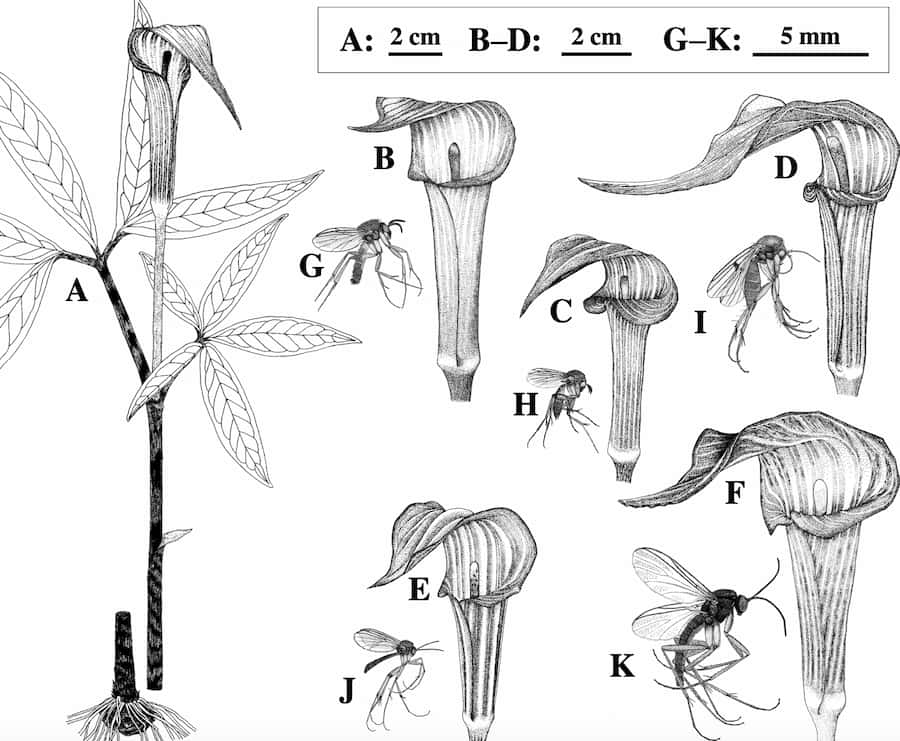



Fungus gnats might not be a glamorous group of insects but they are important pollinators, especially attracted to plants with dark red flowers. Not much is known about their pollination behaviour and plant species-specificity as they are especially hard to observe in the field. Plants with pitchers, however, provide an opportunity to study the trapped pollinators.
Dr Tetsuya Matsumoto and colleagues from Okayama University and Center for Biodiversity, Forestry and Forest Products Research Institute investigated three pollination barriers (geography, time, pollinator species) amongst five Arisaema species along an altitudinal gradient at a Japanese skiing resort. Fungus gnats were the main pollinators of the five species and all reproductive barriers were strong, making these plant-pollinator interactions highly vulnerable to habitat disturbances. Dr Matsumoto recently found that an Arisaema species that can reproduce via clonal propagation could persist more in an intensively grazed plot than a sexually-reproducing Arisaema species.
Matsumoto and colleagues surveyed over 1,000 plants belonging to five Arisaema species (A. maekawae, A. angustatum, A. peninsulae, and A. pseudoangustatum var. pseudoangustatum and A. ovale) along an altitudinal gradient ranging between 650 m to >900 m near the Wakasugi Pass. The researchers examined 283 plants every day for over two months, recorded when they were flowering and collected over 2,500 insects from their pitchers. Next, the researchers grew five plants of each species at lower and higher altitudes to experimentally test what insects pollinate them at the two locations. After two years, the scientists calculated the Reproductive Isolation (RI) between different species based on shared and unshared reproductive opportunities (i.e., habitat elevation, flowering days, and pollinator).
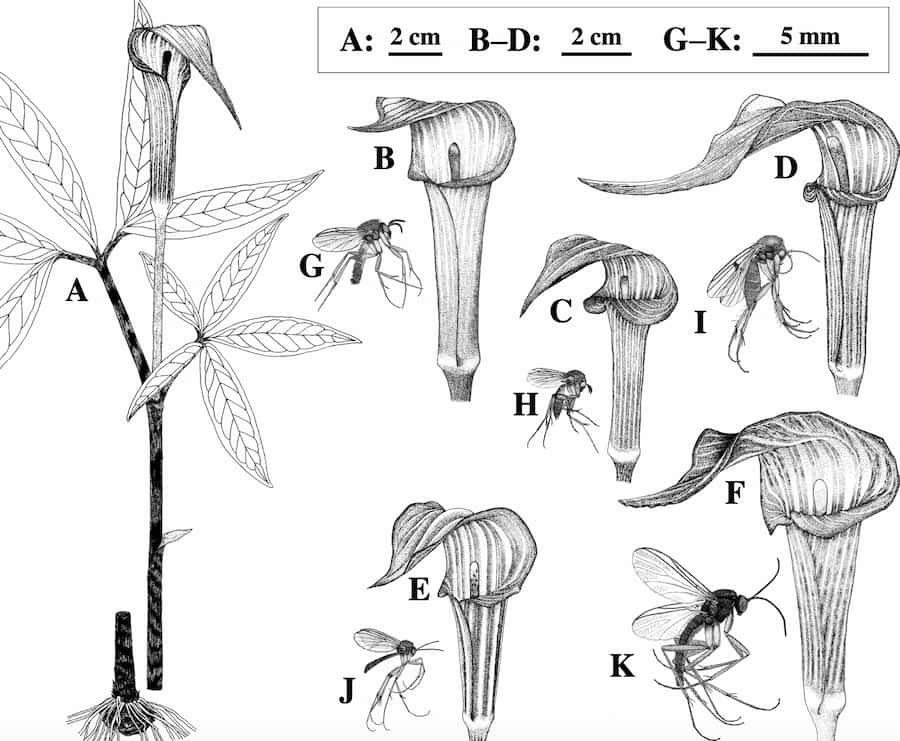
The researchers found strong geographic, phenological and pollinator reproductive isolations between the five Arisaema species during field observations and experiments. Three species were mainly found in low-altitude areas (660-910 m), whilst A. pseudoangustatum was endemic to high-altitude areas (810–1,083 m). A. maekawae began flowering ahead of the other four species and the five species were visited by different species of fungus gnats and a few other insects.

This is the first study to study the pre-pollination reproductive barriers of Arisaema species that are pollinated by such small insects. Understanding how the location, flowering time and pollinator specificity impact the reproduction of these plants can help with better habitat management.
“Despite the high strength of pollinator isolation, its absolute contribution to total reproductive isolation was smaller than that of geographic and phenological isolations,” Matsumoto and colleagues wrote.
“Our results suggest that these habitat disturbances not only may bring about the decline of fungus gnats, but also have unpredictable effects on plant species diversity,”
Hence, is important to monitor pollinator and plant populations. Whilst the female and male flowers did not appear to be pollinated by different species, the common Jack-in-the-pulpit(Arisaema triphyllum) can change from a female to a male plant. Whilst fungus gnats can escape from the male plant pitchers through a hole, the pollinators get trapped within the female flower.