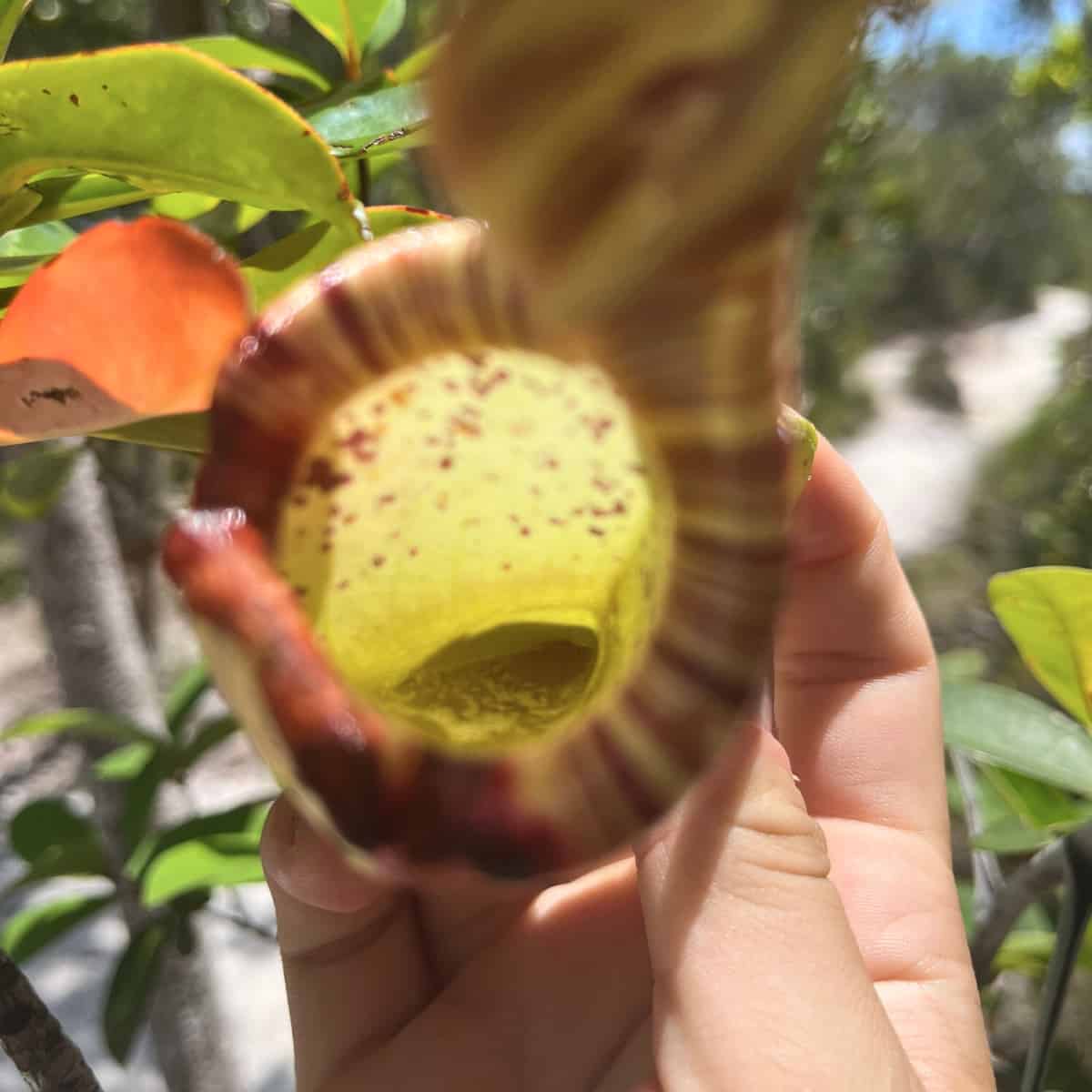



The carnivorous pitcher plant Nepenthes rafflesiana must maintain its fluid levels no matter the weather. These digestive fluids are vitally important to the capture and breakdown of the plant’s prey, and now, for the first time, scientists publishing in the Annals of Botany have shown that N. rafflesiana has the ability to regulate pitcher fluid volume in response to field conditions such as flooding during heavy rains and evaporation under dry conditions.
By regulating pitcher fluid levels in this way, the plants can maintain and optimise their prey capture success in the face of changing weather.
“This active control is a previously unrecognized pitcher plant adaptation to their exposed habitats,” write Andrew et al in Annals of Botany. “Pitchers actively maintain an intermediate fluid level by regulating it through the secretion and absorption of water.”
To test whether pitcher plants can regulate their fluid levels, Andrew et al studied the upper pitchers of N. rafflesiana in its native habitat of Brunei, Northern Borneo. They measured the natural fluctuations of the pitcher fluid levels and their effects on prey capture success as well as the effect of pitcher age on fluid level.
“To test the capacity of plants to respond to changes in fluid level, we experimentally simulated flooding by adding water to pitchers and simulated evaporation by replacing the contents with a smaller volume of concentrated pitcher fluid,” write Andrew et al. “To measure trapping efficiency, a colony of Polyrhachis triaena ants (a common prey of N. rafflesiana) was collected at the study site.”
Andrew et al found that newly opened pitchers were consistently filled about halfway, but that the fluid levels fluctuated with the weather, increasing under wet conditions and decreasing under dry conditions. But, changes in volume were significantly less in the pitchers than in water-filled control vials, meaning the plants actively regulate volume, and presumably do so because of an advantage when capturing prey.
To measure the effect of volume on prey capture efficiency, a pitcher was removed from its plant and placed into a container with a P. triaena ant colony. Andrew et al then sequentially adjusted the pitcher’s volume from 25% to50%, 75% and 95% of capacity, while allowing the ants to roam freely over the pitcher and fall in. At each percentage level, Andrew et al monitored how many of 20 ants could escape the pitcher within 10 minutes.
Both low and very high fluid levels were detrimental to prey capture, with intermediate fluid levels yielding the highest trapping rate.
“When the fluid level was low, we observed that many ants fell into the pitcher but landed on the dry pitcher walls and were then able to climb back to safety,” write Andrew et al. “In contrast, when pitchers were nearly full, we observed that several ants hauled themselves horizontally onto the peristome [rim] and managed to escape.”
Andrew et al suggest that the advantages to maintaining intermediate fluid levels go beyond escape prevention. Changes in fluid concentration due to dilution or increased concentration would likely have a negative impact on thevarious bacteria and arthropods that live in the fluid and help break down larger prey. And so, maintaining a stable environment for these symbiotic species would be beneficial to the pitcher plant’s digestion.
However, as the pitcher ages, Andrew et al showed that it loses its ability to efficiently regulate fluid level. Intermediate fluid levels, which are ideal for prey capture, are maintained by a combination of water secretion and absorption, but older pitchers are less able to secrete fluid.
“This diminished fluid secretion might be related to the lower prey capture in older pitchers of N. rafflesiana,” write Andrew et al. “Fluid level control might be less crucial in this phase, when pitchers primarily extract nutrients.”
Finally, Andrew et al found that pitcher morphology and gland-mediated fluid transport are important to maintaining fluid level. In particular, the lid is useful in reducing the amount of rainfall that enters the pitcher. Also, the pitcher shape is likely optimised to minimise evaporation and rain collection. Plus, the pitchers are able to dynamically secrete and absorb fluid, likely via multicellular digestive glands on their inner surface using an ion pumping mechanism.
By combining dynamic fluids with all the other deadly tools at its disposal, Nepenthes rafflesiana can set the perfect trap for dinner.
The carnivorous pitcher plant Nepenthes rafflesiana must maintain its fluid levels no matter the weather. These digestive fluids are vitally important to the capture and breakdown of the plant’s prey, and now, for the first time,scientists publishing in the Annals of Botany have shown that N. rafflesiana has the ability to regulate pitcher fluid volume in response to field conditions such as flooding during heavy rains and evaporation under dry conditions.
By regulating pitcher fluid levels in this way, the plants can maintain and optimise their prey capture success in the face of changing weather.
“This active control is a previously unrecognized pitcher plant adaptation to their exposed habitats,” write Andrew et al in Annals of Botany. “Pitchers actively maintain an intermediate fluid level by regulating it through the secretion and absorption of water.”
To test whether pitcher plants can regulate their fluid levels, Andrew et al studied the upper pitchers of N. rafflesiana in its native habitat of Brunei, Northern Borneo. They measured the natural fluctuations of the pitcher fluid levels and their effects on prey capture success as well as the effect of pitcher age on fluid level.
“To test the capacity of plants to respond to changes in fluid level, we experimentally simulated flooding by adding water to pitchers and simulated evaporation by replacing the contents with a smaller volume of concentrated pitcher fluid,” write Andrew et al. “To measure trapping efficiency, a colony of Polyrhachis triaena ants (a common prey of N. rafflesiana) was collected at the study site.”
Andrew et al found that newly opened pitchers were consistently filled about halfway, but that the fluid levels fluctuated with the weather, increasing under wet conditions and decreasing under dry conditions. But, changes in volume were significantly less in the pitchers than in water-filled control vials, meaning the plants actively regulate volume, and presumably do so because of an advantage when capturing prey.
To measure the effect of volume on prey capture efficiency, a pitcher was removed from its plant and placed into a container with a P. triaena ant colony. Andrew et al then sequentially adjusted the pitcher’s volume from 25% to50%, 75% and 95% of capacity, while allowing the ants to roam freely over the pitcher and fall in. At each percentage level, Andrew et al monitored how many of 20 ants could escape the pitcher within 10 minutes.
Both low and very high fluid levels were detrimental to prey capture, with intermediate fluid levels yielding the highest trapping rate.
“When the fluid level was low, we observed that many ants fell into the pitcher but landed on the dry pitcher walls and were then able to climb back to safety,” write Andrew et al. “In contrast, when pitchers were nearly full, we observed that several ants hauled themselves horizontally onto the peristome [rim] and managed to escape.”
Andrew et al suggest that the advantages to maintaining intermediate fluid levels go beyond escape prevention. Changes in fluid concentration due to dilution or increased concentration would likely have a negative impact on thevarious bacteria and arthropods that live in the fluid and help break down larger prey. And so, maintaining a stable environment for these symbiotic species would be beneficial to the pitcher plant’s digestion.
However, as the pitcher ages, Andrew et al showed that it loses its ability to efficiently regulate fluid level. Intermediate fluid levels, which are ideal for prey capture, are maintained by a combination of water secretion and absorption, but older pitchers are less able to secrete fluid.
“This diminished fluid secretion might be related to the lower prey capture in older pitchers of N. rafflesiana,” write Andrew et al. “Fluid level control might be less crucial in this phase, when pitchers primarily extract nutrients.”
Finally, Andrew et al found that pitcher morphology and gland-mediated fluid transport are important to maintaining fluid level. In particular, the lid is useful in reducing the amount of rainfall that enters the pitcher. Also, the pitcher shape is likely optimised to minimise evaporation and rain collection. Plus, the pitchers are able to dynamically secrete and absorb fluid, likely via multicellular digestive glands on their inner surface using an ion pumping mechanism.
By combining dynamic fluids with all the other deadly tools at its disposal, Nepenthes rafflesiana can set the perfect trap for dinner.
READ THE ARTICLE
Andrew, C.N.S., Bu, J.Y., Kelly, N.S., Johnson, S., Metali, F., Grafe, T.U., Bauer, U. and Federle, W. (2025) “An insect trap adjusting to weather conditions: Nepenthes rafflesiana plants control the fluid level in their pitchers to maximise prey capture,” Annals of Botany, (mcaf294). Available at: https://doi.org/10.1093/aob/mcaf294
Cover image: Nepenthes rafflesiana in Malaysia by kaylrow / iNaturalist CC-BY-NC