


Orchids are a diverse group of over 31 000 species, with a few of these species found as common houseplants. According to the Cornell Cooperative Extension, the Phalaenopsis orchid, also commonly called the “moth orchid”, is a popular choice because it is easy to grow indoors. This type of orchid is commonly found in stores.
But orchids are not just popular houseplants. Researchers have been using them to study evolution since the 1800s. According to Dr John Freudenstein at Ohio State University, who recently wrote a review of orchid evolution in the Annals of Botany, “Orchidaceae are one of the two largest families of angiosperms; they exhibit a host of changes – morphological, ecological and molecular – that make them excellent candidates for evolutionary study.”
Most orchid species (about 70%) are from the tropics and are epiphytic, meaning they grow on other plants for structural support but are not parasitic. Typically, they grow on trees of tropical forests, placing them in a warm and humid shade. The Cornell Cooperative Extension recommends replicating these conditions for Phalaenopsis by providing “low light, warm temperatures, moist growing mix, and high humidity.” An east or west facing window is also recommended and direct sunlight should be avoided. Nighttime temperatures should be above 15°C and daytime temperatures below 30°C.
The challenge with orchid care in some home environments, particularly those that experience winter or live in dry climates, is maintaining good humidity (40-60%) around the plant. Epic Gardening recommends filling a saucer with pebbles and water and then placing the orchid’s pot on top of the pebbles, making sure the bottom of the pot does not touch the water. This arrangement allows the plant to be surrounded by evaporating water, and consequently humid air, without exposing the roots directly to constant water which causes root rot.
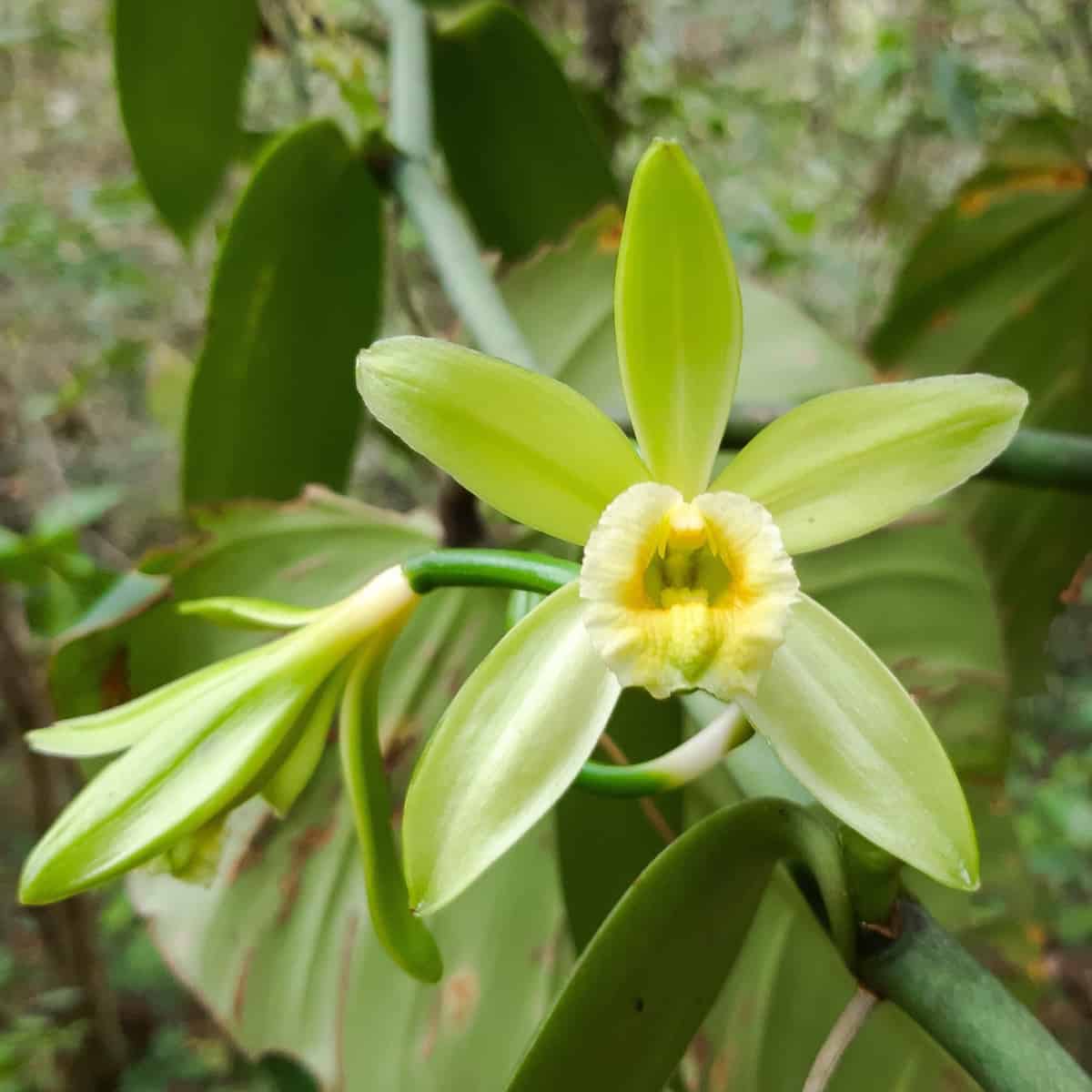
A well-treated orchid will reward you with beautiful floral displays and even scents, if you get a vanilla bean orchid. Vanilla planifolia which is native to Mexico, Central America, Columbia and Brazil is used in commercial vanilla production and will display yellow flowers with a delicate vanilla scent. But it is harder to grow as a household plant than Phalaenopsis. According to the Spruce, the vanilla orchid requires filtered shade and a high humidity of at least 80%. Also, a higher daytime temperature of 35°C is tolerated. This mix of high humidity and temperature make the plant more suited to very humid climates or glasshouses.
Unfortunately, even the best cared for vanilla orchid is unlikely to yield homegrown vanilla beans. The natural pollinator of vanilla orchid is still unknown and even in commercial production the crop is hand pollinated by toothpick, according to a recent publication in MDPI by Van Dyk et al.
Should you be bold enough to attempt vanilla bean production, you should know that “flowers of V. planifolia bloom for only one day, opening early in the morning and must be hand-pollinated the same day before they close in the afternoon,” according to Van Dyk et al. Furthermore, self-pollination is not possible in some vanilla orchid varieties and flowers must be cross-pollinated.
If you are successful, then congratulations are in order. You will have produced a fruit beloved by humans and many other mammals including monkeys. In a recent study in Plant Biology (Stuttgart) by Dr. Emerson Pansarin, the black-tufted marmoset (Callithrix penicillata) was for the first time identified as an abundant seed disperser of Vanilla pompona in Brazil. The marmoset opens the vanilla seed pod at the fruit dehiscent valve to eat the seeds, leaving the toxic fruit wall uneaten, and enjoys a deliciously fragrant snack.
Cover image: Vanilla planifolia in Nicaragua by Ariel Salinas Seq / iNaturalist CC-BY-NC