


Selecting the right cultivars and planting dates are two critical decisions that soybean growers must make each year. To help address this challenge, a new user-friendly interactive decision support tool called CRONOSOJA has been developed for soybean growers in in the Southern Cone.
While numerous decision support tools exist for soybean growers in the United States, such resources are relatively scarce for South American countries. CRONOSOJA aims to fill this gap by providing South American soybean growers, particularly in Argentina, Paraguay, and Uruguay, with the necessary guidance to make informed cultivar and planting date choices.
The CRONOSOJA web-based tool is designed to assist growers in identifying the ideal planting date based on their chosen cultivar and field location. This is particularly important in this South American region, where the common practice of double-cropping soybeans with wheat or barley often forces growers to plant outside of the optimal planting windows.
Dr Alan Severini, former researcher at Instituto Nacional de Tecnología Agropecuaria, Argentina and current postdoctoral researcher at University of Queensland, Australia led a team that developed and tested the model behind this tool. This work is described in a new article published in in silico Plants.
The researchers developed 34 individual genotype-based models through extensive fieldwork. They then created a hierarchical model by unifying these 34 models across different genotypes and maturity groups.
Maturity groups are a classification system that categorizes crop genotypes (varieties/cultivars) based on time to maturity.
Severini explains the advantage CRONOSOJA has over more complex models like DSSAT and APSIM.
“By leveraging the maturity group classification framework, model users can acquire information about genotypes beyond the original 34 studied, creating a more comprehensive and generalizable model. DSSAT and APSIM, on the other hand, are parameterized for specific cultivars and therefore require adjustments for each new plant variety. This approach reduces the likelihood of overfitting, which makes it better at predicting outcomes in varying environments and for different plant types.”
Overfitting is when a model performs extremely well on the training data, but fails to generalize well to new, unseen data.
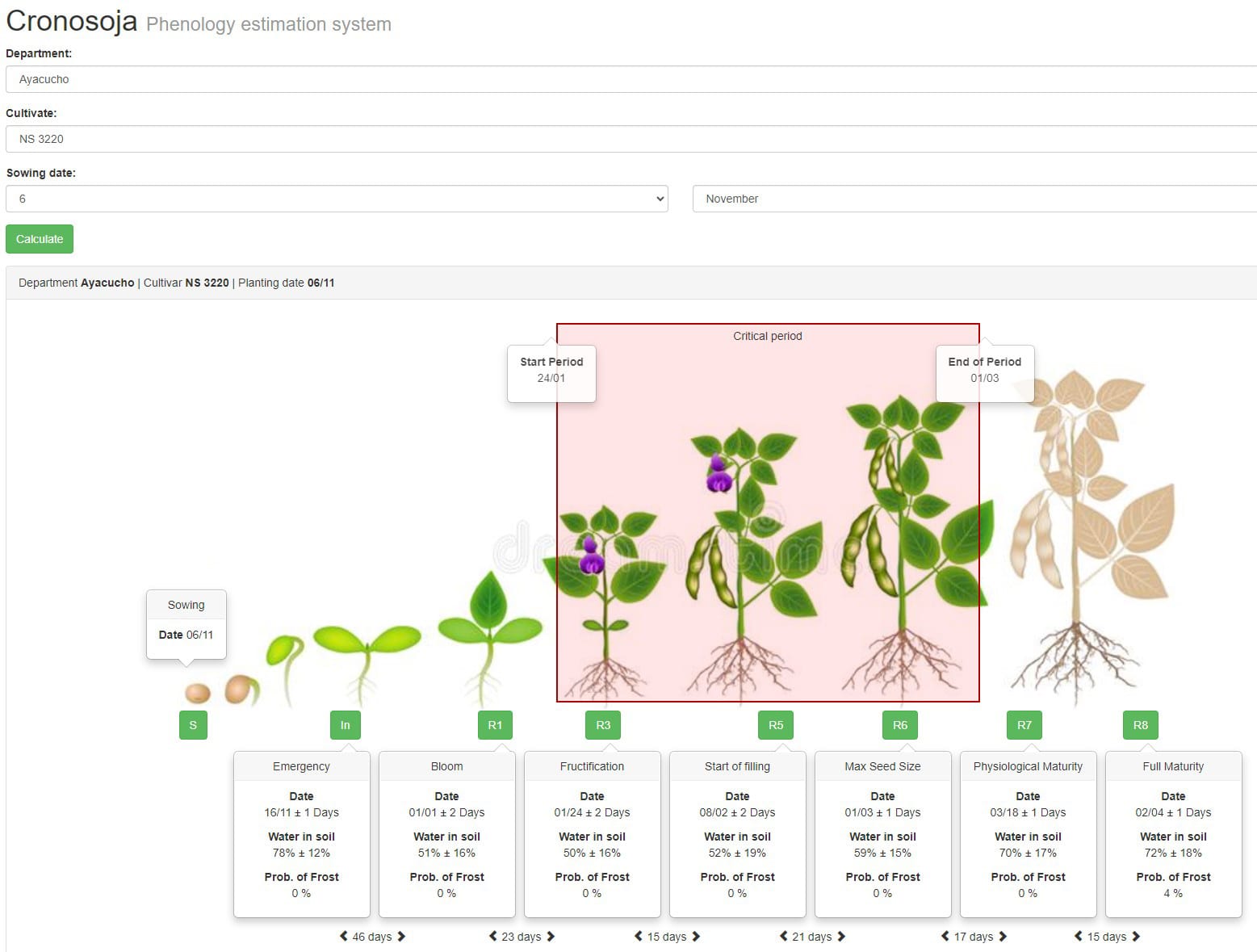
The CRONOSOJA website-based tool allows users to choose a given location, then select from 34 different soybean cultivars representing 7 maturity groups to see how these variables affect development.
The model is based on the predictable development of soybean and its dependance temperature and photoperiod. One key factor growers use to select cultivars is the duration of each developmental stage, and therefore time to maturity.
This variation in the development time of different genotypes is incorporated into the model. While a longer time to maturity is related to higher yield due to greater vegetative growth, it is important that plants mature before the first frost occurs. The model includes probability of frost, providing growers with insights on the optimal cultivar and planting date for their specific location.
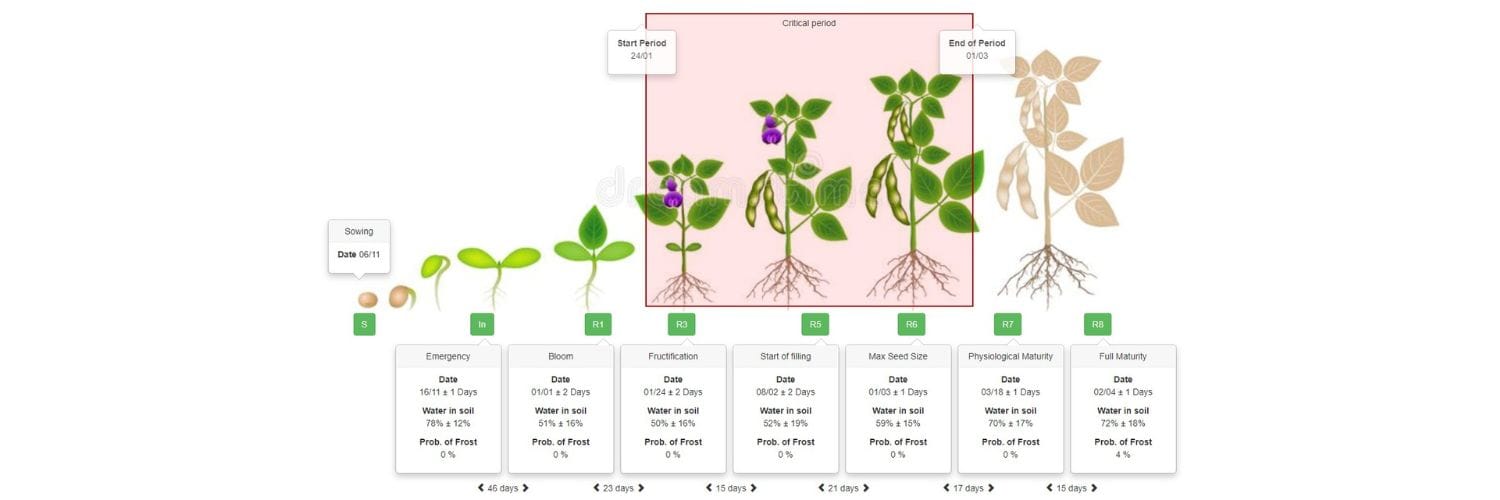
The tool also includes soil water content. Water availability is a particularly critical factor during the pod formation and early seed filling stages of soybean development. The decision support tool highlights this ‘critical period’ for users, as it is a key consideration in selecting the appropriate soybean genotype and sowing date.
In addition to serving as a practical decision-making aid for growers, this tool can also be leveraged as a valuable teaching resource. The model’s comprehensive dataset and visualization capabilities make it well-suited for use in educational settings. Instructors in agronomy, crop science, and related fields can utilize the tool to demonstrate key concepts around soybean phenology, environmental factors influencing crop development, and the decision-making process for optimizing planting strategies.
READ THE ARTICLE:
Alan D Severini, Santiago Álvarez-Prado, María E Otegui, Monika Kavanová, Claudia R C Vega, Sebastián Zuil, Sergio Ceretta, Martín Acreche, Fidencia Amarilla, Mariano Cicchino, María E Fernández-Long, Aníbal Crespo, Román Serrago, Daniel J Miralles, CRONOSOJA: a daily time-step hierarchical model predicting soybean development across maturity groups in the Southern Cone, in silico Plants, Volume 6, Issue 1, 2024, diae005, https://doi.org/10.1093/insilicoplants/diae005