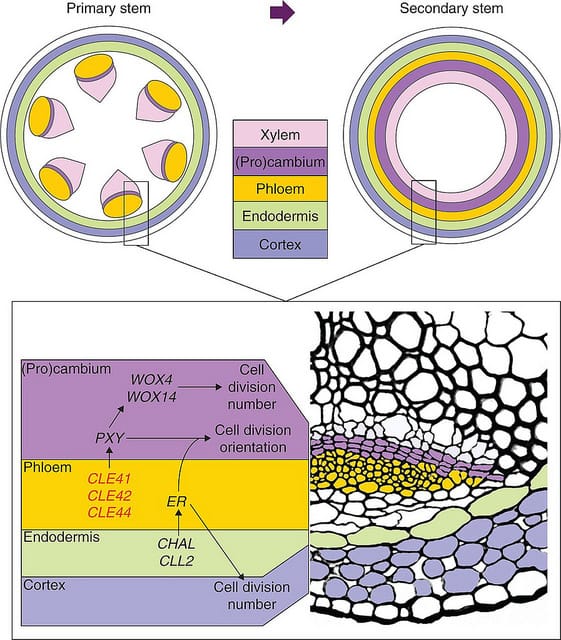




Omics and modelling approaches for understanding regulation of asymmetric cell divisions in Arabidopsis and other angiosperm plants
Asymmetric cell divisions are formative divisions that generate daughter cells of distinct identity. These divisions are coordinated by either extrinsic or intrinsic regulatory mechanisms and are fundamentally important in plant development. This review describes how asymmetric cell divisions are regulated during development and in different cell types in both the root and the shoot of plants and highlights ways in which omics and modelling approaches have been used to elucidate these regulatory mechanisms.
Stomatal and pavement cell density linked to leaf internal CO2 concentration
Stomatal density (SD) generally decreases with rising atmospheric CO2 concentration (Ca). However, SD is also affected by light, air humidity and drought, all under systemic signalling from older leaves. This makes our understanding of how Ca controls SD incomplete. This study tests the hypotheses that SD is affected by the internal CO2 concentration of the leaf, Ci, rather than Ca, and that cotyledons, as the first plant assimilation organs, lack the systemic signal.
Dinitrogen fixation associated with shoots of aquatic carnivorous plants: is it ecologically important?
Rootless carnivorous plants of the genus Utricularia are important components of many standing waters worldwide, as well as suitable model organisms for studying plant–microbe interactions. In this study, an investigation was made of the importance of microbial dinitrogen (N2) fixation in the N acquisition of four aquatic Utricularia species and another aquatic carnivorous plant, Aldrovanda vesiculosa.