
Until this item, the last launch of a new plant journal I shared with you was for the august publication Nature Plants (although in its 3rd year of publication, it still awaits an Impact Factor. Will it get one before before such metrics are considered dead? Nigel wrote this quite a bit in advance, Jeffrey Ross-Ibarra has pointed out that Nature Plants does have an Impact factor now /Alun). Now, two more academic journals can be added to the list of plant-based periodicals.

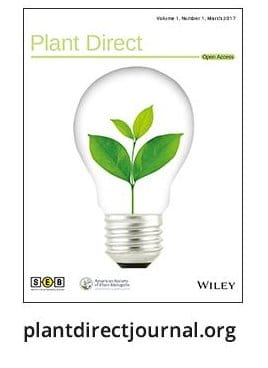
First is Plant Direct, which is open access [i.e. it’s free to read and download the articles, but a fee is charged to publish your article in the journal…] and covers such topics as genetics, biochemistry, development, cell biology, biotic stress, abiotic stress, genomics, phenomics, bioinformatics, physiology, molecular biology, and evolution. In determining the publication-worthiness of a manuscript it intends to apply the test of “sound science”, i.e. NOT on the basis of novelty or impact of the paper. This is refreshing, and arguably a more egalitarian approach than that of those novelty-fixated journals. And, in a plant-community-inclusive way, the plant science community was invited to contribute ideas to shape the editorial policies of the journal. You can read Plant Direct‘s first article(s) here.
Plant Direct is published by Wiley in collaboration with the Society for Experimental Biology (SEB, which publishes plant-based journals The Plant Journal, Journal of Experimental Botany, and the Plant Biotechnology Journal) and the American Society of Plant Biologists (ASPB, which already publishes high profile botanical journals The Plant Cell and Plant Physiology).
The second new arrival is Phytobiomes Journal, another open-access journal, published by The American Phytopathological Society (APS, which also publishes Phytopathology, plant disease, and Molecular Plant-Microbe Interactions (MPMI). Phytobiomes Journal is a “transdisciplinary journal of original research on organisms and communities interacting with plants in any ecosystem. It includes the fundamental to translational work of scientists in the areas of microbiology, virology, nutrient cycling, climate change, ecology, agronomy, entomology, computational biology, nematology, plant pathology, and more.”
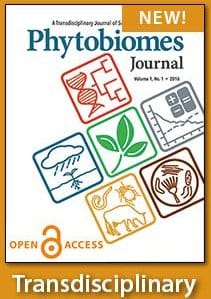
Phytobiomes Journal is the research publishing facet of the phytobiomes initiative, whose ‘Roadmap’ “offers a new vision for agriculture in which sustainable crop productivity is achieved through a systems-level understanding of diverse interacting components”. This holistic approach and mission is further supported by the Phytobiome Alliance, “an industry-academic collaborative initiative focused on building a phytobiome-based foundation for accelerating the sustainable production of food, feed, and fiber [sic.]”. Life-affirming, planet-sustaining ideals – which are sorely needed in a Paris-depauperate, post-Trump world.
More plant journals can surely only be good news for Botany (and for our plant-dependent people and planet…), and we wish Plant Direct and Phytobiomes Journal well.
[Ed. – From two newly-created journals to an old and venerable one that will be celebrating its 200th anniversary in 2018. Marking that historic landmark, publisher Elsevier has made all content in Flora free access until March 2020.]
Image credits: Plant Direct cover, Phytobiomes Journal cover.