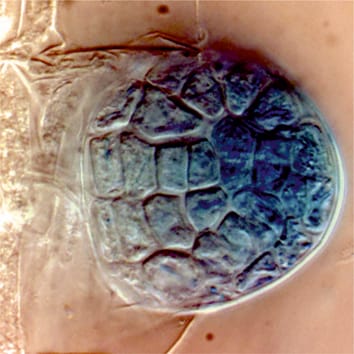



The crucial role of roots in plant nutrition, and consequently in plant productivity, is a strong motivation to study the growth and functioning of various aspects of the root system. Numerous studies on lateral roots mostly focus on the physiological and molecular bases of developmental processes. Unfortunately, little attention is paid either to the morphological changes accompanying the formation of a lateral root or to morphological defects occurring in lateral root primordia. The latter are observed in some mutants and occasionally in wild-type plants, but may also result from application of external factors.
A recent free review article in Annals of Botany discusses morphological aspects of lateral branching in roots are analysed, examining studies that have looked at developmental changes in lateral root morphology in order to understand better the process of lateral root development.
Our knowledge of the molecular bases of lateral root initiation and development has increased rapidly within recent decades. Building on these advances, we may try to widen our knowledge of the probable relation between auxin and root system morphology, based in part on the auxin-related mutants whose root growth and development are altered in comparison with wild-type plants. Yet it is important to remember that, as a physical object, the lateral root (as well as other plant organs) also has characteristic physical properties. A change of form of such an object implies either a change in the distribution of mechanical stress or a change in mechanical properties. Direct measurement of both of these remains a challenge, mostly because of technical difficulties. However, the few reports examining the mechanical parameters of tissues of roots show that no challenge in science is so great that it is not taken up.