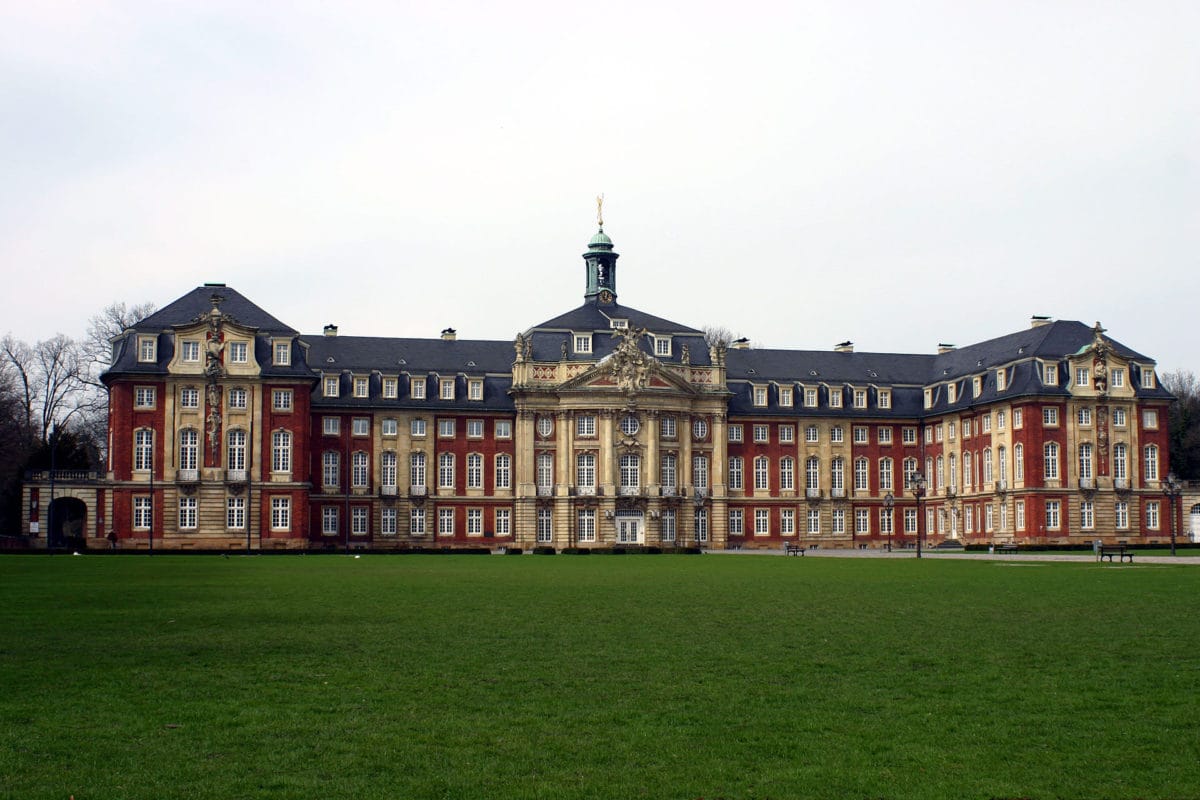


Calcium ions (Ca2+) are important signal molecules to relay information around, and between cells. In plants, calcium signals are involved in many processes including cell growth, environmental stress (e.g. high salt in soil) responses, and defence against disease-causing microbes. Last week, many of the researchers studying calcium signals in plants gathered together at the Plant Calcium Signalling 2014 meeting in Münster, Germany.

I really enjoyed the meeting. It was great to hear about the current research being undertaken by others, and to see how much the research area has moved forward since the previous meeting was held in 2010. Lots of exciting research was presented at the conference, but I’m just going to mention a few of my favourites.
Long-distance calcium waves in plant roots were discussed from the perspective of a biologist (Simon Gilroy, University of Wisconsin), and then a physicist (Matthew J Evans, John Innes Centre). Gilroy’s research group found that treating plant roots with salt (NaCl) activates rapid calcium (Ca2+) waves that travel at speeds of around 400 µm/s from root to shoot (1). High salt levels can be harmful to plants and the calcium wave is likely to be involved in activation of whole-plant stress responses that help the plant survive in these conditions. In the video below the wave is visible as a colour change from yellow (low calcium ion levels) to red (high calcium ion levels).
Evans then presented the mathematical model he is developing based on Gilroy’s biological data. Although the model is a simplification of what would be happening in a plant, it matches the current biological data pretty well. Using the model, it is possible to make predictions that Gilroy’s research group can now test in plants.
Calcium signals are sensed by calcium-binding proteins that then activate/inactivate downstream responses in cells. There are loads of calcium-binding proteins in plants, grouped into several types. Why plants need so many calcium-binding proteins is a bit of a mystery. At the meeting, Jürg Kudla (WWU Münster, Germany) presented data that may help to answer this question. He found that two calcium-binding proteins from different families act synergistically to activate a downstream cell response. Although both proteins could activate the response on their own, a much higher level of activation was achieved when both were present.
Researchers have access to several tools to visualise calcium signals in cells. Melanie Krebs (University of Heidelberg) discussed her work adapting the GECO calcium sensors, which were first developed for use in animal cells (2), for expression in various locations within plant cells. The GECOs are more sensitive than other calcium reporters such as Cameleon YC3.6. Krebs demonstrated that they could be used to visualise some calcium changes in individual cells that have only previously been observed at the whole plant/organ level.
My two other favourite talks were about the roles of calcium in plant development. José Feijo (University of Maryland) discussed the role of calcium in pollen tube growth during fertilisation. Straight after, Alex Webb (University of Cambridge) presented his research on the role of calcium in the circadian clock, which is the internal clock plants have to co-ordinate their growth and metabolism with the day-night cycle. Alongside all the talks, the conference had poster sessions where researchers could discuss their work on a more informal basis.
The meeting was a really useful opportunity for the plant calcium signalling research community to get together and I would like to thank the organising committee for all the hard work they put into running it.
References
1) Choi et al (2014) Salt stress-induced Ca2+ waves are associated with rapid, long-distance root-to-shoot signalling in plants. PNAS. PMID: 24706854
2) Zhao et al (2013) An Expanded Palette of Genetically Encoded Ca2+ Indicators. PubMed Central. PMID: 21903779