

During the development of different plant organs, they may turn 180°, causing them to be upside down. This process – known as resupination – is present in fourteen plant families, including orchids. Although the physiological mechanisms for this process have been extensively described, the recent study by Cardoso and colleagues adds gravity as an additional driver of resupination and highlights that this flip helps insects land on them properly for pollination.
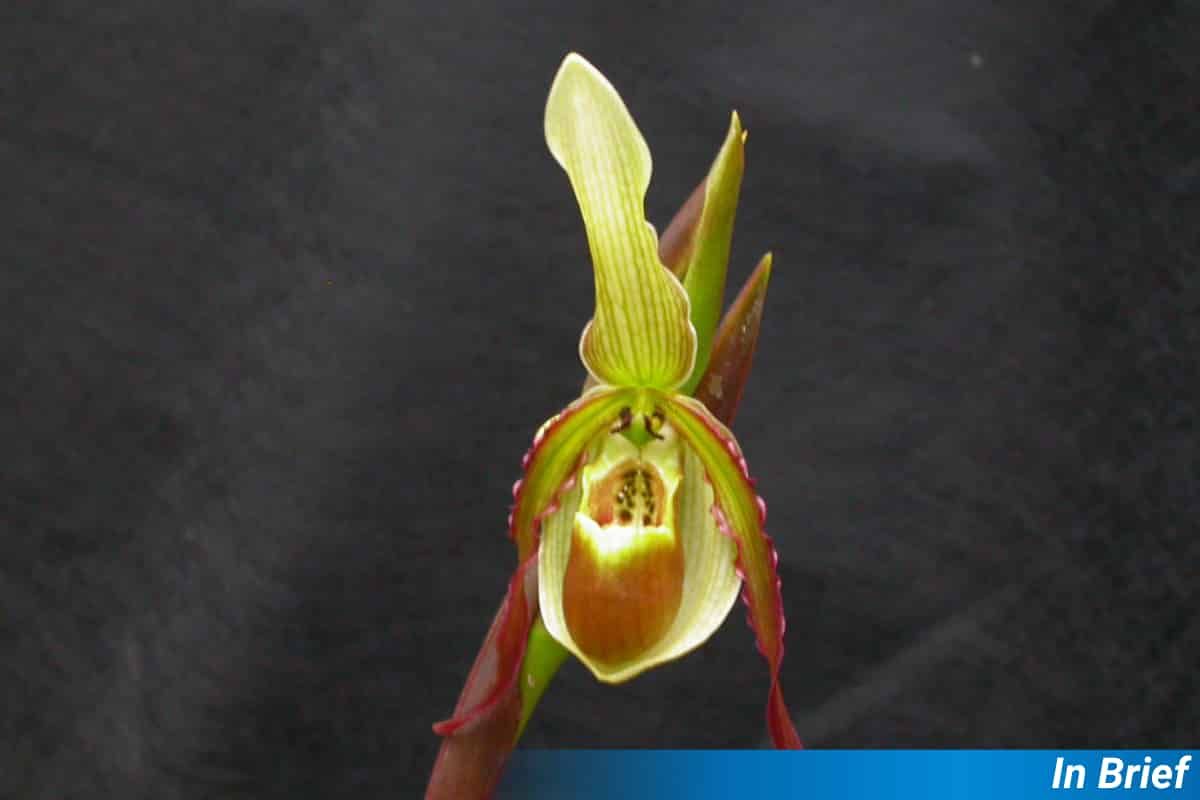
The team experimented with a population of Phragmipedium vittatum orchids, which presented individuals with flowers with different levels of resupination, from non-twisted to entirely upside-down. They compared the weight of the different flower types and their flower parts. If gravity was responsible for their twisting, they expected heavier flowers to have a higher probability of being resupinated, with heavier flower parts contributing more to this process.
The researchers discovered that as flowers grow heavier before opening, their weight creates a turning force that helps complete the flip. The pouch-shaped lower labellum is particularly important in this turning: being the heaviest part, it acts like a pendulum weight pulling the flower downward. Such an orientation seems key for pollination, as it makes reproductive organs accessible for pollinators.
While previous research has shown the physiological processes that control flower turning, this is the first study to prove that passive forces, such as gravity, play a crucial role in getting flowers into their final position. Therefore, the study by Cardoso provides exciting insights into the mechanisms behind flower morphology and its interaction with pollinators.
Cardoso, J.C.F., Johnson, S.D., & Oliveira, P.E. (2024). Flowers meet Newton: testing the role of gravitational pull in resupination of orchid flowers. Journal of Experimental Botany. https://doi.org/10.1093/jxb/erae413 ($)
Cross-posted to Bluesky, Mastodon & Threads.
Cover image: Phragmipedium vittatum by Dalton Holland Baptista – Own work, CC BY-SA 3.0, Link