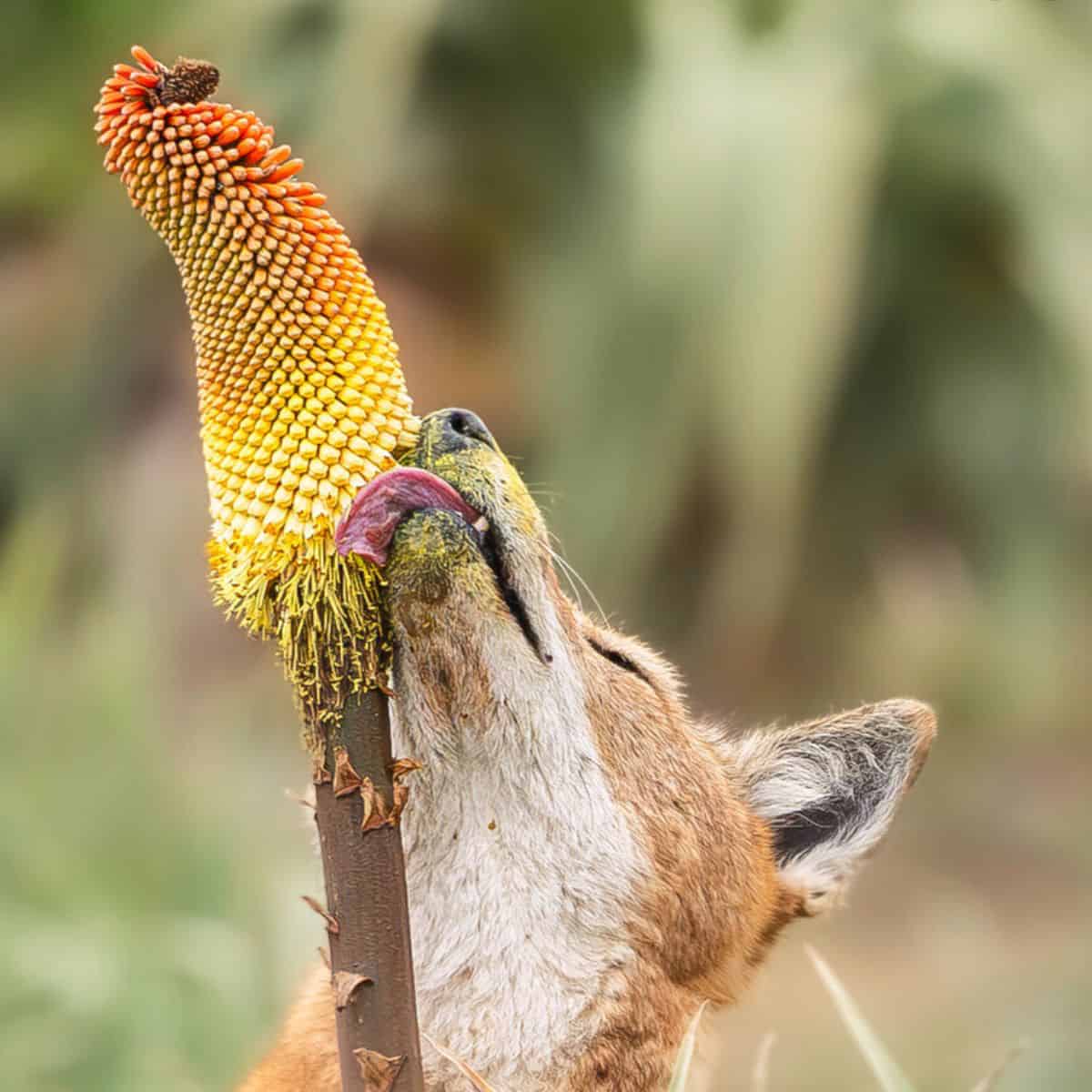



When you think of wolves, you likely picture fierce predators stalking their prey. However, in the high-altitude grasslands of Ethiopia’s Bale Mountains, the endangered Ethiopian wolf has been observed doing something completely unexpected: sipping nectar from flowers. This surprising discovery suggests a new role for these predators—not only as hunters but also as potential pollinators.
The Ethiopian wolf is primarily known for feeding on rodents in the high-altitude grasslands of Ethiopia. However, recent observations have shown that these wolves can also forage for nectar. By feeding on the flowers, the wolves inadvertently pick up pollen on their muzzles, suggesting that they could help in the plant’s reproduction.
But why does this matter? Pollination by non-flying mammals, known as therophily, is a rare and understudied phenomenon. While we don’t yet know how effective the wolves are as pollinators, their involvement highlights the complexity of ecosystems and the surprising ways in which species can interact.
To investigate whether Ethiopian wolves play a role in pollinating plants, Sandra Lai and her team focused on their interactions with Kniphofia foliosa, a flower that grows in the Bale Mountains and produces large amounts of nectar. The team tracked the behaviour of six Ethiopian wolves from three packs.
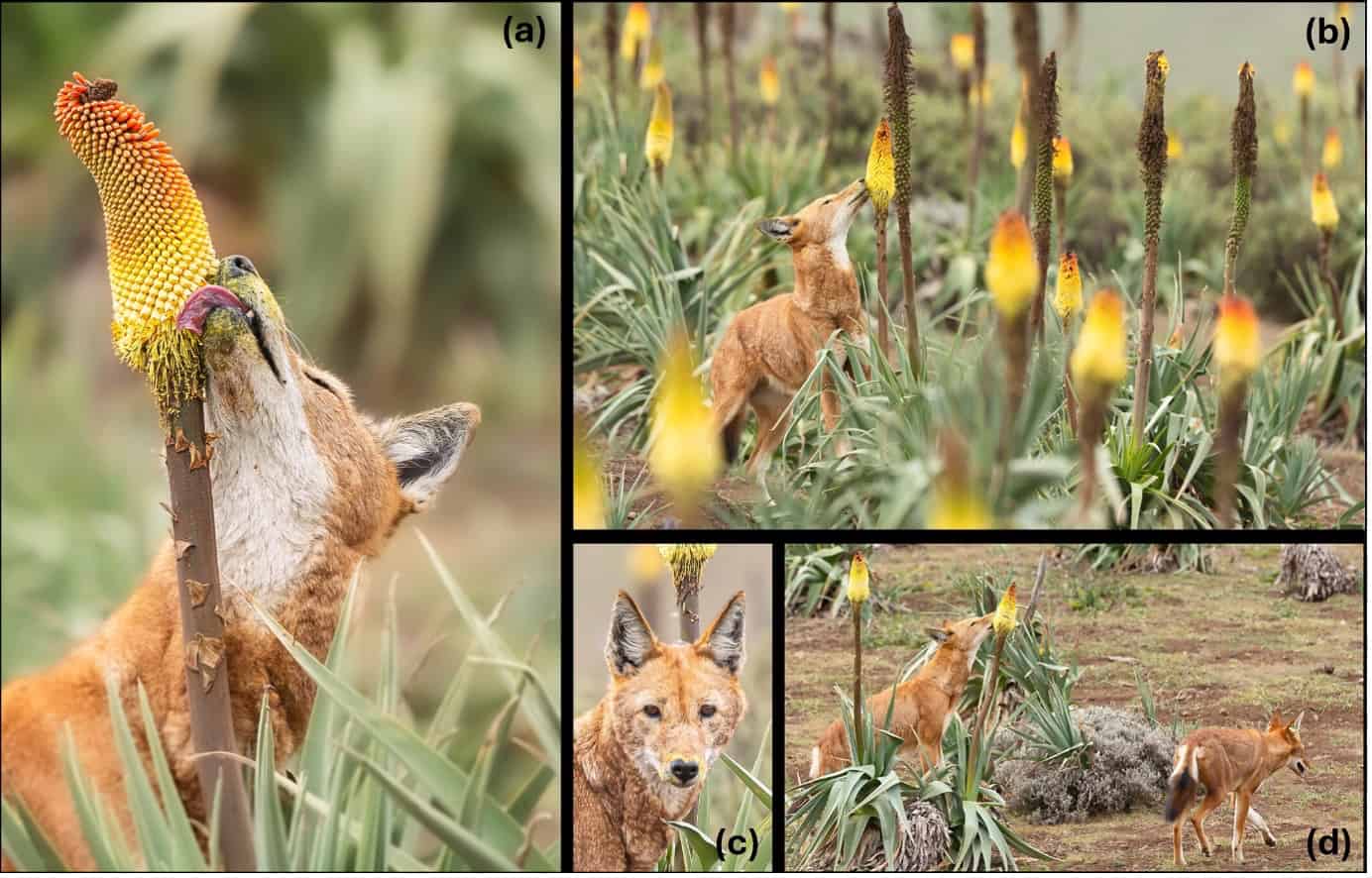
Ethiopian wolves sipping nectar from the flowers of Kniphofia foliosa. Photos from Lai et al. (2024).
Surprisingly, they found that the Ethiopian wolves indeed feed on the nectar of these flowers. However, nectar likely plays only a minor role in the wolves’ diet, with rodents being their main food and where nectar is more like an occasional treat. Moreover, this behaviour was observed across several wolves from different packs, suggesting it is a common practice that may be socially learned. After feeding, the wolves had pollen stuck to their muzzles, indicating they may help transfer pollen between flowers.
This discovery is significant because it is so rare and could have important ecological implications. Although nectar seems to be a small dietary supplement for the wolves, their potential role in pollination is worth considering. Kniphofia foliosa relies on external agents for pollination, as it cannot self-pollinate effectively. Along with birds and insects, the Ethiopian wolf could act as an additional pollinator, helping to maintain local plant populations and facilitate genetic exchange.
However, the effectiveness of wolves as pollinators is still unclear. While they pick up and deposit pollen, it’s not certain whether this consistently leads to successful fertilization. The study also notes that wolves sometimes damage flowers while foraging, which could reduce their potential benefits as pollinators.
These findings open up exciting avenues for future research on this unique plant-animal interaction. Investigating how much Kniphofia foliosa depends on wolves compared to other pollinators and whether this relationship has evolutionary significance could deepen our understanding of pollination dynamics in the Afroalpine ecosystem. The findings also raise intriguing questions about ecological balance and the mutual benefits of these interactions, not just in the Afroalpine region but in other overlooked environments worldwide.
READ THE ARTICLE:
Lai, S., Léandri‐Breton, D. J., Lesaffre, A., Samune, A., Marino, J., & Sillero‐Zubiri, C. Canids as pollinators? Nectar foraging by Ethiopian wolves may contribute to the pollination of Kniphofia foliosa. Ecology, e4470. https://doi.org/10.1002/ecy.4470

Victor H. D. Silva is a biologist passionate about the processes that shape interactions between plants and pollinators. He is currently focused on understanding how plant-pollinator interactions are influenced by urbanisation and how to make urban green areas more pollinator-friendly. For more information, follow him on ResearchGate as Victor H. D. Silva