


Light interception describes how effectively a plant captures sunlight with its leaves. Maximizing this interception is essential for enhancing photosynthesis, which directly influences crop yields. A new study compares the effectiveness of simple, intermediate, and complex models in accurately calculating light interception. By simulating various canopy characteristics and plant architectures over a growing season, the research demonstrates that, despite differences in modeling complexity, the simplest model is sufficient for light interception calculations in maize.
Several factors influence light interception, including:
- leaf optical properties such as color and water content,
- plant architecture such as leaf size, angle, distribution, and shape, and
- environmental conditions such as shading from other plants, cloud cover, and solar angles.
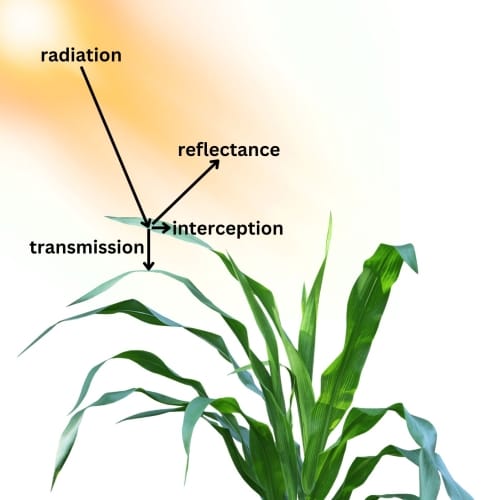
Light that is not intercepted is either reflected off its surface or transmitted through the leaves reaching lower parts of the plant.
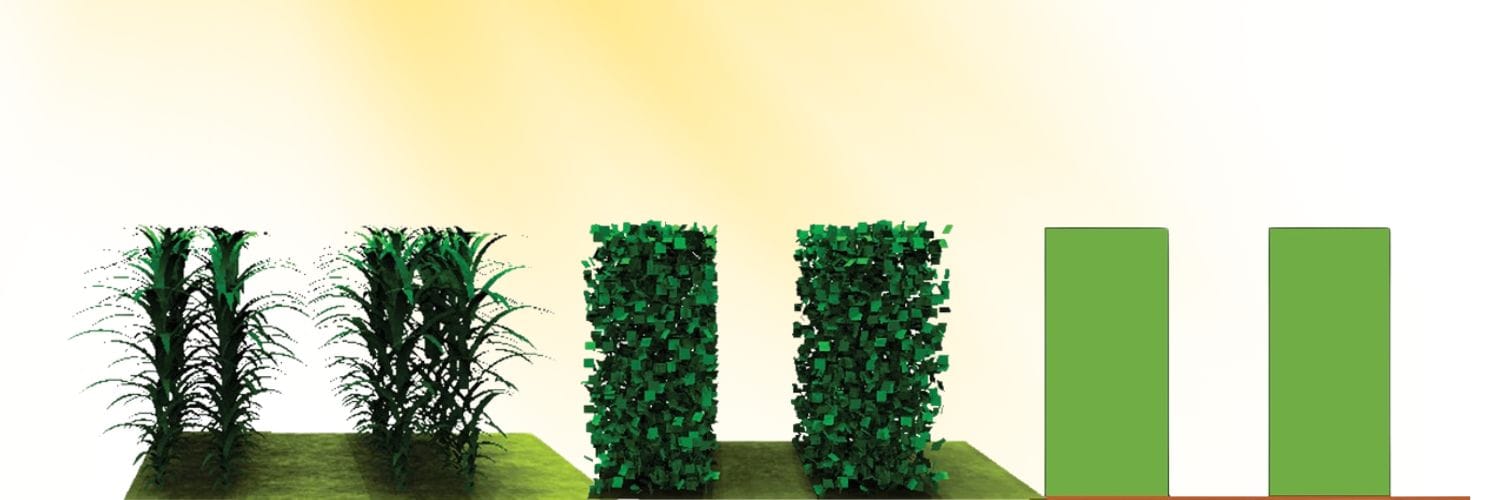
A simple model of light interception that captures key aspects of crop geometry was developed by J. Goudriaan almost 50 years ago and is still widely used today. It represents the rows of the canopy as homogeneous blocks, separated by empty paths. The blocks are characterized by height and width and the amount of leaf material contained in the block volume. The radiation component of the block model, which calculates incoming light, assumes that incoming light originates from a uniform overcast sky and light interception by the block is uniform.
In contrast, functional–structural plant models (FSPMs) represent the rows of the canopy considering the 3D structure, size, orientation and optical properties of individual leaves and stems. The radiation component of the FSPM uses a ray tracing algorithm. It works by tracing the path of light rays in 3D and captures the solar angles as affected by the day of the year, latitude, and time of day.
FSPMs require numerous parameters to be estimated, leading to high data demands and significant computational complexity. In contrast, simpler methods like the block approach are less data-intensive and have much shorter calculation times.
Dr. Shuangwei Li from China Agricultural University and colleagues investigated if the block approach can calculate light interception as accurately as a FSPM.
Because the FSPM and block models used by Dr. Li differed in two key aspects (how they simulate radiation and the canopy), it would be impossible to determine which factors contributed to any differences between their simulated light interception. To determine whether the variations between the FSPM and block model results were due to the radiation component, she created an intermediate model that used ray tracing for the radiation model and block structures for the canopy. Comparing the intermediate model with the FSPM will demonstrate how simplified representations of plants and canopy influence calculated light interception, whereas comparing it with the block model will illustrate the impact of the simplified radiation component on light interception.
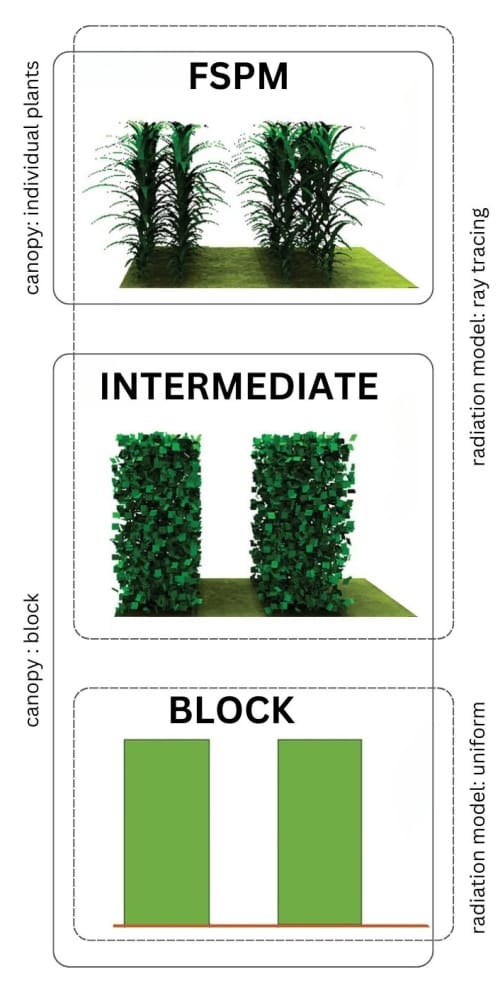
The authors ran simulations using the three models over a growing season, with plant architecture and canopy characteristics like canopy height and leaf density changing daily. The simulations also incorporated daily changes in plant architecture that influence the amount of light absorbed, transmitted or reflected by the canopy. These changes were modeled in detail for the FSPM, with a more general approach for the intermediate model (uniform leaves), while the block model used a fixed value in its calculations.
The authors discovered that although the three models differed in their daily simulations of light interception, the total light interception over the growing season was comparable across all three models. The difference between the Block Model (the simplest approach) and the FSPM (the most complex approach) was only 3.1%.
Despite the simplifying assumptions made in the block model regarding the representation of the canopy and the calculation of light interception, the estimated light interception was close to the estimates made with more complex and realistic models that use ray tracing and 3D representation of plant architecture. These results support the use of the Goudriaan’s block model for calculating light interception in maize in lieu of FSPM.
READ THE ARTICLE:
Shuangwei Li, Wopke van der Werf, Fang Gou, Junqi Zhu, Herman N C Berghuijs, Hu Zhou, Yan Guo, Baoguo Li, Yuntao Ma, Jochem B Evers, An evaluation of Goudriaan’s summary model for light interception in strip canopies, using functional-structural plant models, in silico Plants, Volume 6, Issue 1, 2024, diae002, https://doi.org/10.1093/insilicoplants/diae002