


Plants that we farm for human use have all undergone a domestication process over time from wild species. During this process, we humans select for traits we prize, such as larger fruits. But by making these selections for our own purposes, we necessarily cause a reduction in genetic diversity in the crop species compared to its wild relatives. Unfortunately, this reduction can include plant immunity genes, and as a result, the affected crop is less able to defend itself against disease than its wild relative. Ultimately, this has a negative impact on crop health and agricultural yields.
Scientists are therefore very interested in understanding how the plant immune receptor gene repertoire is affected by domestication and would like to apply knowledge of wild genes to breeding programs to boost crop immunity. A recent study by Bourne et al published in the journal Genome Biology and Evolution has compared the immunity genes of a diverse set of crop plants and their wild relatives to get a broad overview of how domestication affects crop immunity.
“We analyzed the immune receptor gene repertoires of 15 domesticated crop species and their wild relatives, representing nine plant families,” write Bourne et al.
The results show that five crops, namely grapes, mandarins, rice, barley and yellow sarson (mustard seed), have reduced immune receptor gene repertoires compared to their wild relatives, but the rate of gene loss for the immunity genes is similar to the background rate of gene loss for all genes. Additionally, there is a positive association between domestication duration and the loss of immunity genes.
“Together, these results suggest that domestication imposes a subtle, cumulative pressure, consistent with relaxed selection rather than a strong cost-of-resistance effect,” write Bourne et al, meaning that immune response genes are slowly lost over time.
The Bourne study looked at two different types of immune receptor genes that recognize pathogens: pathogen recognition receptors (PRR), which are found on the cell surface, and the nucleotide-binding leucine-rich repeat receptors (NLR), which are located inside the cell. Bourne et al found no significant differences in the PRRs, but the NLRs of grape (Vitis vinifera subsp. vinifera [Vitaceae]) and mandarin orange (Citrus reticulata [Rutaceae]) had significant reductions relative to their wild counterparts. When considering the entire repertoire of immune receptor genes, rice (Oryza sativa [Poaceae]), barley (Hordeum vulgare [Poaceae]) and yellow mustard (Brassica rapa var. yellow sarson [Brassicaceae]) were also significantly reduced.
Bourne et al then calculated the rate of gene loss amongst the immune receptor genes relative to genome-wide losses in the crops compared to their wild species. No differences were found.
Finally, possible explanatory variables were statistically tested to determine whether they could account for the gene loss. Bourne et al found that time since domestication has a significant positive correlation with the loss of immune receptor genes. Other factors did not have an effect.
As a result, Bourne et al conclude that “since many crops remain unaffected, it suggests that repertoire-wide selection against immune receptor genes is weak, thereby contradicting the ‘cost of resistance hypothesis’,” which states that plants might shed immune related genes because they are metabolically costly (i.e., require a lot of energy to maintain) in the face of human selection for increased biomass (e.g. larger seeds, bigger fruits, leaves, stems, etc.).
“Remarkably, despite the nonuniform history of crop domestication, a notable trend persists with the positive correlation between immune receptor gene loss and time since domestication,” write Bourne et al. “Our results provide new insights into the impact of domestication on plant immunity, with implications for improving crop resistance through breeding strategies.”
READ THE ARTICLE
Bourne, N., Walker-Hale, N., Dunning, L. and Chomicki, G. (2025) “Domestication reduces plant immune receptor gene repertoires across lineages,” Genome Biology and Evolution, 17(8). Available at: https://doi.org/10.1093/gbe/evaf147 (FREE)
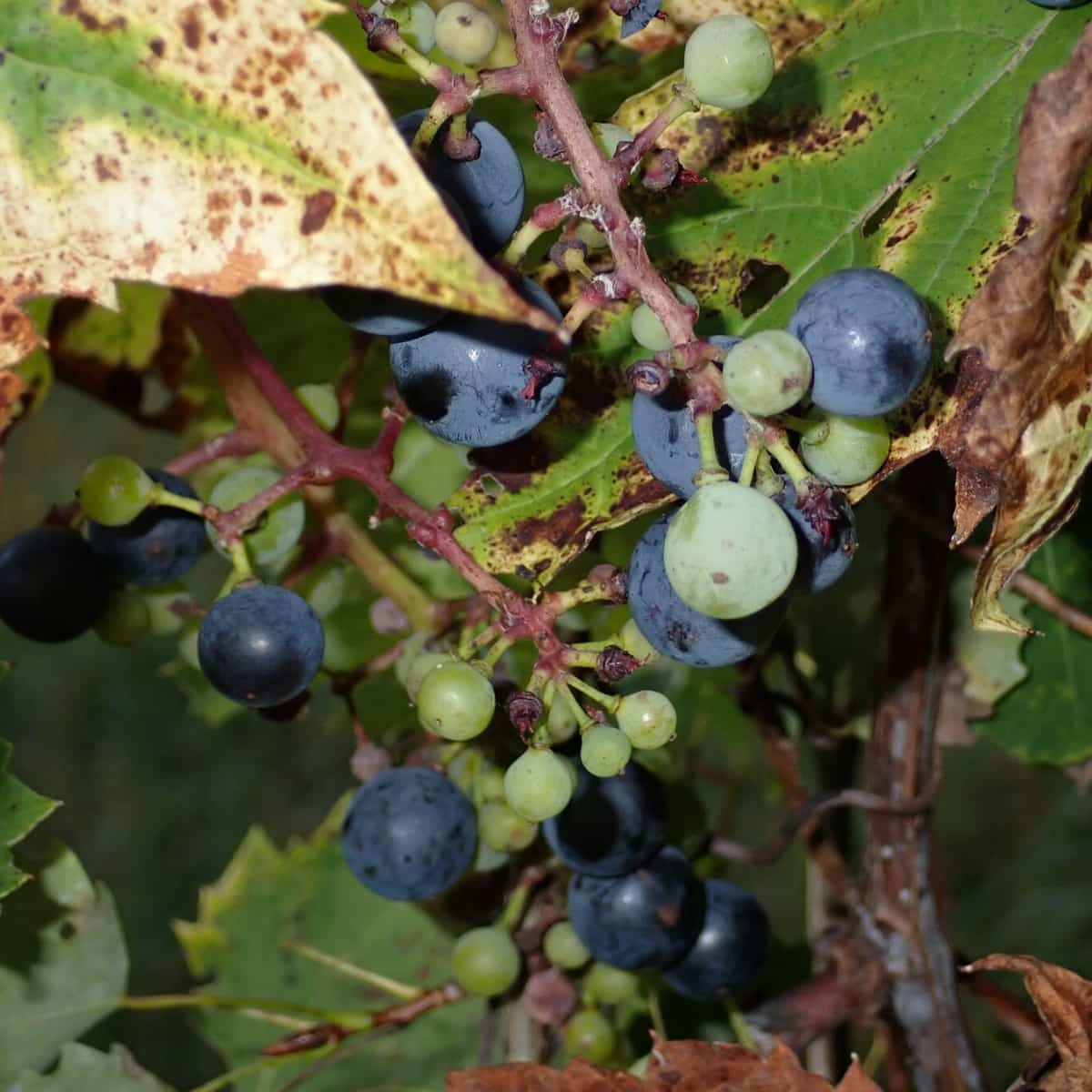
Cover image: Vitis vinifera ssp. vinifera by Petzenbär / iNaturalist, CC-BY-NC