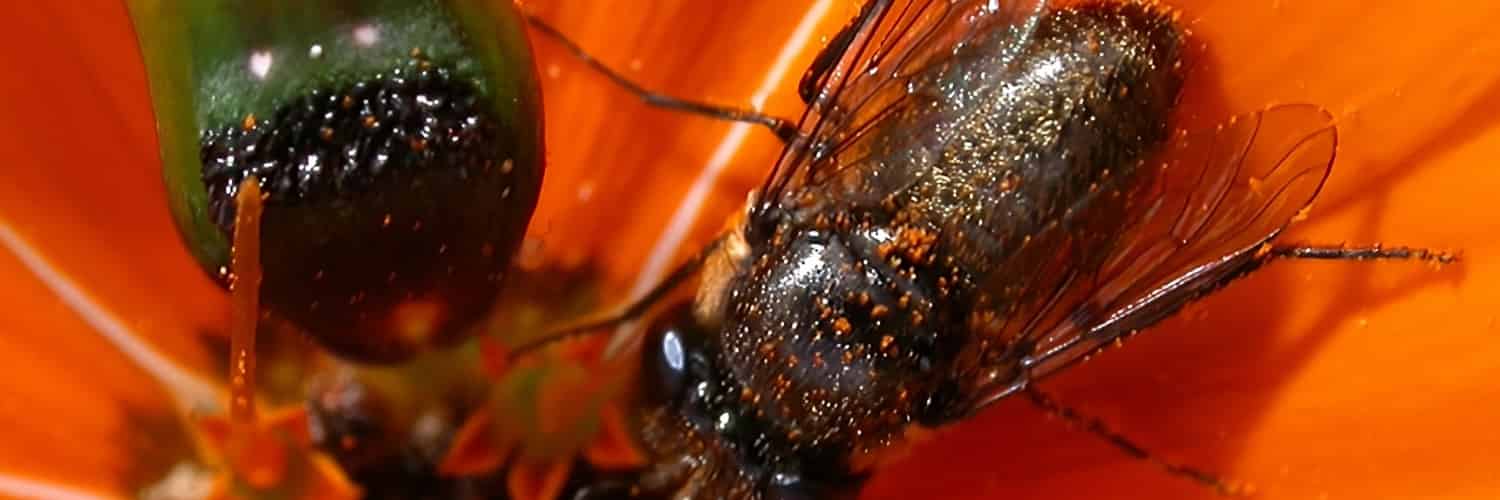



South African Beetle Daisy, Gorteria diffusa, has long captivated scientists with its unique petal structure that resembles a female fly, enticing male flies to pollinate the plant. A recent study by Roman Kellenberger and colleagues, published in Current Biology, reveals the fascinating mechanism behind this three-dimensional deception, which repurposes existing genes to create a highly convincing imitation.
Researchers discovered three sets of genes in the daisy’s petals responsible for constructing the faux fly, all of which already serve other functions within the plant. The first set manages iron distribution, the second promotes root hair growth, and the third regulates flower production. The daisy achieves its remarkable deception by utilizing these gene sets in novel ways.
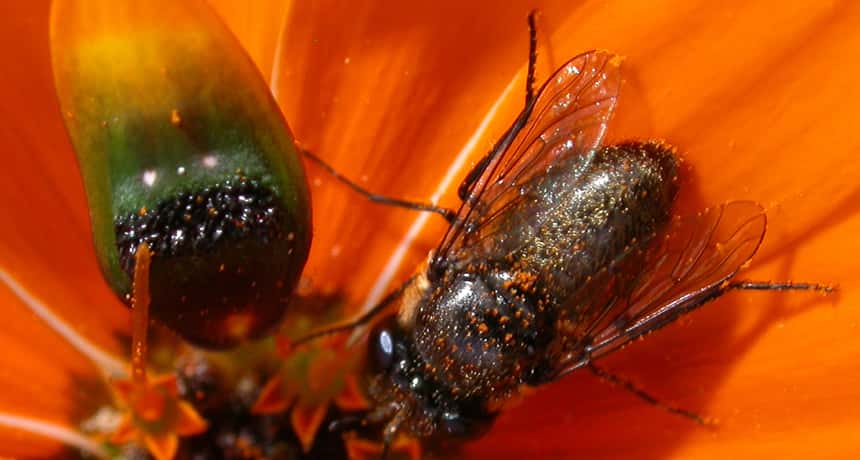
The iron-moving genes alter the petal’s pigmentation, transforming the natural reddish-purple hue to a more fly-like blue-green. Root hair genes cause hairs on the petal to expand, creating texture, while the third gene set ensures the fake flies appear in random positions on the petals.
“This daisy didn’t evolve a new ‘make a fly’ gene. Instead it did something even cleverer – it brought together existing genes, which already do other things in different parts of the plant, to make a complicated spot on the petals that deceives male flies,” said Professor Beverley Glover, senior author of the study, in a press release.
A fly lands on Gorteria diffusa, for a date with disappointment.
This tactic provides an evolutionary advantage, attracting more pollinators to the daisy, which is crucial in its harsh desert habitat in South Africa. The brief rainy season leaves a small window for the plants to flower, get pollinated, and set seed before they die, making the competition for pollinators fierce. The petals with fake lady flies allow the South African daisy to stand out from the crowd.
The sexually deceptive daisy and its plant group are relatively young in evolutionary terms, estimated to be between 1.5 to 2 million years old. The rapid appearance of the fake fly spots on the petals showcases the remarkable adaptability of the daisy.
"We'd expect that something as complex as a fake fly would take a long time to evolve, involving lots of genes and lots of mutations. But actually by bringing together three existing sets of genes it has happened much more quickly," said Dr Roman Kellenberger, first author of the study.
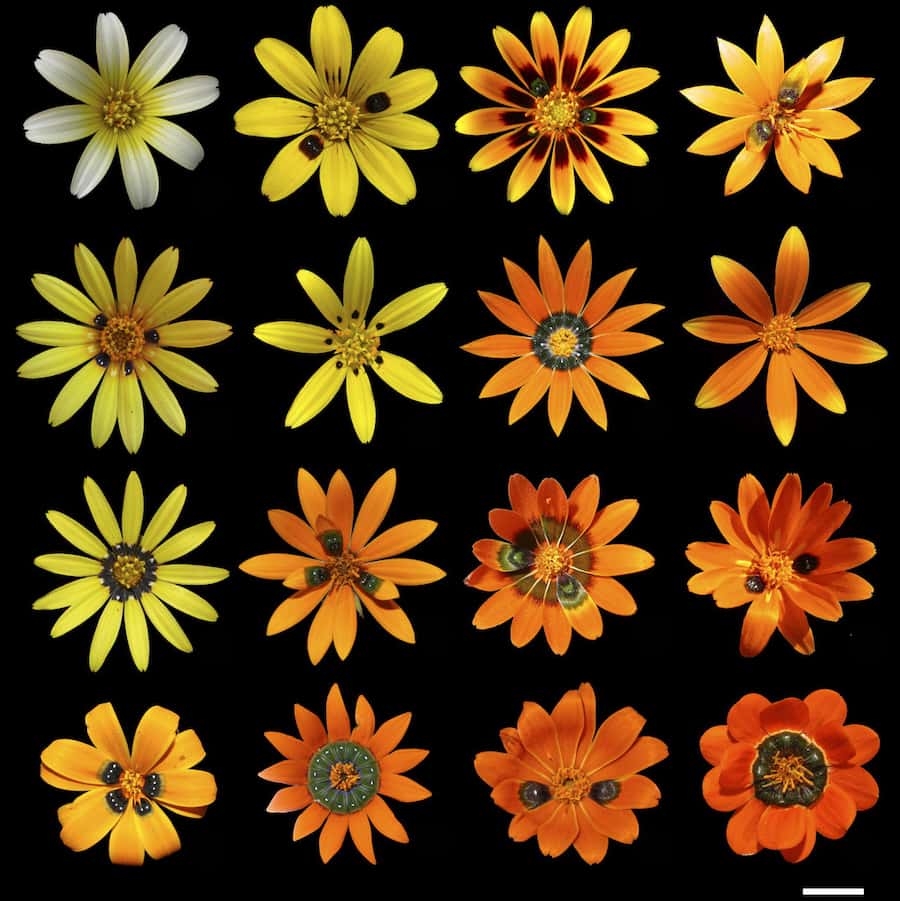
To reach their conclusions, the researchers compared the genes activated in petals both with and without the fake flies in the same daisy type. They also analyzed a different daisy type that exhibited a simple spot pattern, helping them identify the genes specifically involved in creating the intricate spots on Gorteria diffusa's petals.
This South African daisy is the only known flower to produce multiple fake flies on its petals. Other daisies in the same family exhibit simpler spot patterns, such as rings around the petals, which are less convincing to real flies. By comparing various daisies within the family tree, researchers were able to determine the order in which the fake flies evolved: colour alteration came first, followed by random positioning, and finally, texture.
"It's almost like evolving a whole new organ in a very short time-frame. Male flies don't stay long on flowers with simple spots, but they're so convinced by these fake flies that they spend extra time trying to mate, and rub off more pollen onto the flower – helping to pollinate it," said Kellenberger.
In their article, Kellenberger and colleagues conclude:
Our study indicates several directions for further investigations of the underlying evolutionary-developmental processes. First, tissue-specific gene expression and protein interaction studies may uncover more elements of the genetic pathways underlying petal spot formation. Second, transgenic manipulation of G. diffusa may allow functional verification of the co-opted genetic elements. Third, genomic comparisons among morphotypes and their hybrids may further elucidate the evolutionary trajectory of plant sexual deception. Altogether, these analyses may contribute to a better understanding of gene co-option in general, including its genetic initiation, fine-tuning and possible pleiotropic effects.Kellenberger et al. 2023
The findings provide valuable insights into plants' extraordinary adaptability and ability to repurpose existing genetic mechanisms for new functions, illustrating the remarkable resilience and resourcefulness of the natural world.
READ THE ARTICLE
Kellenberger, R.T., Ponraj, U., Delahaie, B., Fattorini, R., Balk, J., Lopez-Gomollon, S., Müller, K.H., Ellis, A.G. and Glover, B.J. (2023) “Multiple gene co-options underlie the rapid evolution of sexually deceptive flowers in Gorteria diffusa,” Current Biology: CB, 0(0). Available at: https://doi.org/10.1016/j.cub.2023.03.003.