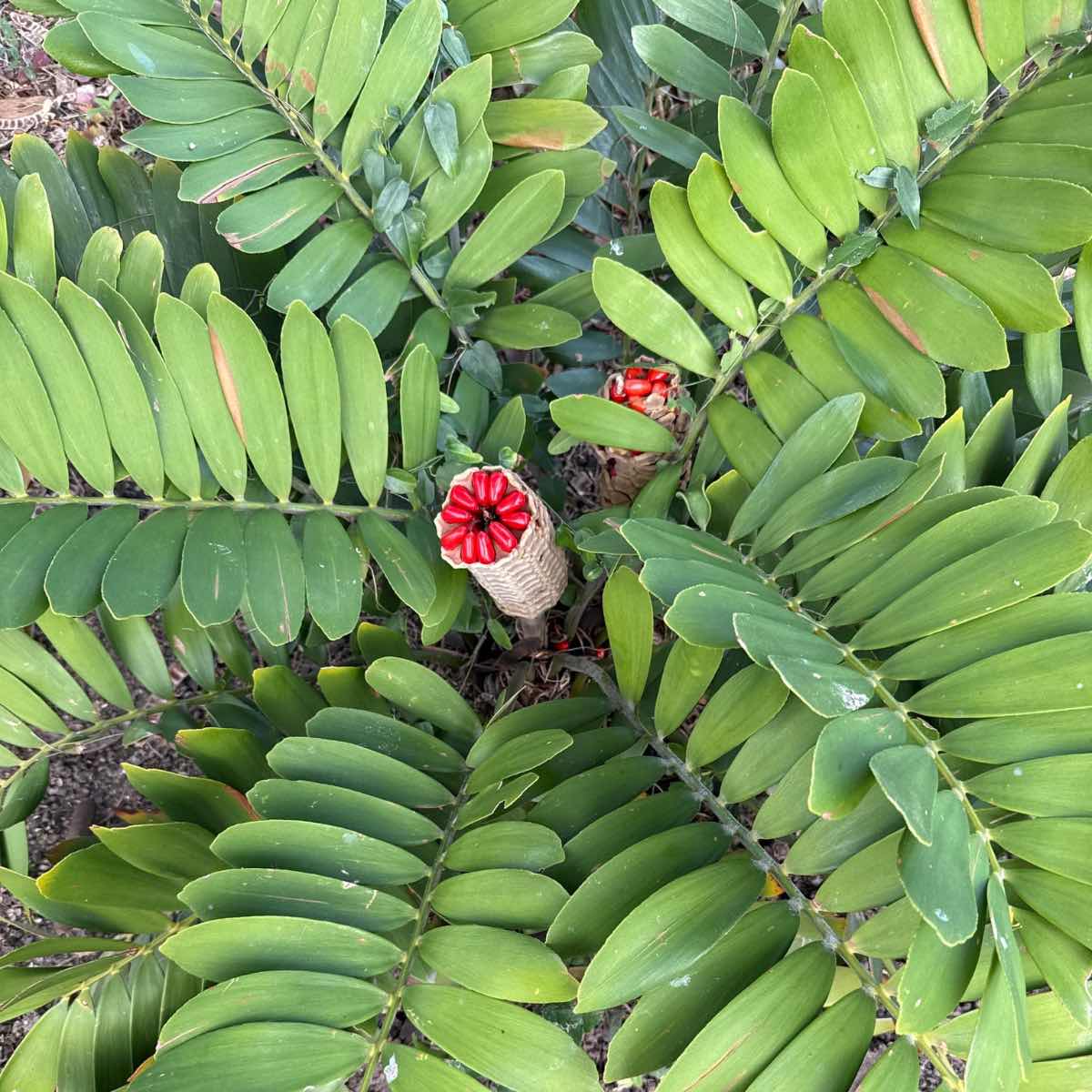



Many plants rely on living pollinators – like insects, bat or birds – for reproductive success. To attract these pollinators, plants use a broad repertoire of signals, such as colour, glossiness, scent, and humidity to entice them. And now, another attractant can be added to the list – heat produced by infrared radiation. According to new research published in Science by Valencia-Montoya et al., heat is an evolutionarily ancient pollination signal that has been attracting beetles to reproductive cones since the age of the dinosaurs.
Valencia-Montoya and colleagues became interested in the role of heat in plant reproduction because many animals are known to use heat to locate prey, hosts or forest fires. This raised the question of whether animals might also use heat signals for foraging, particularly at night.
“Considering that most thermogenic plants begin to heat at dusk and are pollinated at night, when IR [infrared] is especially conspicuous, we investigated whether pollinators could use IR as a foraging signal,” write Valencia-Montoya et al.
The researchers decided to test this hypothesis in cycads, which collectively account for over 50% of thermogenic plant species and represent the oldest living lineage of seed plants pollinated by animals.
Cycads are gymnosperms known to be pollinated by beetles since at least the Jurassic period. The beetles are responsible for moving pollen from male to female cones, which are present on separate male and female plants. In their research, Valencia-Montoya et al chose to initially focus on the cycad Zamia furfuracea and then extend their sampling across the Zamia genus.
“We first took thermal images of the cycad Zamia furfuracea to confirm that heat production occurs primarily in the sporophylls of pollen-shedding cones,” write Valencia-Montoya et al. They then broadened the scope of species tested to span the Zamia genus and found that heat production is always restricted to organs involved in reproduction.
Interestingly, the heat dynamics differed between the male and female plants, suggesting a concrete role in pollination. Additionally, the heat was produced in a daily rhythm, starting in the afternoon and peaking in the early evening.
“Male cones of Z. furfuracea heated first and then cooled, whereas female cones entered peak thermogenesis ~3 hours later,” write Valencia-Montoya et al. “This observation led us to investigate the relationship between plant thermogenesis and pollinator behavior.”
They specifically tracked the behaviour of the beetle Rhopalotria furfuracea, which pollinates Zamia furfuracea, in an open field experiment. Male and female plants were placed 50 m apart and the beetles’ movements were followed using an ultraviolet fluorescent dye.
The beetles were attracted to the warmest part of the pollen cones. Furthermore, follow-on experiments in controlled cages found that beetle visits to male and female cones rose and fell along with cone temperature, leading the researchers to hypothesise that “cone temperature could act as a dynamic signal for the beetles to leave the pollen [male] cones and visit the ovulate [female] cones”.
However, it was still possible that other chemicals (volatiles) or humidity might be responsible for the beetle movements, rather than heat being directly responsible.
Therefore, Valencia-Montoya et al created artificially-heated model cones and placed them near real cycad plants. They found that the beetles were more attracted to the heated female and male models than room-temperature controls. Infrared heat was specifically confirmed as the attracting signal using an enclosure experiment that allowed only for thermal infrared heat transmission, but not convective heat.
Through further experimentation on the beetles themselves, Valencia-Montoya et al. found that the beetle Pharaxonotha floridana has thermosensitive regions in their antennae that respond to infrared heat. The protein TRPA1 was found to be responsible for infrared thermodetection in this species.
“These experiments demonstrated that beetles actively move between male and female cones during thermogenic events,” write Valencia-Montoya et al. “We discovered that IR [infrared] is effective at short- and midrange distances, advertising cones that release and receive pollen.”
Heat has therefore been attracting beetles for pollination since the time when flowers were first evolving and before the colour-based flowers we see today – a time when the dinosaurs ruled.
READ THE ARTICLE
Valencia-Montoya, W., Liénard, M., Rosser, N., Calonje, M., Salzman, S., Tsai, C., Yu, N., Carlson, J., Cogni, R., Pierce, N., and Bellono, N. (2025) Infrared radiation is an ancient pollination signal. Science, 390(6778), pp. 1164-1170. Available at: https://doi.org/10.1126/science.adz1728.
Cover image: Cardboard Cycad (Zamia furfuracea) by ritylag / iNaturalist CC BY-NC 4.0