


Most land plants live in a mutualistic relationship with arbuscular mycorrhizal fungi. In this friendly symbiosis, plants provide fungi with carbon from photosynthesis, and fungi provide mineral nutrients such as nitrogen, phosphorus and potassium to plants. It is an ancient interaction that predates the evolution of roots and flowers in plants, but one that is not observed in carnivorous plants, which are known to rely on their specialised leaves to capture, kill and digest arthropod prey for their minerals.
Until recently, scientists have been unsure of whether carnivorous plants are capable of arbuscular mycorrhizal interaction. Now, a broad genetic study of carnivorous plants by Montero et al in the New Phytologist has found that meat-eating plants have lost the genes necessary to host fungi. The carnivorous plant lineages have lost these genes independently, effectively swapping one mineral acquisitions system for another in an example of convergent evolution.
“In order to scrutinize possible connections between the independent losses of AM [arbuscular mycorrhizal] symbiosis and the independent gains of plant carnivory, we undertook a comparative genomics approach to explore the presence of symbiosis-related genes in carnivorous plants across angiosperms,” write Montero et al. “Additionally, we coupled this with inoculation assays and microscopic examinations.”
For their comparative study, Montero et al asked which genes are commonly lost across carnivorous plant species from different evolutionary groups. To that end, they generated a dataset of 124 genomes and 105 transcriptomes from five plant orders that have carnivorous and non-carnivorous species.
Montero et al identified 75 symbiosis-related genes and evaluated their presence or absence across all species in their dataset. They found that 14 of the 16 genera of carnivorous plants surveyed lacked the majority of the symbiosis genes, with flypaper-type carnivorous plant Roridula gorgonias (Roridulaceae) and Brocchinia reducta (Bromeliaceae) being exceptions. R. gorgonias retained 89% and B. reducta 67% of the symbiosis genes.
But are R. gorgonias and B. reducta capable of symbiosis with their reduced gene sets? Montero et al addressed this question with inoculation studies and found that indeed R. gorgonias can be colonised by fungal species and develop arbuscules in their roots at six weeks post-inoculation. However, inoculation of B. reducta, with two different fungal species, led to aberrant colonisation. Extraradical hyphae and hyphopodia developed, but the arbuscules were stunted or absent, revealing that the loss of genes in B. reducta eliminates its ability to successfully interact in arbuscular mycorrhizal symbiosis.
“Based on this genotype–phenotype association, we infer that other carnivorous lineages with similarly limited symbiosis gene repertoires are also likely to be AM-incompetent,” write Montero et al.
Montero et al conclude that arbuscular mycorrhizal symbiosis and carnivory are mutually exclusive traits and that the loss of symbiosis-related genes is an important contributor to the convergent evolution of carnivory in diverse plant lineages. They hypothesise that since both symbiosis and carnivory are expensive energetically, only one mineral acquisition system is maintained over evolutionary time.
In other words, plants that eat meat turn a cold shoulder to their ancient fungal friends.
READ THE ARTICLE
Montero, H., Freund, M. and Fukushima, K. (2025) “Convergent losses of arbuscular mycorrhizal symbiosis in carnivorous plants,” New Phytologist, 248(4), pp. 2040–2051. Available at: https://doi.org/10.1111/nph.70544
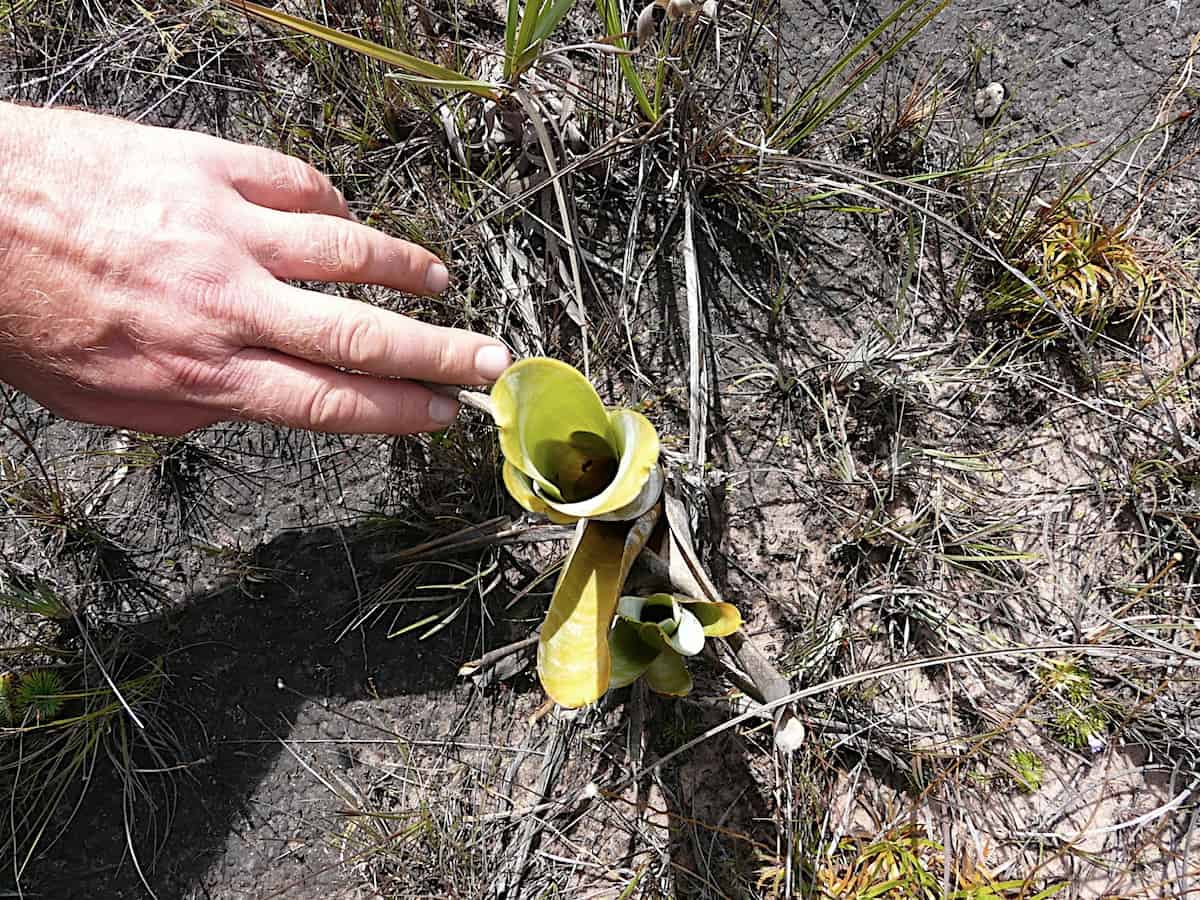
Cover image: Brocchina reducta in Venezuela by Steven Bodzin / iNaturalist. CC-BY