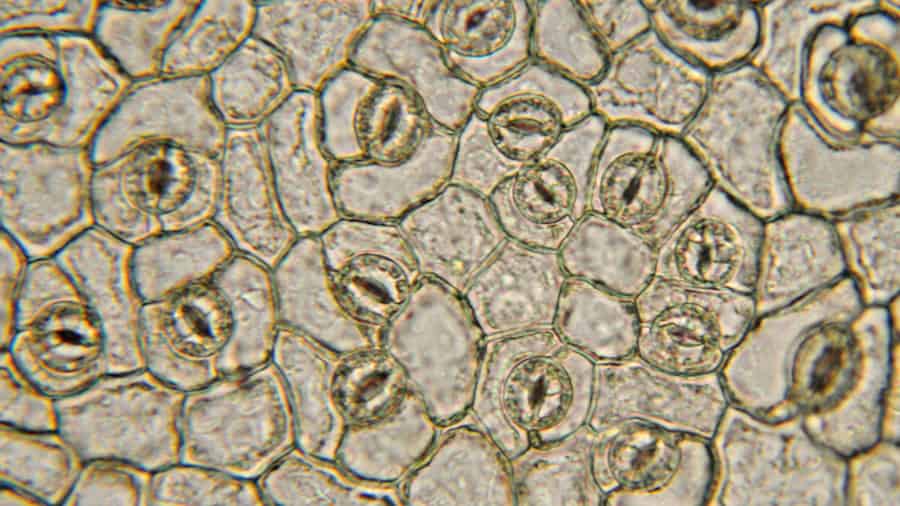


Stomata are tiny pores in leaves that allow the plant to respire. We typically think of plants breathing in carbon dioxide, but they also let gases out. Along with gases, plants can lose water that they have drawn up from the soil. In order to prevent excessive water loss, plants must be able to control their stomata, shutting them when necessary to avoid losing too much moisture. But how is this done? Mohanned Abdalla and colleagues used a novel root pressure chamber to measure the relation between transpiration and leaf xylem water pressure. In their article in Annals of Botany, the scientists show how below-ground hydraulics control stomatal closure during soil drying.

To examine the relationship between stomata and below-ground hydraulics, Abdalla and colleagues took tomato plants and grafted them onto two kinds of rootstock. One had short roots, while the other had long roots and so could reach deeper into the soil when looking for moisture. They then used a root pressure chamber system that could simultaneously measure transpiration and leaf xylem water pressure within an intact plant.
The team found the relationship was linear in wet conditions but became non-linear as the soil dried. Plants with shorter root systems required larger gradients in soil water pressure to sustain the same transpiration rate and exhibited an earlier non-linearity and stomatal closure.
Abdalla and colleagues conclude that the relation between stomatal conductance and leaf water potential is affected by root length and below-ground hydraulics, particularly soil hydraulic conductance. They state: “Our results show a tied link between soil hydraulic conductivity, active root length and stomatal conductance, and the coordination between these variables is central in predicting the ability of plants to cope with water shortage.”
READ THE ARTICLE
Abdalla, M., Ahmed, M.A., Cai, G., Wankmüller, F., Schwartz, N., Litig, O., Javaux, M. and Carminati, A. (2022) “Stomatal closure during water deficit is controlled by below-ground hydraulics,” Annals of Botany, https://doi.org/10.1093/aob/mcab141